Across South Asia, a new wave of youth-led uprisings has been reshaping the region’s political landscape. Since 2022, young people have toppled or challenged entrenched political elites across the region, expressing grievances against corruption. In both Sri Lanka and Bangladesh, mass pro-democracy protests forced out the ruling power. Scholar Paul Staniland notes that such movements mark a dramatic shift in South Asia, a region long familiar with political protests but rarely with regime overthrows.
The Uprising
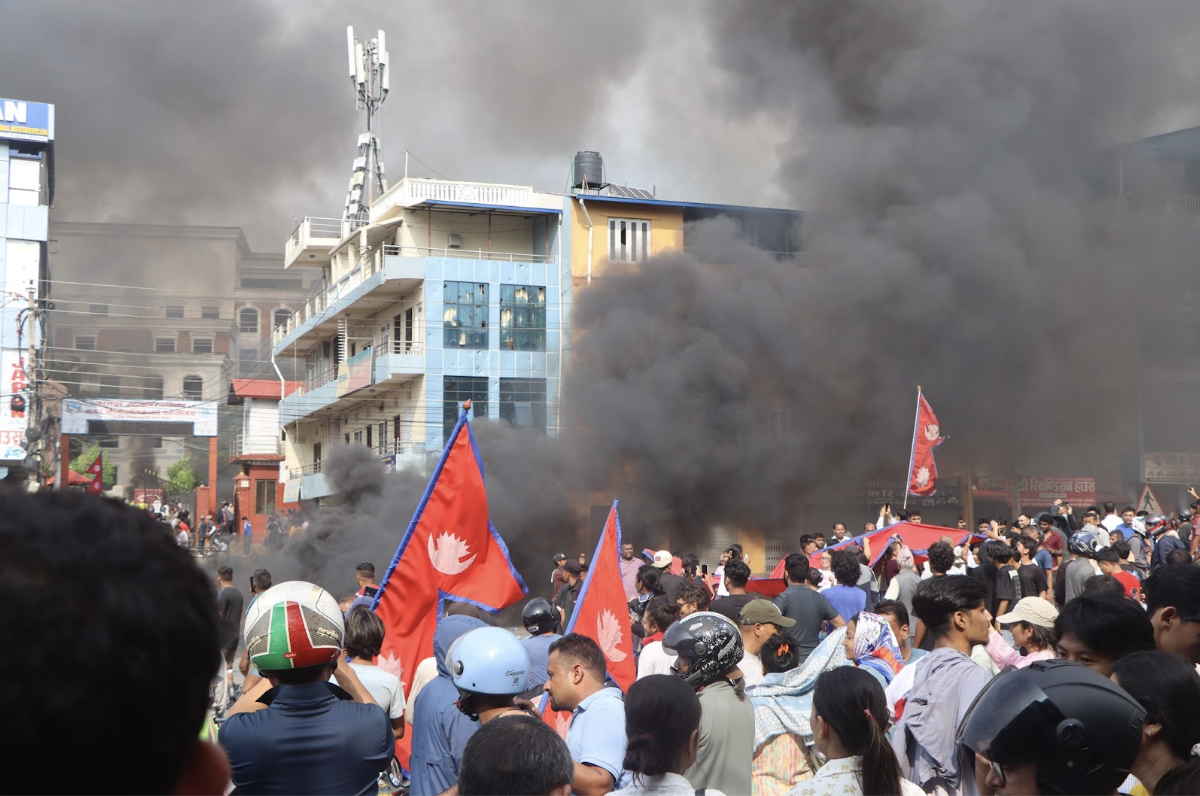
Within this broader regional pattern, Nepal is the most recent and stark example of youth-led regime change. On September 9, 2025, youth activists flooded the streets of Kathmandu, setting fire to the Supreme Court, parliament, and other government buildings. Only a week before, Prime Minister K. P. Sharma Oli’s government had banned twenty-six social media and messaging platforms for allegedly failing to comply with new regulations, widely seen as an attempt to suppress free speech. Platforms such as Instagram and Facebook, used daily by millions of Nepalis for entertainment, news, and business, went dark overnight. By September 10th, the country was in a state of anarchy: Nepal’s President was forced to appoint an interim Prime Minister, dissolve the country’s elected Parliament, and announce new elections.
From Cairo to Katmandu
The events in Nepal mirror the Arab Spring, with a new generation of youth rising up against corruption and harnessing digital communication to drive their movement. Where Facebook once helped Egyptians fill Tahrir Square, Discord and TikTok now mobilize Nepal’s Gen Z. Both movements also reveal a similar pattern: while digital tools make it easier to spark revolutions, they don’t guarantee lasting political transformation. In this context, digital authoritarianism offers a useful framework for understanding a deeper structural shift in political power: the adaptation of authoritarian practices to the digital age. Like the aftermath of the Arab Spring, Nepal illustrates the global lesson that connectivity alone does not ensure democratization.
Gen Z and Social Media
Constant exposure to social media keeps Gen Z immersed in a never-ending stream of news, increasing their anxiety while also fueling their political engagement. Unable to disconnect from the flow of information, many feel driven to respond and take action on the issues they see unfolding online. In this context, the events in Nepal are particularly revealing: what role can Gen Z play in overturning abusive regimes?
During Nepal’s 48-hour revolution, thousands of Gen Z protesters poured into the streets without a single, unifying leader emerging from the crowd. Their message was clear: change can arise from the collective, not just the charismatic. According to scholar Bingyu Zheng, protests in South Asia should not be understood as “leaderless mobs” but rather as movements with democratized and decentralized leadership, allowing young protesters to act beyond the regime’s reach and respond to new developments with much more flexibility. This development created a major challenge for the Nepalese authorities, who couldn’t stop the movement simply by detaining a few individuals, hoping the rest would disperse.
This uprising succeeded because Gen Z was able to blend political action with digital tools. Gen Z social media users exposed the luxurious lifestyles of politicians’ children and grandchildren by sharing their photos and videos on platforms like Instagram, TikTok, and Facebook. Posts with hashtags such as #Nepobaby, #NepoKids, and #Corruption quickly went viral. During the protest, they relied heavily on Discord servers for tactical coordination, polling, discussion, and decision-making. Social media became both the spark that ignited public anger and the tool that mobilized these protests.
The regime failed to suppress the movement because Gen Z had already mastered the digital platforms it sought to control. Their fluency in online storytelling, memes, and viral communication allowed messages to spread faster than censorship could keep up. By using these familiar tools to define their own political narrative, they turned the internet into a space of resistance rather than repression.
An Uncertain Future
Protesters leveraging social media to fight abusive regimes is not new. During the 2011 Arab Spring, social media powered mass mobilization across the Arab world. Pro-democracy uprisings erupted in countries like Tunisia, Egypt, Libya, and Syria. However, these protests fell short of consolidating democratic change. Over a decade later, it appears these countries have largely transitioned from dictatorships, where power is concentrated in a single ruler, to authoritarian regimes in which control remains centralized but is exercised through ruling parties or political elites rather than one dominant figure. Mass protests are hard to sustain indefinitely, especially when civil society lacks an independent structure. This idea is evidenced by the Arab Springs. Youth coalitions and online networks were crucial for mobilization but not for long-term governance. Islamist groups had better organizational capacity, leading to electoral success. This precedent resonates strongly in today’s Nepal, where a new, youth-led digital civil society has operated through informal and decentralized networks. Removing authoritarian rule matters, yet the uprising’s lasting democratizing effects are still unclear.
The current high political consciousness may force politicians to address their concerns directly. The upcoming March elections will be an important test for democracy: both the interim administration with Nepal’s first woman prime minister in an interim capacity, and the electoral process represent rare windows in which the institutional rules of the game can be redefined. As Tilly and Tarrow argue, social movements rarely achieve change solely through grievances; they succeed when they capitalize on political opportunity structures. This theory explains that successful mobilization depends not only on motivation and organization but on the broader political environment that either opens or constrains possibilities for change. These windows are moments when the state is divided and elites need new sources of legitimacy, making collective action more effective. The collapse of the Oli government and creation of an interim administration have temporarily opened the opportunity structure. Youth actors can institutionalize their demands through elections and party formation.
Hence, the uprising succeeded precisely because it was decentralized and spontaneous, allowing widespread mobilization across Nepal’s geographical and social boundaries. However, this lack of structure may now threaten the durability of Gen Z’s political agenda, as the decentralized nature of the protest made it difficult to develop coherent political demands or negotiating positions. Online networks amplify the voices of young people and challenge long-standing structures, but enduring change still depends on the work of parliaments, courts, and constitutions. According to Palla, democracy has an uncertain future in Nepal unless young citizens actively engage in the political process to protect the democratic system. Gen Z must now channel their frustration into institutions if they hope to achieve enduring reform.
Edited by Patrick Armstrong
The argument defended in this article is solely that of the author and does not reflect the position of the McGill Journal of Political Science, the Political Science Students’ Association, or the McGill Department of Political Science.
Featured image by हिमाल सुवेदी
