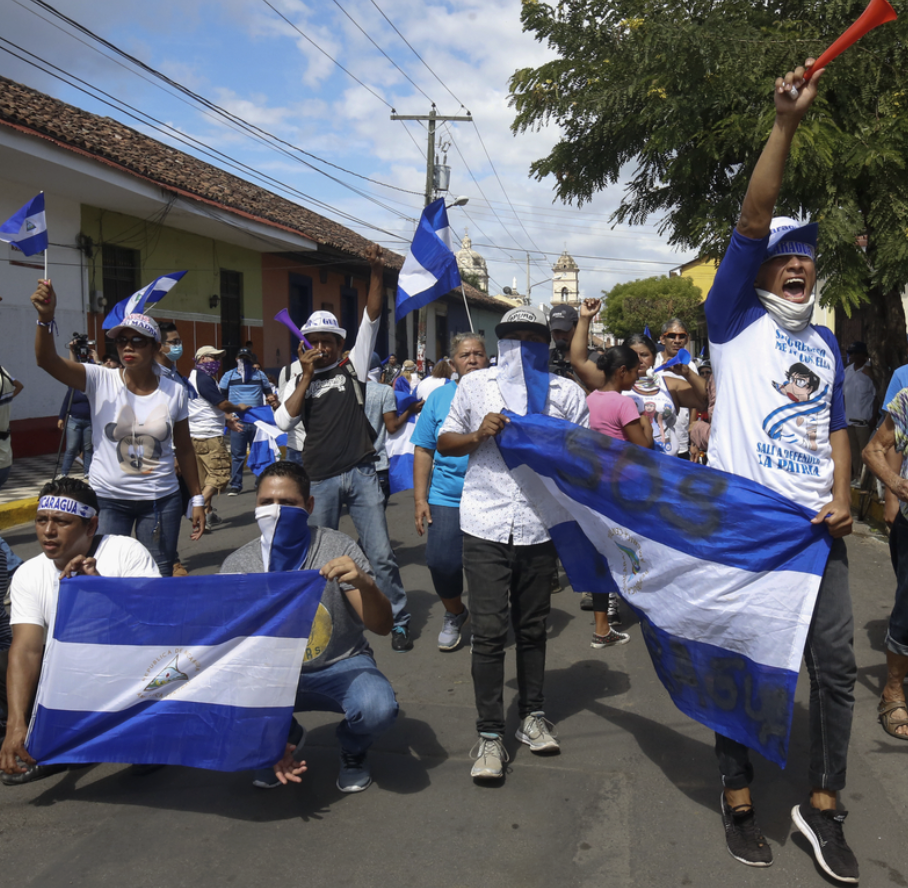
Since his return to power in 2007, President Daniel Ortega and the Sandinista National Liberation Front have overseen and facilitated a steady erosion of Nicaragua’s democratic institutions, transforming the nation from a fragile democracy into an increasingly autocratic regime. Amid the dismantling of constitutional safeguards and centralization of state power, the state has heavily repressed opposition groups, drawing the attention of transnational advocacy groups, and increasingly weary foreign governments.
In 2018, police heavily repressed protests against changes to the nation’s pension system. Since then, the Ortega-Murillo regime has assumed control of the media, criminalized dissent on social media and traditional news outlets, and cracked down brutally on antigovernment protests. Repression of Nicaraguan citizens, however, is not limited to the territorial boundaries of the small Central American state.
As a recent UN Report Documents, the Nicaraguan regime has begun taking measures to systematically erase the legal and civic existence of citizens. This “Civil Death” as it is known, serves as a tool to punish regime dissidents living both within Nicaragua’s borders and abroad.
The Range of Mechanisms for Civil Death
In Nicaragua, this erasure of civic identity is realized through a range of mechanisms. For one, the government physically erases records from official state registries and existing personal information of its citizens. This erasure of records is problematic twofold. For one, without proof of identity, citizens are prevented from collecting pensions, denied health care, and deprived of all voting rights.
Additionally, without official government documentation, Nicaraguans who experience Civil Death often struggle to prove their identity when seeking asylum—thus leaving these individuals stateless in a sort of national black hole. While some nations such as Spain have begun accepting exiled Nicaraguans, for others, the absence of government identification bars access to asylum procedures, leaving them in a precarious position. Finally, the regime has begun expropriating tangible belongings, confiscating physical assets and property of the now ex-citizens. In doing so, the state extends the erasure of identity into the material realm further an individual’s presence from society.
From Domestic Repression to Global Concern
Notably, the mechanisms of Civil Death are not only an issue of interest domestically, but have sparked debates at the international level. Critics argue that by denaturalizing its citizens, Nicaragua has undermined established norms of international law, contravening its obligations.
In 2014, the Inter-American Court of Human Rights (IACtHR) affirmed that citizenship, as a “legal and political bond that links a person to a particular State” is a non-derogable right, with the court underscoring its centrality to the enjoyment of other civil and political rights.
It is likely of little coincidence, then, that Nicaragua sought to exit the “interventionist” Organization of American States (OAS) in 2023. As the region’s supra-national judicial body on human rights, the IACtHR serves to interpret and enforce international human rights obligations. By withdrawing from the OAS, Nicaragua effectively sought to abrogate its obligations to observe the Court’s rulings, with intent to denaturalize its citizens a potential motivation.
Regardless of whether Nicaragua exited the OAS in order to avoid non-compliance with international jurisprudence, a complicated issue arises as to whether any sort of Human Rights framework can be used to criticize Nicaragua’s use of Civil Death. This work argues the affirmative, but such analysis requires a focus on norms and not statutory authority.
Nicaragua and the “Spiral” Model
In The Power of Human Rights: International Norms and Domestic Change, Risse and Ropp (2021) posit the “Spiral” model to describe the mechanism of “norms-based” reasoning. According to the model, states progress through five key phases of engagement with international human rights norms:
1. Repression
2. Denial
3. Tactical Concessions
4. Prescriptive status
5. Rule-Consistent behavior
“Repression” describes the initial period where an authoritarian regime suppresses opposition within society. It follows that transnational organizations contest this behavior, accusing the regime of human rights violations. In turn, these regimes pursue “Denial”—contesting international human rights norms to delegitimize the claims of advocacy groups.
The model then assumes that—because of intrepid pressure from transnational groups—the state will then seek to make tactical concessions to alleviate international pressures. The model suggests that, through this process, state actors move to accept the validity of international human rights, thus pursuing “rule-consistent behavior”.
Crucially, the spiral framework does not require that states move in a single direction. States often stall or regress through the model, seeking to deflect international pressure, reassert sovereignty, or even construct counter narratives to legitimize non-compliant behavior.
This model allows us to better understand Nicaragua’s dynamic relationship with human rights discourse. A prima facie analysis of the nation shows both repression—in the form of violence against protestors—and vehement denial of such repression when pressed by the international community.
Further, Nicaragua permitted visits with international institutions, such as the Inter-American Commission on Human Rights (IAHCR) or the UN’s Human Rights Council in 2018. These groups, seeking to understand both the antecedents and outcomes of social upheaval in 2018, were often obstructed in their analyses and in some cases, even expelled when investigating violent acts by the Ortega-Murillo regime.
The era of Civil Death demonstrates a clear regression when analyzed through the model. As norm diffusion stagnates and civic protections are systematically eroded, the state has spurned the very premise of international cooperation, turning inward and finding international backlash, such as the reports, as an affront to its sovereignty.
Ultimately, Civil Death in Nicaragua establishes a grim precedent for the future of human rights in Nicaragua. The deliberate denaturalization of citizens stands out as an idiosyncratic method for silencing dissent, all the while the Ortega-Murillo regime attempts to further insulate itself from international pressure.
Edited by Jude Archer
The argument defended in this article is solely that of the author and does not reflect the position of the McGill Journal of Political Science, the Political Science Students’ Association, or the McGill Department of Political Science.
Featured image via Alfredo Zuniga from the AP via NPR