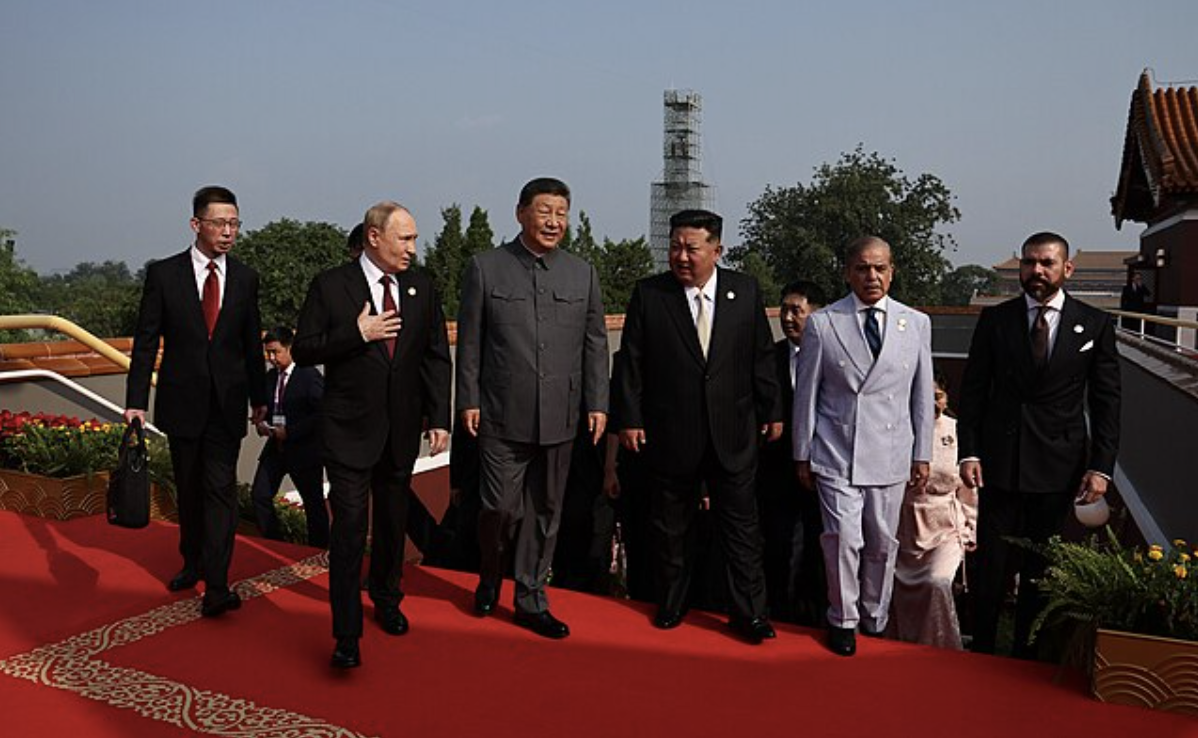
This September at China’s military parade, Russian President Vladimir Putin and Chinese President Xi Jinping were caught on a hot mic musing about living forever. Walking alongside North Korean leader Kim Jong Un, the Russian leader said, “The longer you live, the younger you become, and (you can) even achieve immortality.” In response, Chinese leader Xi Jinping said, “Some predict that in this century humans may live to 150 years old.” What seems like casual conversation reveals a deeper anxiety about their countries’ futures: both leaders have built systems dependent on their personal authority, with no clear succession plans in place. In these autocracies, power transfers are opaque. Vladimir Putin, 73, and Xi Jinping, 72, face a problem: focused on consolidating power, they’ve left no obvious successors, creating a dangerous geopolitical vulnerability window in the coming decade.
Mr. Xi’s Consolidation of Power
In 2018, the Chinese National People’s Congress adopted a recommendation by the Chinese Communist Party (CCP) to eliminate the two-term limits for the President and Vice President. In the 1980s, leader Deng Xiaoping implemented these limits to avoid the risk of a hyperconcentration of power. Since Deng, there has also been a norm of an age limit, and for over two decades, no leader has governed past the age of 68. In 2022, at the end of his second term as president, Mr. Xi turned 69. Deng’s reforms decentralized significant authority from the Communist Party to provincial officials, who became more responsible for administrative tasks in their respective regions. Besides removing term limits, Mr. Xi reversed this change and has since concentrated power back in his own hands, while purging his party of potential challengers. In his first term, Mr. Xi initiated a massive anti-corruption campaign to improve party discipline. By 2017, the CCP Central Discipline Commission had punished around 1.4 million Party members. Among those purged were six powerful Politburo leaders for alleged coup attempts, all of whom were charged with “anti-party activity.”
A Succession Dilemma
The timing of these purges is not coincidental and sets the stage for Mr. Xi to remove term limits without concern for internal dissent. The crackdown showed his party that loyalty is key. By enforcing this loyalty through fear, Mr. Xi has ensured the elite’s fealty to the CCP and to himself, even as he broke convention.
Mr. Xi also maintains complete control over the military and domestic security, including the police force. China now has a personalistic strongman leader, the same kind Deng sought to avoid. The guidelines and norms which ensured smooth succession in the past no longer exist. Mr. Xi and his predecessor were both selected as successors five years before their terms, to give them time to be groomed to hold the most powerful position in the country. Now, Mr. Xi faces a dilemma: name a successor and risk being made obsolete, or put it off and risk plunging the country into political turmoil.
The Russian Case
Russian President Vladimir Putin faces the same problem. Unlike China, Russia is not officially a one-party state. There are annual elections, though these are neither free nor fair. In 2024, he won the presidential election with 88% of the vote, cementing his rule until 2030. In power since 2000, he is set to be the longest-serving Russian leader in 200 years. Like Mr. Xi, Vladimir Putin has made cracking down on elite dissent and corruption a priority. Many of the oligarchs who had become massively powerful in the 1990s lost their fortunes and sway. After serving his two constitutionally permitted presidential terms from 2000 to 2008, Mr. Putin supported Dmitri Medvedev as the presidential candidate. During Medvedev’s tenure, he amended the constitution to extend presidential terms to six years. Mr. Putin returned as president in 2012, sidelining Medvedev to prevent him from becoming a rival or succession candidate. Mr. Putin was apparently displeased that Medvedev had shown sympathy to liberal groups who questioned the 2011 parliamentary elections. Medvedev returned to the role of Prime Minister in 2012, with Mr. Putin as president. In 2020, the government’s principal ministers, including Medvedev as Prime Minister, resigned to enable a constitutional overhaul, allowing Mr. Putin to remain in power until 2034.
The veneer of elections distinguishes Mr. Putin’s succession dilemma from Mr. Xi’s by giving him an institutionalized way to promote a successor. At the same time, if a successor from his own circle is chosen, liberal opposition groups may offer an alternative. The possibility for the Kremlin to allow an opposition politician to gain power is unlikely, considering that former opposition leader Alexey Navalny was jailed on charges of fraud and extremism in 2021 – accusations he called politically motivated. He later died in prison, after spending 300 days in solitary confinement. Even if the Kremlin manages to crush opposition, without Mr. Putin in control, social unrest will likely arise.
Both Xi Jinping’s and Vladimir Putin’s resistance to naming a successor stems from the uncertainty it creates, and from the fact that they have both made identifying a successor difficult. Personalist autocracies are uniquely vulnerable when grooming successors; strong ones can depose the leader, and weak ones collapse after them. Mr. Xi’s anti-corruption purges led to a shrunken elite coalition and high dependence on personal loyalty. Similarly, Mr. Putin’s patronage system ensured that no one with an independent power base could rise to prominence. Both of these changes rendered the traditional mechanisms of power transfer in their respective countries ineffective.
International Implications
This has far-reaching geopolitical implications. As an economic and military powerhouse, China is one of the most influential and powerful countries on Earth. A transfer of power and the potential instability it creates would therefore throw the global balance of power into question. Russia, commanding the world’s largest nuclear arsenal, poses a similar geopolitical risk. The autocrat’s succession dilemma is an international issue. As leaders age, their risk tolerance becomes harder to predict. Rival states will find it increasingly difficult to assess whether aggressive moves abroad stem from personal ambition, elite pressure, or regime insecurity. Personalist regimes create uncertainty not only for their own elites but also for the entire global order, which must find ways to interpret their actions.
A Brittle Status Quo
Personalist autocracies, such as Russia and China, appear stable because they elevate a single, strong leader above institutions; this stability is brittle. Over time, institutions that once mediated elite conflict or provided policy feedback weaken because leaders punish dissent and surround themselves with loyalists. This produces a system that functions smoothly only as long as the leader remains in place. The moment leadership becomes uncertain, due to age, illness, or a looming transition, the entire political order is exposed to shocks. Without clear mechanisms for succession and an inability to dissent, elites have no predictable way to navigate a post-Xi or post-Putin landscape. This reveals how their refusal – or failure – to name successors matters: the systems they built cannot produce a stable transfer of power. The same centralization that has allowed them to rule unchallenged now leaves their states vulnerable. The most destabilizing force may not be what they do next, but the passing of time, which will lead them to a point of no return.
Edited by Jude Archer
The argument defended in this article is solely that of the author and does not reflect the position of the McGill Journal of Political Science, the Political Science Students’ Association, or the McGill Department of Political Science.
Featured image by wikicommons
.jpg)