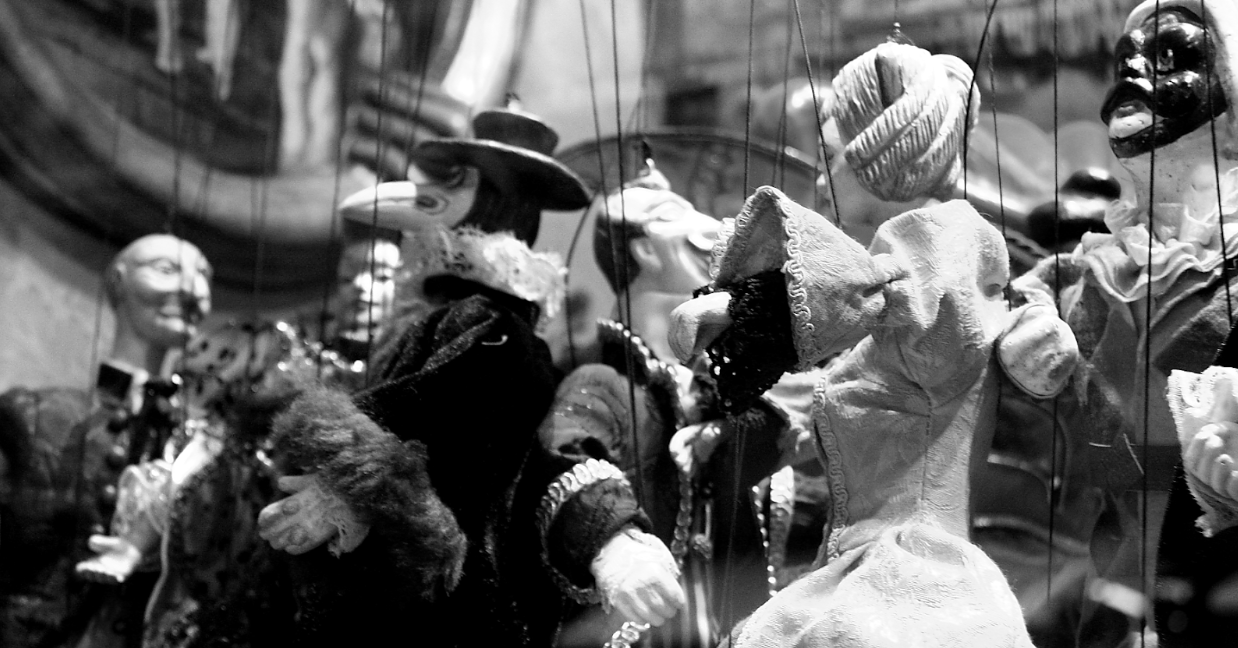
Advocates of the digital era have promised that this development would set us free: from boredom, from work, from isolation, and from ignorance. Instead, in the age of big data, algorithmic curation, and Leviathan tech corporations, autonomy has become increasingly scarce. Freedom today must be understood less in the negative sense as the absence of physical restraints, but rather, positively as the ability to see—and resist—our own cognitive blind spots.
This idea is explored in the digital context by the twenty-first-century philosopher Byung-Chul Han. However, Jean Jacques Rousseau, the Enlightenment philosopher from the eighteenth century, is one of the first proponents of the same basic concept of unfreedom. While these two theorists belong to entirely different traditions of thought and respond to concerns that are centuries apart, both Han and Rousseau propose strikingly similar theories of freedom—or more appropriately here, unfreedom. Instead of coercion and compulsion acting on the material human body—whether through capitalist exploitation of labour or brute physical force—both Han and Rousseau home in on the primary cause and manner of unfreedom as rooted in the psychological.
In a world where threats to freedom seem more salient than ‘unfreedom’ itself, why might it be useful to reflect on the latter idea? The answer is simple: It is only by acknowledging the extent of our unfreedom that we can begin to grasp the freedom we do possess, and imagine how we might expand it.
Theories of Unfreedom
What is freedom? Simply put, there are both positive and negative interpretations of the concept. In the liberal tradition, freedom is understood in a negative sense; in liberal societies, freedom is ‘freedom from’ the undue infringement of others in our own lives. Yet, this is not the only way to interpret the meaning of freedom. Rather than freedom from, people also have the freedom to do, think, and feel—positive freedom accounts for humans as autonomous agents. Rousseau and Han develop their theories in line with the latter understanding of freedom.
Han attributes our unfreedom to the overwhelming positivity of what appears to be freedom—an expansive phenomenon enabled by the entwinement of capital and technology.1 In a world where we feel like we can do anything, it seems as though we must always be doing something. Rather than a “real feeling of freedom”2 stemming from our capacity to engage in fruitful and fulfilling relationships with others—ones that are devoid of an external purpose—Han argues that as capitalism has permeated the immaterial realm of information, a profuse amount of positive freedom resembles compulsion more than it does a lack of constraint.
What enables Han’s conception of this capitalist system of positive unfreedom, rather than a form of politics which acts on and against our physical bodies, is what Han terms ‘smart power’. This form of power operates positively by ‘activating,’ ‘motivating,’ and ‘optimizing’ us, “constantly calling on us. . . to communicate our opinions, needs, wishes, and preferences—to tell all about our lives.”3 What is relevant in the information age is therefore not biopolitics—through which power is exercised positively on human life—but what Han calls psychopolitics, a form of power whose external origin is masked by its operation on our psyches.
In this sense, psychopolitics is intrinsically tied to the prevalence of data in driving our own personal lives, as well as society as a whole. According to Han, digital society “makes intensive use of freedom,” as “data is not surrendered under duress so much as offered out of an inner need.”4 This unbounded ‘freedom’ we have to share every aspect of our lives in the digital sphere—whether it is the positive compulsion to do so on social media, or through the data collected passively on our online presences—functions as total control and surveillance: a digital panopticon.5
Despite living before the advent of modern technology, Rousseau laid the foundation for psychopolitics with the idea that society corrupts our positive freedom by obstructing our deliberative capacity and rational autonomy, especially when it comes to deliberating our own self-worth. Reduced from true self-dignity—amour de soi—to mere appearances, amour propre means that one always exists outside themselves: one is “capable of living only in the opinions of others. . . [deriving] the sentiment of [their] own existence solely from [others’] judgement.”6 While society presents opportunities for collaboration and cooperation, we also find that interacting with others opens us to competition for esteem. Recognition becomes a rivalrous concept, and rather than being simply satisfied by others merely acknowledging our value, we seek to be considered as superior; comparison on the societal level is internalized in the individual. The end point of this psychological development—or devolution—is amour propre. Amour propre obscures our access to amour de soi, a corruption that, to a large extent, is beyond our individual control. This phenomenon, where our most basic freedom to think is subverted without our knowing, is exactly what we witness through the operation of smart power in the digital age.
Bearing this in mind, power is not merely a basic ability to achieve self-preservation (the object of amour propre), but operates psychologically. Rousseau attributes our ineffectiveness at reforming society to this fundamental error in recognizing the root of conflict7: the misperception of our dependencies on the opinions of others to the extent that we consider society’s warped measures of value to be ones that we have imagined ourselves. Veiled by positivity, this unfreedom of thought is also described by Han’s account of psychopolitics: amour propre does not ‘forbid or deprive’, but rather ‘pleases and fulfills’.8 Society’s corrupting influence eliminates a true freedom of choice, instead “[making] way for a free selection from among the items on offer.”9 Rather than exercising an independent capacity, we become subject to the influence of the private interests of others.
Unfreedom: the Digital Age in Perspective
While the pairing might feel incongruous, Han and Rousseau’s ideas, taken together, can make sense of unfreedom in the modern context—especially given the growing entrenchment of artificial intelligence into our personal and public lives. Employing Han’s psychopolitics and Rousseau’s amour propre, we can understand the real threat to freedom not as the actual redirection of our interests by technology, but our unawareness of just how far our interests are directed without our knowing.
According to Han and Rousseau, unfreedom lies in the misperception of the range of our autonomy: not understanding the extent to which our choices are really our own. The language of the Internet seems to imply a degree of autonomy: one is a “user” of digital platforms, actions are governed by buttons that must be actively pressed, and you can always unplug when you feel like it. Being lulled into this false sense of security, however, leaves us vulnerable to a rapidly changing landscape where avoiding technology or not leaving a digital footprint is almost impossible.
The prevalence of algorithms in daily life is precisely what Han describes when he conceptualizes smart power in psychopolitics. While there exists a responsivity between ourselves and algorithms, the increasing speed and complexity of these algorithms blinds us to the extent to which we truly curate the information with which we engage online. In essence, we can curate algorithms, but the algorithm presents us with new material based on our past feedback. Where your feed is tailored to your tastes, while always offering new content as trends cycle and new information emerges, it is increasingly difficult to apprehend when you are truly in an echo chamber. The effects of these algorithmic feedback loops in the public arena have been well-documented, from their contribution to the rise of partisanship in the United States to the facilitation ethnic violence in Myanmar.
While bringing up the issues algorithms can create seems hardly controversial, a more nebulous topic—and one to be explored through the lens of Han and Rousseau’s psychopolitics—is the smart power potential of AI. To most people, even the technologically apt, AI remains somewhat of an abstraction, albeit a vaguely threatening one. While we are widely aware of the economic and social shocks AI presents in a concrete sense, there remains a lack of consensus among experts on the nature of the potential future risks of AI.
Despite AI models—specifically large language models (LLMs)—being creatures of human creation and trained on ‘tangible’ data, their inner machinations remain largely opaque to the general population. Prompts can override one another to bypass content filters, highlighting our inability to guide certain AI capabilities. Another example of potential AI misuse lies in the assumption that because it is based on data, AI models are ‘objective’ and solely aimed at ‘optimization’. Applied to empirical situations, a dependence on AI in our public systems can actually reinforce patterns of inequality and bias. Yet, data and surveillance-driven solutions continue to proliferate in the hopes that interpretations of objective ‘facts’ will continue to approximate reality, especially under close human supervision. However, the dangerous belief that such AI models—and the data they were trained on—merely reflect what we prompt them to do, or even reflect reality itself, exemplifies the subtlety of psychopolitics. A real risk of AI lies not in the prospect that it will mislead us, but in the possibility that we are currently being misled while wrongly assuming that we maintain total control—plunging us into further psychological unfreedom.
What is to be Done?
Our unfreedom persists because it is experienced as freedom: “Man is free, yet everywhere he is in chains.”10 But can we ever shake these chains off, or must we learn to live with them? Here, Han and Rousseau diverge in their answers.
Han believes the answer to an all-permeating psychopolitics is idiocy: being an outsider to the digital world by ‘veiling oneself in silence’.11 Naturally, this is an idiosyncratic position to take, and inasmuch as it is, idiocy is isolating. Han is responding to a society that he sees as almost irreversibly atomized, therefore eliminating any consequential possibility for collective resistance against psychopolitics.
While it is true that the developments of the digital age have already functioned to isolate many of us, we must not forget the capacity for connection the digital sphere originally had, and continues to foster. Rousseau harnesses the idea that we all have a shared capacity for the recognition of a greater ideal, a general will that resists the amour propre that corrupt society has engendered. While positive freedom can be subverted by this amour propre or psychopolitical smart power, it can also be directed autonomously, in alignment with this general will, toward the creation of institutions that more properly engender an unadulterated form of agency. According to Rousseau, despite the reality of subtle, everyday forms of domination, true freedom is not beyond reach.
Thus, in the age of total psychopolitics, where our impulses are shaped extrinsically, using technology as an instantaneous conduit, and unfreedom operates positively, we must more wholly embrace freedom itself in its positive form. Can we still exercise this freedom to—to associate, to self-legislate—in concert with one another, despite our profound and deepening unfreedom? If, at least, we can all recognize that we are all unfree, perhaps society is not so atomized as Han describes it to be. The urgent challenge remains whether we can collectively and continually apprehend our unfreedom despite an ever-changing digital landscape, resisting Han’s retreat into idiocy without abandoning Rousseau’s hope that we are always able to reshape the norms and consciousnesses that bind us.
Edited by Martín Rojas Remolina
The opinions expressed in this article are solely those of the author and they do not reflect the position of the McGill Journal of Political Science or the Political Science Students’ Association.
Featured image by Christine Zenino (Wikimedia Commons)

- Psychopolitics (Verso, 2017). ↩︎
- Psychopolitics, 3. ↩︎
- Psychopolitics, 14-15. ↩︎
- Psychopolitics, 9. ↩︎
- Ibid.; drawing on Jeremy Bentham’s concept of a panopticon as a self-enforcing form of total surveillance ↩︎
- Second Discourse on Inequality, in The Discourses and Other Early Political Writings (Cambridge University Press, 2019), ed. Victor Gourevitch, 192. ↩︎
- Second Discourse on Inequality, 193. ↩︎
- Psychopolitics, 14. ↩︎
- Psychopolitics, 14-15. ↩︎
- Jean Jacques Rousseau, On the Social Contract (Hackett, 2019), 3. ↩︎
- Psychopolitics, 84. ↩︎