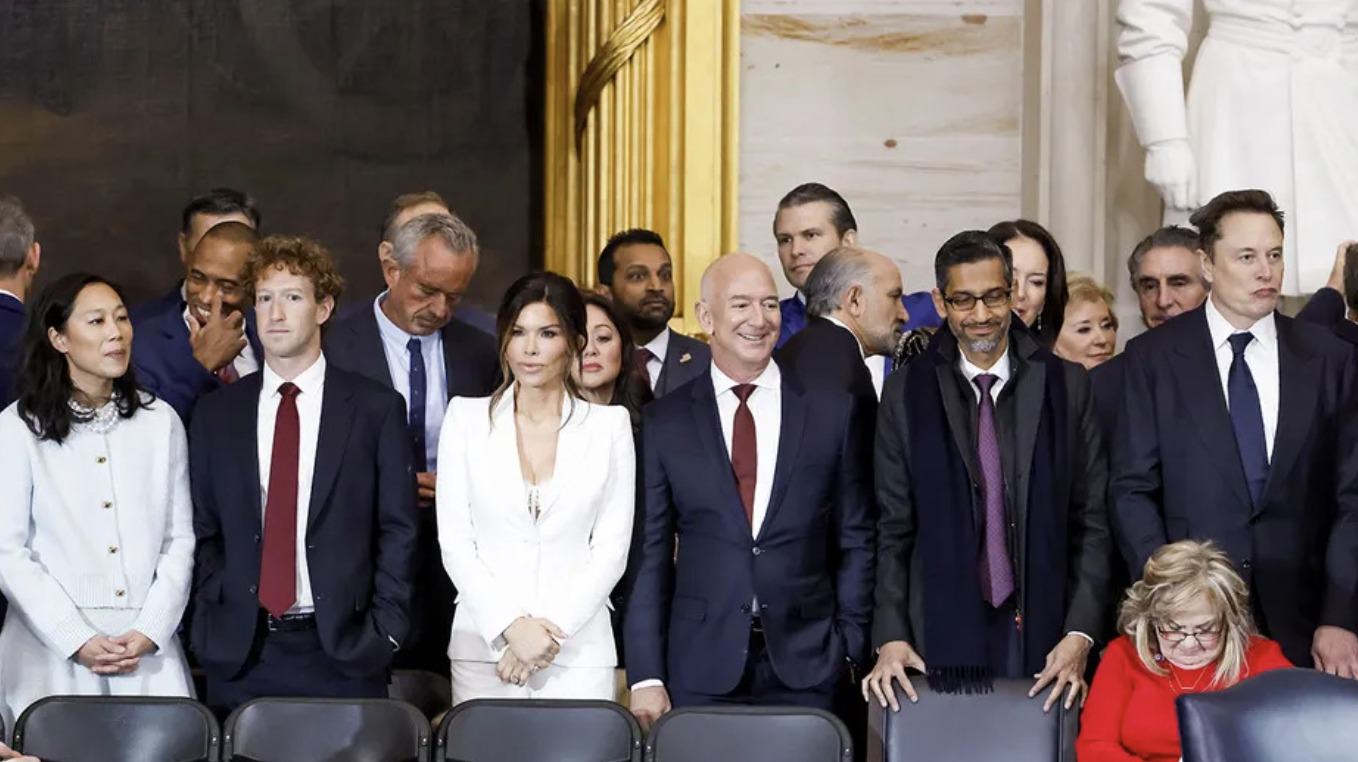
In the digital age, media ownership has become increasingly concentrated within a circle of tech conglomerates, including Apple, Google, Amazon, and Meta. The interests of these technological giants are inextricable from the digital surveillance apparatus that has taken shape since the early 2000s–one that has merged with American state power to produce a reality in which the agency of the individual and voter is increasingly eroded.
As the power of these companies grows with the advancement of information technology, so too does the reality of manufactured consent. Noam Chomsky’s 1988 book on ‘manufacturing consent’ details how the public is primed to support the interests of the elite class through systemic propaganda in mass media.1 Behind the manufactured consent of the public sphere is a profit-oriented media industry that relies on advertising as its primary source of income, thus focusing the political will of consumers toward the ultimate benefit of an oligarchic cohort of corporate interests.
American news readers in the ‘80s, according to Chomsky, were primed to be better consumers of corporate products to align their spending and political wills with corporate interests. As media audiences today, we are subject to an economic/political infrastructure dubbed “surveillance capitalism.” Zuboff makes a strong claim on the nature of political participation within a captured system– meaning we are not the consumers, but rather the sites of raw material extraction for the benefit of a techno-corporate elite.2 Surveillance capitalism is the commodification of private human experiences extracted and stored as behavioral data to be transformed into a system of predictive analysis on human behavior.
In the early 2000s, Google discovered it could predict click-through-rate, or how often people would click on ads, and found it extremely profitable to sell these numbers to advertisers. This model dominates ad-monetized internet platforms, and now handles trillions of daily auctions across tech companies. Thus began the surveillance-capitalist industry of predicting human behavior, in which these conglomerates use social media platforms as the sites for optimized data extraction.
Chomsky’s manufactured consent, and what Zuboff refers to as “psychic mind-numbing” explain the passivity with which the public accepts the idea that giving up privacy for access to the digital world is a transaction in their own benefit. When Edward Snowden became a whistleblower for the National Security Agency after helping to build the technical infrastructure for the United States surveillance programs, he exposed to the public the mechanisms through which their private lives were observed and intruded upon.3 What he expected to be a catalysing scandal that would incite change and outrage became a rather resigned response due to what Snowden described as the normalization of surveillance in post-9/11 America. In response, during an interview after whistleblowing, he said, “I don’t want to live in a world where everything that I say, everything I do, everyone I talk to, every expression of creativity or love or friendship is recorded.”
That reality has only solidified in the years following Snowden’s exposé, and through the incursion of surveillance capitalism into American markets, not only is “every expression” recorded, but they are also used by tech companies to influence human behaviour. The convenience of being known by one’s technology, receiving targeted advertising, and then buying the product of our desires shaped by the consumption of media that intentionally shapes them has become a mundane fact that erodes organic thought and human agency. When applied to the political aspect of private thought, behavioural nudging, or “micro-targeting” infringes upon the integrity of democracy.
Democracy is gradually hollowed as our thoughts and actions become increasingly predictable to corporations with government partnerships. Democracy, as an institution shaped by the aggregation of individual will, is diminished because the individual will is manipulated to mirror the economic interests of corporations. In 2014, Cambridge Analytica – a British consulting firm – was hired by the Trump campaign to harvest personal data from over 80 million Facebook users in order to target voters’s specific interests, leading to Trump’s success in the 2016 presidential election. In 2018, whistleblower Christopher Wylie exposed some of these documents to The Guardian and The New York Times admitting, “We exploited Facebook to harvest millions of people’s profiles. And built models to exploit what we knew about them and target their inner demons. That was the basis the entire company was built on.”
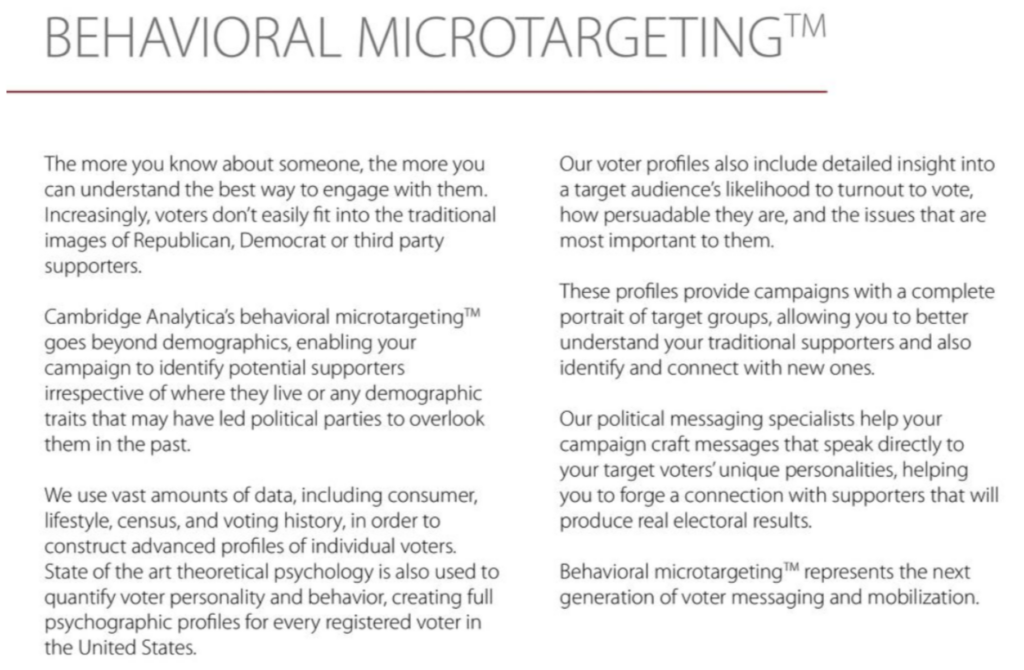
Here is an excerpt from Cambridge Analytica’s briefing pack in 2016:
As part of CA’s mission to go “beyond demographics” and “create full psychographic profiles for every registered voter in the United States”, African American voters were specifically targeted and categorizedby the campaign as voters who they “hope(d) don’t show up to vote.” 3.5 million Black Americans were placed under this category with the label“Deterrence,” and targeted with Facebook content intended to deter them from voting.
In the wake of the scandal Cambridge Analytica was dissolved, but the technological capability to alter voter behaviour remains and continues to advance rapidly alongside the development of AI. Tech conglomerates exist in a realm of unregulated self-legislation, evading accountability by intentionally drawing out lawsuits and directing complaints to internal judiciary boards. Federal legislation surrounding behavioural nudging has yet to take shape, and the responsibility of managing digital voter manipulation campaigns is thus left entirely to the initiatives of the very companies that profit from them.
The prospects of federal regulation have become increasingly grim in the face of intimate partnerships between the current US administration, and leading tech giants. The convergence of state and corporate power in the United States erodes political agency by making citizens’ actions and opinions gathered through surveillance data increasingly vulnerable to manipulation toward the political and economic interests of elite groups within the American polity.
Edited by Tristan Hernandez
The argument defended in this article is solely that of the author and does not reflect the position of the McGill Journal of Political Science, the Political Science Students’ Association, or the McGill Department of Political Science.
Featured image by The Atlantic
- Edward S. Herman and Noam Chomsky, Manufacturing Consent: The Political Economy of the Mass Media (New York: Pantheon Books, 1988). ↩︎
- Shoshana Zuboff, The Age of Surveillance Capitalism: The Fight for a Human Future at the New Frontier of Power (New York: PublicAffairs, 2019), 17–18. ↩︎
- Edward J. Snowden, Permanent Record (New York: Metropolitan Books, 2019), 100. ↩︎