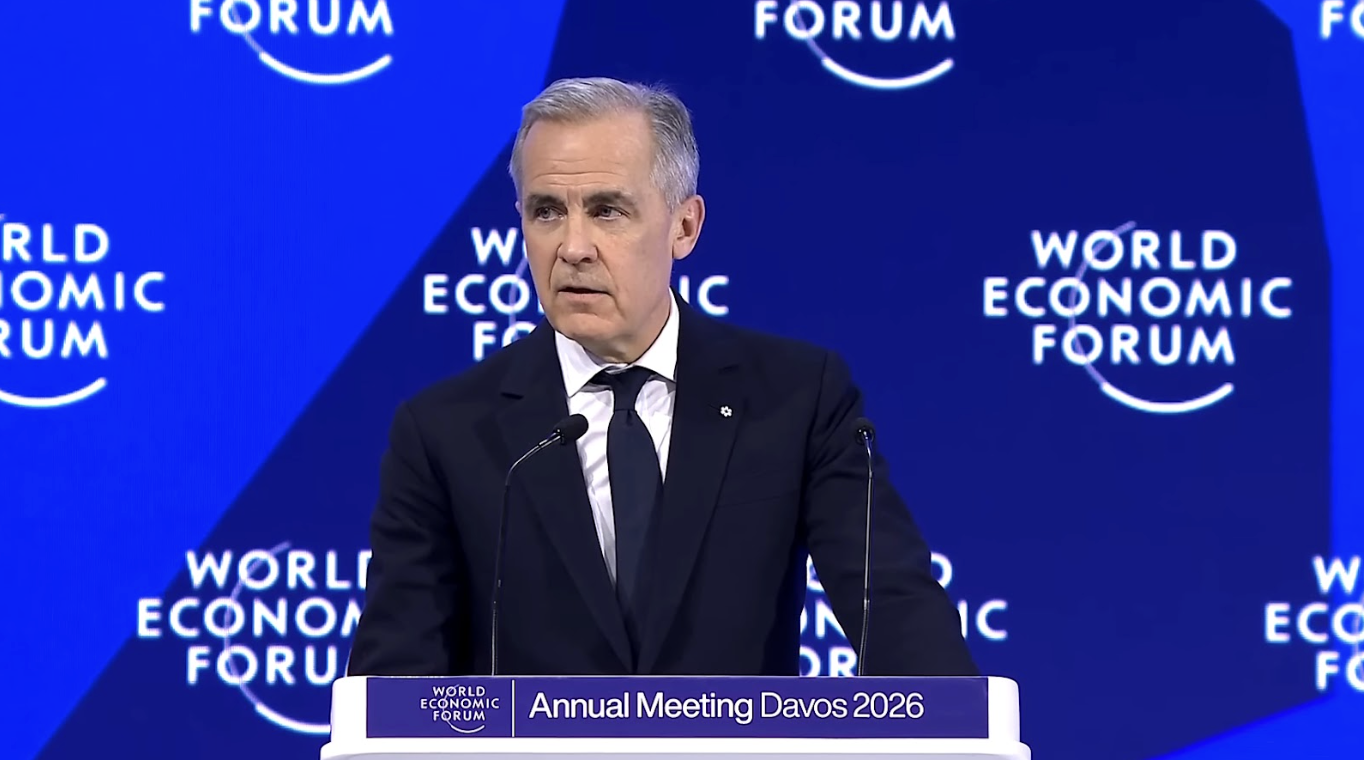
Canadian diplomacy has long treated the rules-based international order as a gesture of affirming compliance that conceals structural limitations. This logic shaped Mark Carney’s Davos address, in which he drew on Václav Havel’s1 notion of “living within a lie” to describe a system sustained by participation in rituals that people privately recognized as false. Given to an audience of political and economic elites in a time of increased global fragmentation, the speech presented at the 2026 World Economic Forum openly questioned the continued plausibility of the rules-based order. This article argues that while Mr. Carney’s intervention disrupts the language through which constraint has been historically justified, it does not displace the underlying logic of middle-power politics. By analyzing the foundations of international order, his speech reshapes how constraints are managed, raising the risk that honesty2 itself becomes a new source of accommodation.
The Logic of Middle Power Politics
Canada’s middle-power identity has never merely been a reflection of its material position; it has also served to explain and support structural limitations. As John Holmes argues, Canadian foreign policy developed around an acceptance that “no country has an independent foreign policy,” and that influence was best exercised by working within, rather than against, existing structures of power. Canada’s reliance on multilateral institutions and discreet diplomacy reflected a pragmatic response to asymmetry rather than an expectation of equal influence. Institutions offered predictability and legitimacy in a system where Canada could not shape outcomes in advance, even when seeking to expand its influence through international engagement.
Mollie Royds similarly frames middle-power behaviour as a pattern used to offset dependence. Within liberal institutionalism, this strategy has operated on the assumption that participation in rules-based institutions could mitigate material asymmetries by embedding states within shared norms and procedures that made power differences less visible. Operating through these forums, therefore, enabled Canada to translate that vulnerability into claims of stability and responsible international conduct, even as major powers continued to control which outcomes were realistically achievable. In this context, Mr. Carney’s Davos speech matters less for proposing a new foreign policy strategy than for disrupting Canada’s vocabulary of justification. His rejection of the rules-based order challenges how accommodation has historically been narrated, marking a shift in liberal internationalism away from faith in rules and institutions and toward a more explicit recognition of power. What ultimately changes, however, is the form through which sovereignty is presented under conditions of constraint.
Performative Sovereignty as a Pattern in Canadian Foreign Policy
Performative sovereignty refers to the assertion of autonomy through rhetoric and symbolic positioning in contexts where the capacity for independent action remains limited. In Canadian foreign policy, this logic has become a recurring pattern, allowing claims of agency to stand in for substantive independence. Research3 on sovereignty identifies this dynamic as a durable pattern of governance, in which symbolic assertion often substitutes for sustained material commitment, leaving underlying authority structures largely unchanged.
Constructivist approaches help to explain why such practices endure. As Conor Smith notes, foreign policy speech acts do not simply accompany policy; they perform political work by situating states within recognized institutional roles. Performative sovereignty, therefore, contributes to the reproduction of Canada’s international identity as reliable and responsible, even when its room for independent action is constrained. Umut Aydin similarly states that middle powers often seek status through recognition, relying on diplomatic ambition to sustain influence. Read this way, Mr. Carney’s critique of “keeping the sign in the window” is directed not only at institutional decline, but at a long-standing pattern through which constraint has been managed symbolically rather than confronted directly.
The Structural Limits of Honest Rhetoric
Mr. Carney’s call to “live the truth” confronts persistent tensions between rhetorical honesty and material constraint, particularly in the trade domain. While Mr. Carney frames diversification as the material foundation of honest foreign policy, Holmes reminds us that Canada’s dependence on an open global economy has long limited its willingness to risk trade retaliation or market exclusion. Royds similarly shows that Canadian foreign policy has historically avoided sustained public confrontation when such risks were high, thereby treating silence as a means of limiting economic and diplomatic fallout. What emerges is a pattern of selective articulation shaped less by preference than by exposure.
Similar tensions appear in the security domain. Mr. Carney pairs alliance commitments with a promise to call out inconsistencies between rhetoric and reality. Holmes once again notes, however, that deep reliance on collective defence arrangements has consistently narrowed Canada’s freedom of action. This produces a dilemma in which honesty about power asymmetries risks unsettling the very relationships that sustain its? security. Emanuel Adler and Alena Drieschova help clarify what exactly is at stake. Their research shows that international order depends not only on material capability but on epistemic consistency.4 When middle powers apply standards unevenly, shared expectations about norms erode. However, when they apply them uniformly, the costs can become destabilizing by weakening the shared basis of trust and predictability which make cooperation possible. The challenge Mr. Carney raises is therefore not moral but instead structural. Is Canada truly prepared to sustain honest rhetoric when it produces costs instead of reassurance, particularly when those costs cannot be easily shared?
Adjustment Without Change
Rather than resolving the tensions identified above, Mr. Carney’s intervention reveals a greater risk in how Canadian foreign policy adapts to constraints. New commitments and rhetorical shifts do not necessarily disrupt established practices and may instead be integrated in ways that leave existing modes of action intact. As Laura Macdonald and Jeremy Paltiel caution, this pattern of “global bricolage,” understood as an ad hoc layering of initiatives onto existing frameworks, allows governments to signal adjustment without altering how Canadian foreign policy is actually conducted. In this context, honesty risks functioning less as a transformation than as a substitution, replacing one legitimating narrative with another while leaving material relationships largely intact.
Adler and Drieschova’s emphasis on epistemic consistency points to a further implication. Once honesty becomes standardized, it can perform the same ordering function as the language it replaces, restoring predictability without redistributing the burden. Dakota Erutse’s warning that sovereignty, when grounded primarily in assertion rather than in material conditions and lived authority, ultimately loses credibility, serves as instructive in these contexts. Whether Canada can bear those costs is only part of the challenge; the deeper risk is that honesty itself becomes a new mode of accommodation.
Mr. Carney’s Davos address matters not because it resolves the dilemmas of middle-power politics, but because it unsettles how those problems have traditionally been discussed. By naming the performative foundations of rules-based international order, the speech disrupts a framework through which Canadian diplomacy has managed limitations while preserving legitimacy. Yet, as this article has shown, disruption at the level of rhetoric does not in itself displace the structural conditions that give rise to performative sovereignty. In this sense, Havel’s warning remains clear. Abandoning ritual has meaning only if the resulting costs are accepted. The durability of Mr. Carney’s words will therefore be measured by the willingness of states like Canada to abandon familiar performances when honesty can no longer reassure and instead confront existing material costs.
Edited by Catvy Tran
The argument defended in this article is solely that of the author and does not reflect the position of the McGill Journal of Political Science, the Political Science Students’ Association, or the McGill Department of Political Science.
Featured image by Wikimedia Commons

- Václav Havel’s “The Power of the Powerless” (1978) is an essay on how authoritarian systems endure not only through coercion, but through everyday participation in rituals of public conformity. Mr. Carney draws on Havel’s essay in his Davos speech to frame today’s rules-based order as sustained by similar compliance, and to argue that refusing said compliance can itself become a source of agency.
↩︎ - Throughout this article, “honesty” refers to a way of speaking that openly acknowledges Canada’s limits and dependencies rather than presenting policy choices as the neutral outcome of rules or institutions. ↩︎
- For more, see my previous article, “Who Holds the North? Indigenous Sovereignty and the Politics of Presence in Canada’s Arctic,” which develops the concept of performative sovereignty in Arctic contexts, where symbolic assertions of control often substitute for material authority and Indigenous self-determination. ↩︎
- The term “epistemic consistency” refers to the shared expectations that make cooperation legible and predictable. For more information, see Adler and Drieschova’s, “The Epistemological Challenge of Truth-Subversion to the Liberal International Order”. ↩︎