Political Islamic movements in the Middle East are predominantly associated with sectarian divisions and violent conflict.1 Western analyses have historically identified Middle Eastern conflicts with a primordial Sunni-Shia antagonism and regularly point to sectarian fragmentation as an inherent outcome of Islamic political movements.2 While some movements have indeed contributed to fragmentation and violent conflict, Islamic political movements do not necessarily produce such outcomes. The use of political thought rooted in esoteric Islamic philosophy by the Nur movement in Turkey, stands as an example that deviates from militant or populist movements in recent history, through its approach to faith based activism and political mobilization. Examining the foundational era of the Nur movement under Kemalist Turkey reveals a nuance of Islamic political thought that persists in exerting influence and exemplifies an activist tradition that approaches its goals through individual awareness rather than institutional power.
Sufi political thought’s insistence on contextual adaptability foregrounds the motivations for political mobilization as part of a broader spiritual way of life. This tenet commands followers to adapt to changes in their societies not through religious seclusion, but through active efforts to influence political decision-making towards their values, which created a motivational social force in Turkey rather than a radical political endeavour. The introspective spiritual outlooks — commonly associated with mysticism that estranges individuals from society through a monk-like lifestyle, are contrasted by the Nur movement’s imperative to achieve spiritual maturity through active immersion in society. Sufism as a mystical philosophy of Islam is susceptible to idealization as a meditative and esoteric form of practice, yet organized political engagement is central to the esoteric inclinations that inspired the neo-Sufi manifestations of Nursi thought. This approach combines political engagement and outward efforts for civic participation with Islamic spirituality.
Outward expressions of faith through political and civic engagement became restricted after Turkey became a republic in 1923. For the Nur movement, this was the period of the “New Said,”3 in which Said Nursi, the Kurdish Anatolian founder of the movement, shifted his activism in response to the changing political atmosphere. Before 1923, the “Old Said” had been involved heavily in political parties, defending liberalism and equal religious rights in the dwindling Ottoman empire. When Kemal Atatürk, the first president of Turkey, took power, he implemented strict reforms intended to Westernize Turkish society and move towards secularism, forming a new national identity that excluded Islam from the public sphere.4 Atatürk cracked down on any perceived threat to the homogenous Turkish identity he molded. This led to a strategic targeting of ethnic minorities particularly against Armenians.
At the same time, the Muslim Brotherhood began to take root in Egypt, where Hassan al Banna founded a grassroots Islamic movement that became inextricable from a top-down endeavour for an Islamic state, and one of the most influential Islamic political movements in the Middle East.5 The New Said in contrast, was garnering support for an Islamic movement that took a bottom-up approach to influencing the socio-political conditions in Turkey. Nursi diverged from mainstream politics, regarding party politics as futile measures against the spread of secular ideology rooted in positivism, which he sought to outweigh with his movement. The Nur movement thus diverged from Salafist6 political thought, disentangling faith from the state and viewing jihad7 as a spiritual inward endeavour to overcome the challenges presented by materialism and positivism in modern times.8 Said’s writings guided followers to view political issues as symptoms of weakening individual faith within a nation, which would not be solved by institutional political activism but rather by strengthening individual faith to be adaptable to changing contexts. Nursi did not encourage Islamisization of socio-economic structures within the state but rather neutrality that allowed for free religious practice and piety. He saw Islam in political propaganda as risking exclusion of Muslims or other parties, and thus was against its monopolization by party politics.9
The impacts of the Nur movement and its ideology spread through Said Nursi’s writing, and were perceived as a significant threat by the Kemalist government. Nursi accused the Kemalist definition of Turkism of being divisive, and saw Islam as a unifying force for Turkish nationalism among ethnic groups.10 He spent over 20 years as a political prisoner. The Nur movement had no official representative body, but broadly sought to unify science and Islam, defend democracy, and promote reason-based Islamic consciousness in accordance with Nursi’s religious teachings. These communities were textual and not uniformly organized, which allowed the texts to spread throughout Anatolia and greater Turkey.11 The simultaneously anti-party political movement that mobilized socio-political outlooks against Kemalism during the New Said era stood out from the populist Islamist ideology that would develop from the Muslim Brotherhood and its counterparts.12 The rise of Islamic movements against secularism in the aftermath of the Ottoman empire bred ideology that led to the divisive outcomes commonly highlighted in Western scholarship, and instrumentalized by secular authoritarians like the Syrian Ba’ath to fearmonger against anti-regime Islamic dissent.13 The era of the New Said represents a nuanced aspect of Islamic political activism that mobilized from the level of individual consciousness and not through formal political or military organization, diverging from the Islamist approaches that simultaneously evolved in the post-colonial era of the Middle East. The contemporary categorization of Islam and its political movements as an adversary that “clashes”14 with democracy and Western values is thus debunked by the sustained prominence of Islamic movements that deviate from the top-down authoritarian narrative imposed upon them.
Edited by Tristan Hernandez
The argument defended in this article is solely that of the author and does not reflect the position of the McGill Journal of Political Science, the Political Science Students’ Association, or the McGill Department of Political Science.
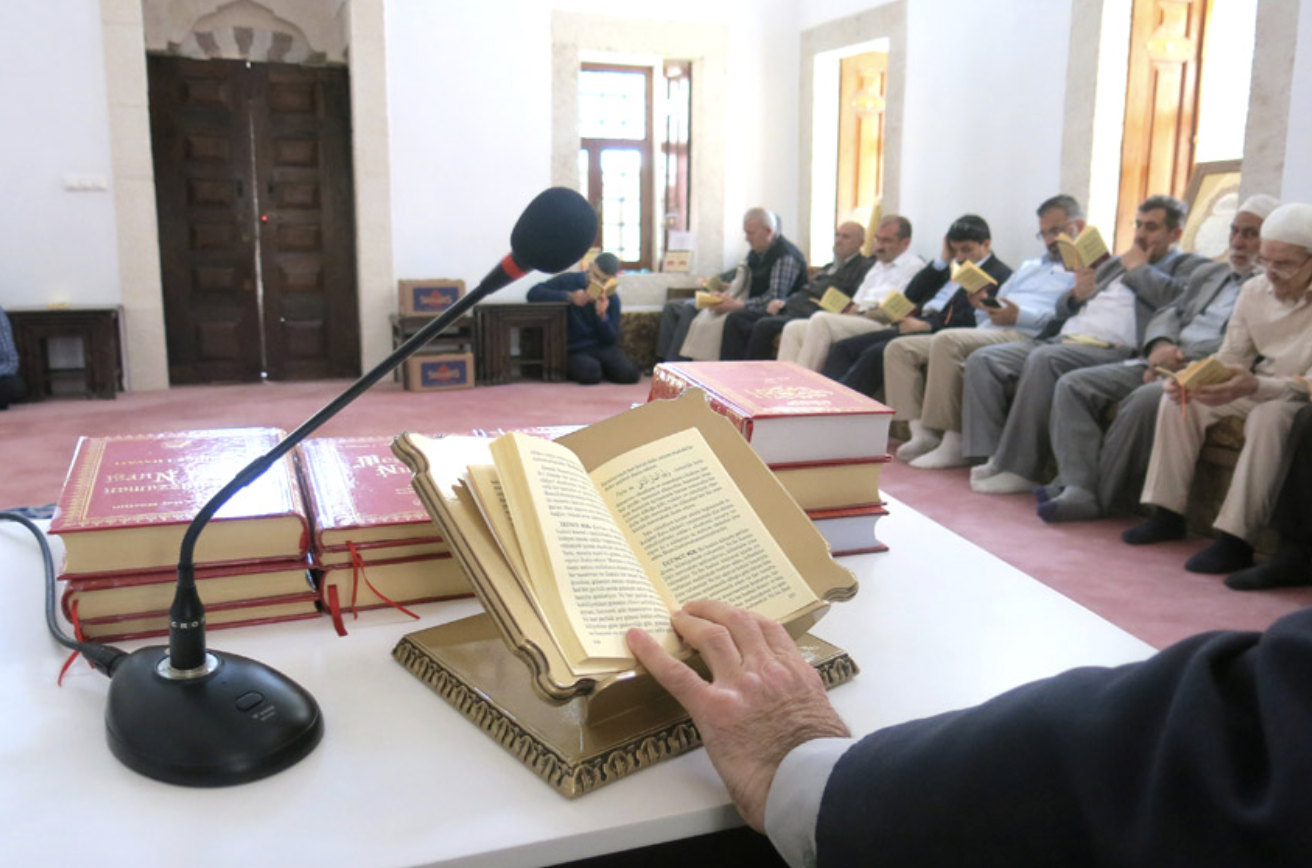
“Risale-dersleri” by Ahtopcu is licensed under CC BY-SA 4.0.
- Amal Saad-L huldi, “Middle East Sectarianism: A Symptom, Not a Cause,” Arab Center Washington DC, May 23, 2021, arabcenterdc.org/resource/middle-east-sectarianism-a-symptom-to-a-cause/. ↩︎
- Saad-L huldi, “Middle East Sectarianism.” ↩︎
- Zeynep Akbulut Kuru and Ahmet T. Kuru, “Apolitical Interpretation of Islam: Said Nursi’s Faith-Based Activism in Comparison with Political Islamism and Sufism,” Islam and Christian–Muslim Relations 19, no. 1 (2008): 99–111, https://doi.org/10.1080/13510340701770311. ↩︎
- Kuru and Kuru, “Apolitical Interpretation of Islam”. ↩︎
- Khalil al-Anani, “The Power of the Jama‘a: The Role of Hasan al-Banna in Constructing the Muslim Brotherhood’s Collective Identity,” Sociology of Islam 1, no. 1-2 (January 2013): 41–63, https://doi.org/10.1163/22131418-00101003. ↩︎
- A puritanical Sunni movement that seeks to restore what it sees as the authentic practice and beliefs of Islam of the Prophet Muhammad’s time and the first three generations of Muslims. ↩︎
- Salih Sayilgan, “An Islamic Jihad of Nonviolence: Said Nursi’s Model,” The Maydan, April 30, 2019, https://themaydan.com/2019/04/an-islamic-jihad-of-nonviolence-said-nursis-model/. ↩︎
- Kuru and Kuru, “Apolitical Interpretation of Islam”. ↩︎
- Ahmet Abdullah Sacmali, “Reconciling Religion and Nationalism: The Nur Movement in Modern Turkey (2002–2018)” (PhD diss., Durham University, 2019), http://etheses.dur.ac.uk/13624/. ↩︎
- Şerif M. Balci, “Bediüzzaman Said Nursi: Politico-Religious Opponent of the Early Turkish State,” Academia.edu, 2019, https://www.academia.edu/143372601/Bediüzzaman_Said_Nursi_Politico_Religious_Opponent_of_the_Early_Turkish_State. ↩︎
- Balci, “Bediüzzaman Said Nursi.” ↩︎
- Kuru and Kuru, “Apolitical Interpretation of Islam.” ↩︎
- Line Khatib, Syria, Saudi Arabia, the U.A.E. and Qatar: Sectarianism and the Arab State (London: I.B. Tauris, 2019), chap. 2, 45–67, www.jstor.org/stable/48541312. ↩︎
- Samuel P. Huntington, The Clash of Civilizations and the Remaking of World Order (New York: Simon & Schuster, 1996) ↩︎