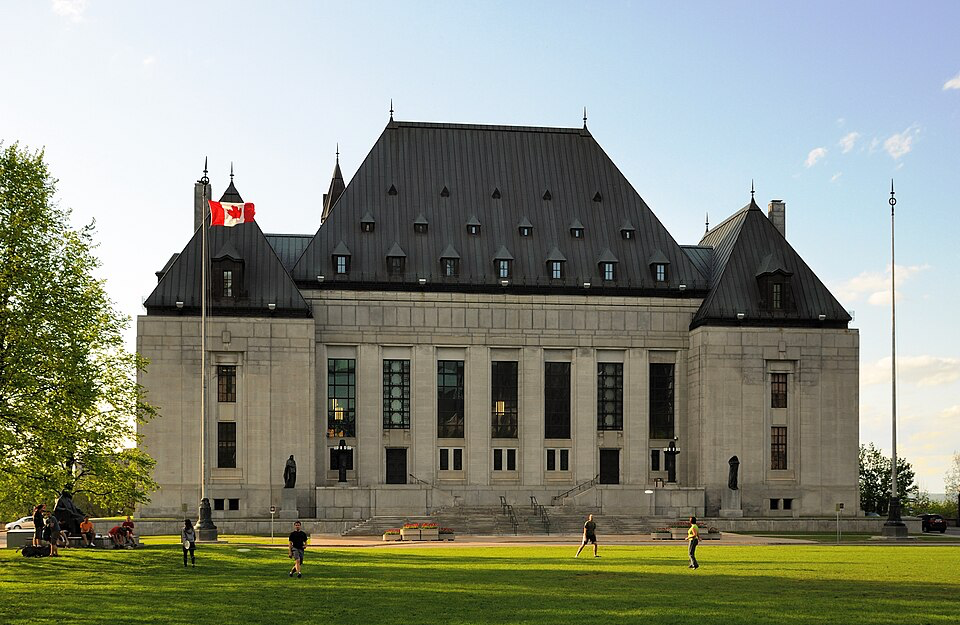
As early as this November, the Supreme Court of Canada could rule on a law that Quebec deliberately placed beyond the reach of most court challenges. Quebec’s Bill 21 has been shielded since 2019 by section 33 of the Canadian Charter of Rights and Freedoms, better known as the notwithstanding clause— a stipulation that allows the legislature to pass bills regardless of whether they violate certain Charter rights. Much of the debate around this topic has focused on issues of secularism, but the case turns on an older and deeper question: in a democracy, who should have the final say on rights – the judiciary or elected legislatures?
This article argues that the notwithstanding clause can be defended as a democratic tool for reasonable disagreement about rights, but only when employed posthumously, as originally intended. If it is used before courts have ruled on whether a law violates the Charter, this protection stands to undermine the power and independence of a crucial part of the federal Canadian government. Used pre-emptively, as Quebec did with Bill 21, and Alberta since, it cuts off the deliberation that makes the principle of legislative supremacy meaningfully defensible.
A Clause Born From and Built for Discord
Without the notwithstanding clause, there would likely have been no Charter. In 1981, Prime Minister Pierre Trudeau sought to patriate Canada from British rule, and institute a charter of rights, but several premiers refused to accept entrenched rights unless legislatures kept final authority. The resulting compromise allows a legislature to override the Charter’s fundamental freedoms, legal rights, and equality rights for renewable five-year periods. Since this compromise, the power of the notwithstanding clause has only grown. In Ford v. Quebec (1988), a challenge to Quebec’s French-only commercial sign rules, the Supreme Court held that invoking the clause requires only an express declaration, not a justification.
Québec’s Bill 21, passed in June 2019 under Former Premier François Legault, bars public employees in positions of authority– including teachers, police officers, and judges– from wearing religious symbols at work. The government invoked section 33 while passing Bill itself, before any court could hear a challenge, and renewed the declaration in May 2024. While supporters see it as an expression of secularism and state neutrality; critics argue it has a disproportionate impact on Muslim women who wear the hijab, as well as on Sikh and Jewish employees. This article sets that debate aside to focus on the clause that has kept the courts from settling it.
Shielded From the Start
In March, the Supreme Court heard four days of arguments on Bill 21. Challengers argued that the law intrudes on rights that the notwithstanding clause section 33 cannot override, including the Charter’s guarantee of gender equality and the right of minority-language communities to manage their own schools. The Quebec Superior Court and Court of Appeal upheld the law, while criticizing how broadly the government had used the clause.
In late 2025, Alberta followed suit by shielding three laws affecting transgender youth and adults while challenges against them were still before the courts. Premier Danielle Smith said she was unwilling to wait out lengthy litigation, a striking stance in a country whose political culture has long favoured gradual, negotiated adaptation over rapid shifts in policy. Prime Minister Mark Carney, by contrast, has said he opposes pre-emptive use of the clause.
What these cases share is timing. When a legislature invokes section 33 after a court has struck down a law, the override is a reply: the legislature has heard the court’s reasons and decided, publicly, that it disagrees. When the clause is invoked before any court has ruled, there is nothing to reply to. No court has weighed the law against the Charter, so the legislature is not disagreeing with anyone’s reasons; it is declaring in advance that reasons will not matter. That is why the coming ruling matters well beyond Quebec, though the question it raises is not the Court’s alone.
The Last Word
The strongest case for letting legislatures decide comes from legal philosopher Jeremy Waldron, who argues that citizens in a healthy democracy disagree, reasonably and in good faith, about what rights require. Judges disagree just as sharply, so there is little reason to think courts find the right answer more reliably. What legislatures offer instead is legitimacy: decisions made after debate by representatives to whom citizens can hold accountable.
Ronald Dworkin offers that rights act as trumps: they protect individuals against what a majority might otherwise do to them.1 It would make little sense to leave their protection to that same majority. Dworkin’s defence of courts rests not on judges being wiser, but on the kind of forum a court is, one where questions of principle are settled by reasons rather than votes.
The Canadian system was designed to sit between these positions. Peter Hogg and Allison Bushell describe the Charter as producing a dialogue: judges give reasons, and legislatures can respond, revise, or, through section 33, override. The clause answers Dworkin by guaranteeing that the courts speak first, and Waldron by guaranteeing that legislatures speak last.
Pre-emptive use breaks this bargain. It also fails on Waldron’s own terms, which depend on legislatures that genuinely deliberate about rights, weighing the arguments and taking responsibility for the outcome. A government that invokes section 33 before any court has ruled is not engaging with a disagreement about rights; it is ensuring that no reasoned objection can have legal consequence.
The strongest objection to this argument is that it asks legislatures to wait for permission they do not need. Nothing in section 33 requires a prior ruling, and Alberta has defended the clause as a hard-won compromise that preserves provincial parliamentary sovereignty. McGill professor emeritus Charles Taylor offers a philosophical version of this objection: a liberal society may legitimately pursue collective goals, such as the survival of a distinct culture, even when they limit some individual claims.2 In this view, Quebec’s use of the clause embodies democracy rather than evading it. For a minority nation, waiting for nine judges appointed by the prime minister can itself feel like a democratic cost, a concern Quebec politicians express when they insist that Ottawa will not decide for them. The five-year sunset also allows voters to revisit the choice.
These objections explain why the clause should survive, but not why it should come first. Taylor defends a society’s right to pursue collective goals, not its right to shield them from scrutiny. Not only did pre-emption sideline Ottawa’s judges; it also limited what Quebec’s own courts could review. Elections cannot fill that gap. Voters judge an entire platform, not the rights one law limits, and when the override comes first, no court has defined those limits for them.
The Court can say where the clause’s legal limits lie, but only legislatures and citizens can decide when using it is legitimate. If section 33 is to remain a democratic check on judicial power, governments must let courts deliberate before overruling them.
Edited by Jaya Choudhry
The argument defended in this article is solely that of the author and does not reflect the position of the McGill Journal of Political Science, the Political Science Studentsʼ Association, or the Political Science Department.
Featured image from the Library and Archives Canada, via Wikimedia Commons
