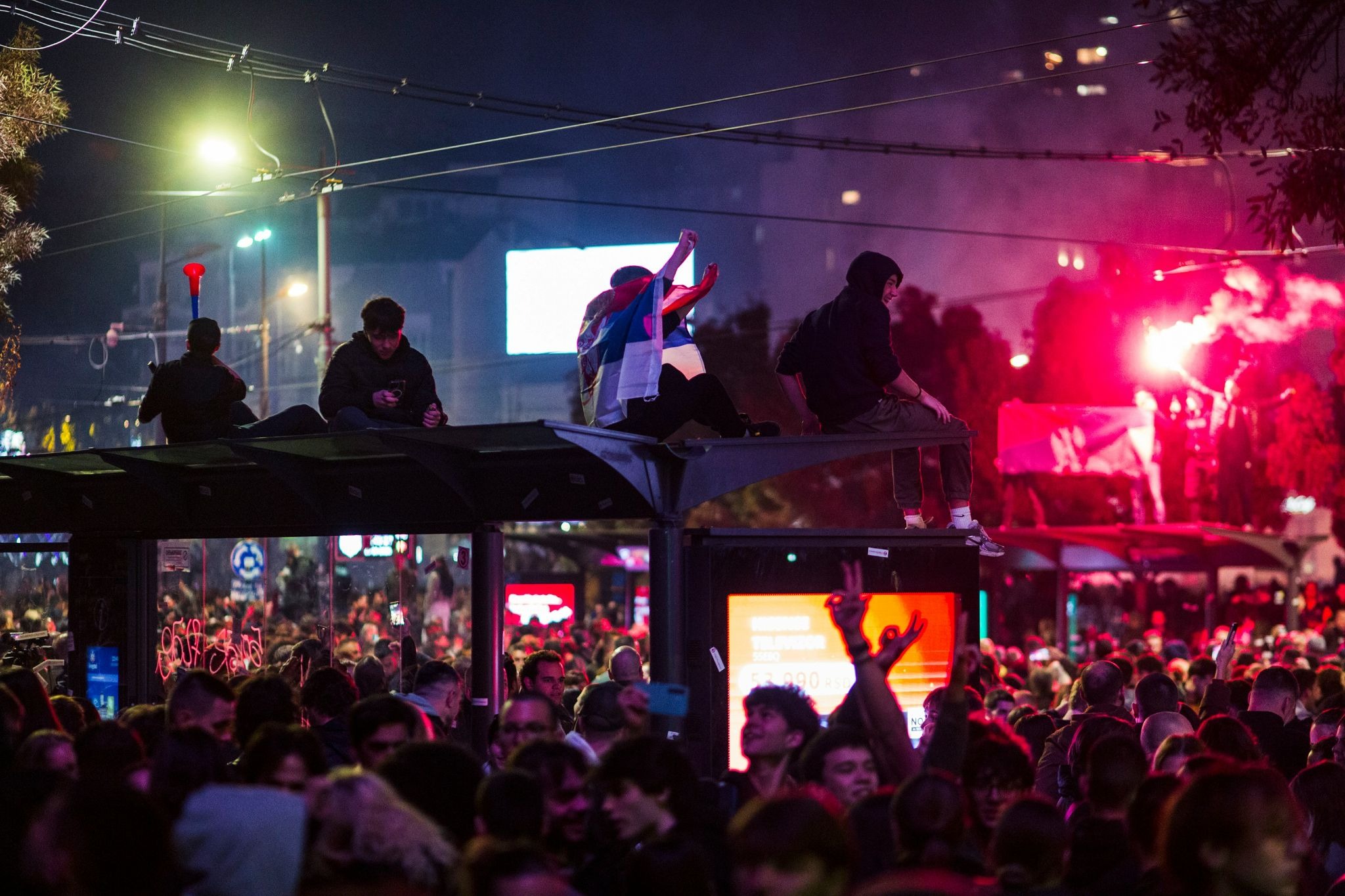
Student-led protests have increasingly become a prominent form of political mobilization across Europe, reflecting growing dissatisfaction among younger generations with current political and socioeconomic conditions. Recent developments in Serbia and Greece illustrate how similar forms of youth mobilization can produce different political trajectories. On October 25, 2026, Serbian President Aleksandar Vučić conceded defeat to the “Student List-Students Win” movement in snap parliamentary elections, marking a significant advancement for a student-led campaign. Meanwhile, thousands of Greek students took to the streets on October 21 of this year to demand increased public education funding and improved economic conditions. Although both movements reflect demands for greater government accountability, their objectives and strategies differ considerably.
Comparing Serbia and Greece demonstrates how the nature of initial grievances, organizational alliances, and political participation shape the trajectories of student movements. While Serbia’s movement transformed a specific tragedy into a direct challenge of political authority, Greek student mobilization has remained primarily focused on policy reform through collective action and organized labour.
Serbia: From a Specific Grievance to Political Dissent
The origins of Serbia’s student movement can be traced back to November 1, 2024, when a railway station collapsed in Novi Sad, Serbia, killing 16 people. The incident prompted widespread public outrage, with many attributing the tragedy to government corruption, negligence, and inadequate oversight. These accusations were largely fueled by the fact that the station had undergone extensive renovations in the years preceding the collapse, yet questions emerged surrounding the quality of the reconstruction and the government’s supervision of the project. Furthermore, authorities faced criticism for withholding construction documentation and failing to to be sufficiently transparent regarding the contracts awarded to the Chinese companies involved. The discovery that the station was operating without a use permit further intensified concerns about regulatory oversight and institutional accountability.
Students initially mobilized around demands for transparency, the publication of relevant construction documentation, and accountability for those responsible. However, these demands gradually expanded beyond the immediate circumstances of the collapse and developed into a challenge to Serbia’s political incumbency, the Serbian Progressive Party (SNS) led by President Aleksandar Vučić for nearly a decade.
The progression from protest movement to electoral opposition became particularly significant with the establishment of the Student List – Students Win (Student List) ahead of Serbia’s October 25, 2025 snap parliamentary elections. The electoral list brought together 250 independent candidates selected through university assemblies and included academics, doctors, activists, and other civil society figures. Its platform centred on tackling government corruption and establishing fairer electoral conditions. Rather than aligning itself with an established political party, the movement sought to maintain its non-partisan identity while offering voters a political alternative to the current SNS leadership. On election day, Serbia saw the highest voter turnout since the breakup of Yugoslavia. The Student List’s strategy proved successful as they secured approximately 53.7 per cent of the vote and 140 of the 250 parliamentary seats—thus concluding the SNS-led coalition’s 14 years of majority in government.
The movement’s expansion was facilitated by its organizational structure and ability to sustain participation. Through university campus occupations and nationwide assemblies, students established a decentralized movement that could mobilize across different regions. Additionally, the movement’s non-partisan identity helped attract support from individuals beyond traditional political affiliations, unifying citizens against a common opposition. Initial demands included the release of all documentation related to the railway station reconstruction, prosecution of individuals responsible for attacks against protestors, the withdrawal of charges against detained students, and increased university funding. These demands were reinforced through large-scale protests and blockades across the country, including Serbia’s largest ever anti-government protest in March 2025 in the streets of Belgrade. As dissatisfaction with the government’s response continued, demands increasingly centred on democratic accountability, anti-corruption measures, and early parliamentary elections.
President Vučić’s concession was especially notable given his longstanding dominance over Serbian politics. Following the election, he acknowledged the defeat, stating that “it is clear we have lost these elections,” while recognizing the Student List’s projected victory. The result marked a major setback for the SNS, which had governed since 2012, highlighting how sustained student mobilization had developed into a credible electoral challenge to the political establishment.
The shift from issue-specific demands to various political objectives ultimately brought the movement into electoral politics. Rather than limiting their activities to demonstrations and public pressure, students sought to translate their objectives into formal political representation through the “Student’s List.” Vučić’s October 25 concession therefore represents a significant development in the movement’s trajectory and reinforces the influence that civilians can have on their governments.
Greece: Mobilization Around Education and Economic Insecurity
In Greece, recent student demonstrations have emerged from a different set of grievances. On October 21, 2026, thousands of students gathered in Athens and other cities to demand improvements to public education, including increased funding and better educational infrastructure. Their demands also reflect concerns surrounding economic insecurity, housing affordability, and the financial challenges facing younger generations. On November 5 of this year, thousands of students and allies marched through Athens and Thessaloniki, declaring “From Greece to France, we fight for free public education” and borrowing “Étudier ou survivre?” from France’s protests. Unlike Serbia, where a specific tragedy became the catalyst for broader political opposition, Greek student mobilization has developed primarily around dissatisfaction with public education services and its objectives have remained focused on government policy—particularly the allocation of resources toward education and the economic circumstances affecting students and young workers.
The movement has relied on different forms of organization to exert pressure on government officials without explicitly engaging in electoral politics. Teachers, education workers, and established labour organizations have participated in strikes and demonstrations alongside students. Support from labour unions such as the Confederation of Civil Servants’ Union (which represents public-sector employees) provides a foundation for the movement to expand beyond education and into various aspects of civil society. At this stage, mobilization has primarily relied on collective strikes and demonstrations to pressure the government to implement policy reform rather than direct electoral participation.
Diverging Political Trajectories
The contrasting pathways of these movements highlight how the context of initial grievances can influence the development of political mobilization. In Serbia, the Novi Sad railway station collapse provided a specific focal point around which widespread dissatisfaction could develop. The tragedy became representative of overarching concerns about institutional corruption and government responsibility, allowing students to connect a seemingly isolated grievance to systemic political problems. Dissatisfaction has grown in Greece, arising from ongoing concerns about education and economic security. Unlike Serbia, where a specific tragedy galvanized opposition to the ruling government, mobilization has been primarily driven by narrowly defined policy goals without developing a general challenge to political incumbency.
Moreover, national political institutions help contextualize the different opportunities available to each movement. The extent to which political institutions are perceived as responsive and accountable can shape whether movements pursue greater political change or focus on specific policy reforms. In Serbia, concerns surrounding government accountability and electoral conditions contributed to the movement’s emphasis on institutional reform. In Greece, students have directed their demands toward an established political system through demonstrations, organized labour, and pressure for policy changes. These differences illustrate how the relationship between civil society and political institutions can influence whether mobilization develops into a challenge to political leadership or remains focused on reforming existing policies.
Edited by Laila Graham
The argument defended in this article is solely that of the author and does not reflect the position of the McGill Journal of Political Science, the Political Science Students’ Association, or the McGill Department of Political Science.
Featured image by Aleksandr Popov on Unsplash