In the prelude to the First World War, Europe arranged itself into a series of opposing alliances, some of them secret. A cascade of declarations of war then drew several major powers into what was supposedly a regional matter: the alleged Serbian state-sponsored assassination of Archduke Franz Ferdinand. A crisis in the Balkans quickly escalated into a full-scale war that would plunge the continent into four years of catastrophe.
Today, a similar development is taking place in the Middle East. New blocs are becoming visible as military ties between partners against a common rival overlap. If Country A is close to Country B, and Country C is also close to B, then the three can grow stronger together by formalizing a tripartite pact, as is the case with Saudi Arabia, Turkey, and Pakistan. This arrangement is not too dissimilar from how German Chancellor Otto von Bismarck used Germany as a mediator between the European great powers to form tripartite or dual alliances and ententes.
The use of alliances in Europe before WWI was primarily motivated by the principle of deterrence. After Bismarck’s time, the alliances became more secretive and strategic in pursuing imperial ambitions, rather than peace. While this escalation of tensions was a major trigger in WWI, the alliances in the Middle East embody the former principle rather than the latter. These pacts can continue to serve as a deterrent, stabilizing the region’s geopolitics rather than undermining it and risking a larger conflict.
The Concert
To understand the developments in the Middle East, it is important to consider how Europe managed to avoid a great-power conflict for nearly a century after the Napoleonic Wars. The Congress of Vienna established a doctrine of cooperation, uniting forces against a disruptive state to preserve the balance of power. This policy played out during the negotiations of the summit itself, as national delegates coalesced to dissuade others from making ambitious demands. In the decades that followed, some of those powers also joined arms to put down liberal revolutions, such as those in 1848.
This Concert of Europe gradually deteriorated through successive developments. The UK’s withdrawal from continental affairs, the Crimean War, and the unification of Germany and Italy challenged the original precepts. As the fearful memory of the Napoleonic Wars faded, the decline of the Vienna system gave way to a new strategy of realpolitik pioneered by the brilliant statesman Otto von Bismarck.
Bismarck skilfully orchestrated Germany’s diplomacy by brokering alliances among the great powers. In doing so, he successfully dissuaded each nation from overzealousness by threatening overwhelming consequences. This strategy, an example of realpolitik, created a new concert system during Bismarck’s career, but quickly dismantled following his dismissal as Chancellor by the Kaiser.
With no one to uphold Bismarck’s system, the great powers started to probe the status quo. Conflicts in Europe during the 19th century were usually brief and decisive in the first key engagements. Innovations in military technology simultaneously gave nations a sense of advantage but also led to gross miscalculations about the new, industrialized nature of warfare that would characterize WWI and beyond.
The Entente with Jerusalem
After the collapse of the Ottoman Empire, new states emerged in the Middle East. According to hegemonic theory, an ambitious state would seek to fill the power vacuum and become the new hegemon of a region to pursue its interests in shaping the regional order in its vision. The Middle East has several contenders, but principal among them is Israel.
The security dilemma is ever-present with Israel and many of its neighbors both viewing each other as grave threats. Successive conflicts have not only usually gone in Israel’s favor, but have also made its administrations and military more confident in operational success. This can be seen more clearly by the state’s more audacious strikes against Hamas leadership in Qatar, a nominally neutral ground. Incursions into Gaza, Lebanon, and the Golan Heights in Syria all make Israel’s perception by neighbors as an aggressive and less trustworthy state.
And yet, many national interests still align with Jerusalem’s. Rivals to each member of the Mecca Pact in the Aegean, the Middle East, and South Asia have found common cause with Israel. As previously stated, the overlap of interests across separate theatres recalls the pre-WWI conditions in Europe, where concerns in the Balkans suddenly became a continental issue.
India and the UAE are bitter rivals of Pakistan and Saudi Arabia, respectively. Ever since the partition of the British Raj, Pakistan and India have fought several conflicts, including four wars, becoming nuclear powers, and clashing over Kashmir. The UAE, on the other hand, is a major competitor of Saudi Arabia, and the two countries have backed opposing sides in foreign conflicts. These grievances make India and the UAE natural allies of Israel, which Prime Minister Netanyahu presented as a Hexagon Alliance against the “Sunni” bloc. In this alliance, those who are “friendly” to Israel either have deals, cooperation agreements, or diplomatic ties with Jerusalem.
But the Aegean theatre is particularly interesting. Despite being members of NATO, Greece and Turkey have been disputing the extent of their territorial waters and remain at odds over the Cyprus question. The considerable military strength of Turkey has pushed Greece and Cyprus closer to Israel. A British base in Cyprus was also struck by an Iranian drone during the initial days of the U.S.-Iran war, further encouraging security measures.
While European allies with powerful navies like France are staunch backers of the Greeks, it is probable that their resolve to confront Turkey is not as strong as Israel’s. Turkey remains a strategic NATO ally and economic partner of the EU, and the war in Ukraine has discouraged Europeans from escalating other conflicts in their neighbourhood. And yet, Netanyahu’s Hexagonal Alliance includes Greece as a friendly nation to Israel, as they signed a defence deal for air systems. The alignment of these countries with the rising regional hegemon, Israel, is a worrying prospect for the rivals of this informal entente.
The Mecca Pact
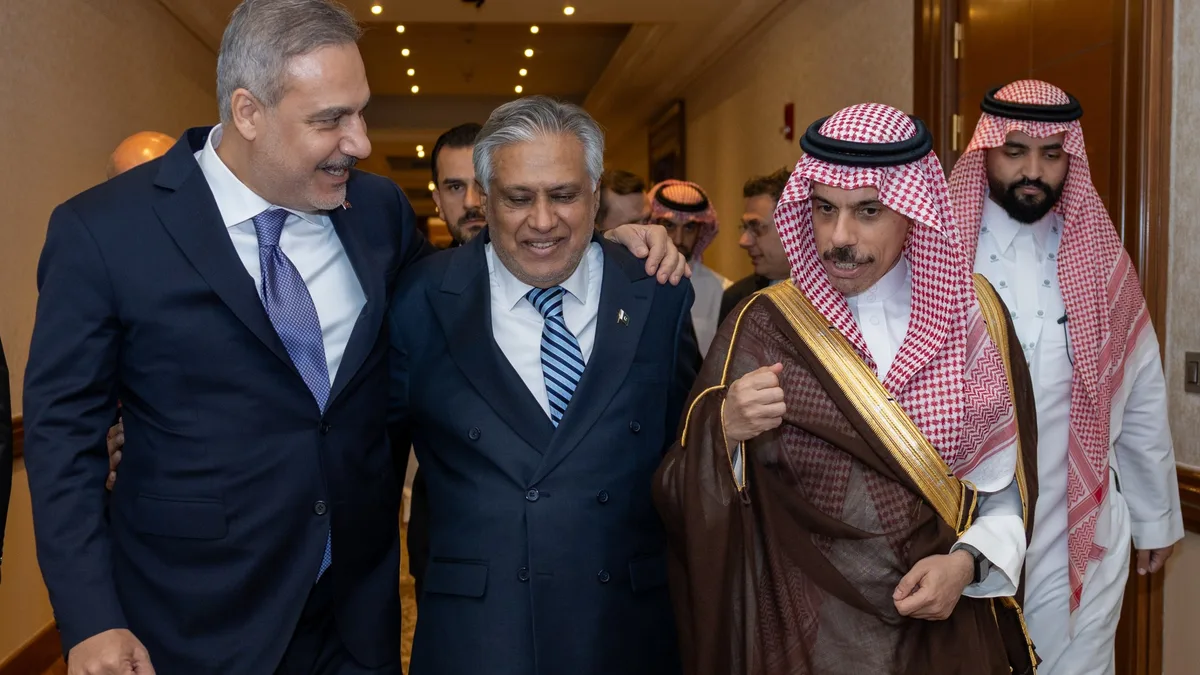
In reaction, mostly to Israel and its connections, rivals have sought closer ties with each other in earnest. Earlier this year, the Mecca Joint Defense Agreement was signed. The pact included a clause similar to Article 5 of the North Atlantic Treaty (NATO), stating that an armed attack on one signatory would be considered an attack on all. The signatories were Turkey, Saudi Arabia, and Pakistan.
The agreement had a precedent in the bilateral defense pact between Saudi Arabia and Pakistan and built upon existing relationships among the three countries, making their alliance more visible to the international community.
Saudi Arabia, the richest and most centrally located in the region, finds itself in a precarious position. Its economy relies on oil exports, most of which pass through the Strait of Hormuz and the Strait of Bab el-Mandeb. Both trade lanes are under significant pressure from Iran and the Houthis in Yemen, respectively. Recently, Saudi Arabia and the Houthis have been exchanging strikes, further escalating the war in Yemen. Finding themselves on the back foot, the Saudis called for help from their allies, with Turkey and Pakistan agreeing to provide them with military support, cementing the pact.
The pact strengthens not only the position of the Saudis, but also that of Turkey and Pakistan, because each power has agreed to treat an armed attack on either of the others as an attack on itself. However, adopting NATO’s Article 5 clause comes with its own risks. The phrasing does not specify what kind of response each ally must adhere to. U.S. President Donald Trump’s antagonistic attitude towards America’s commitments to NATO exemplifies this doubt about the credibility of the clause that the Mecca Agreement also adopts. The credibility of this clause is crucial to ensuring the efficacy of the deterrence the pact is intended to provide.
Regardless, there is certainly an overlap of interests against the threat of Israel, particularly for Turkey given its standoff with Israel in post-Assad Syria. The country supports a Syrian faction that fought against the Kurds, a longstanding security threat to Turkey. Given Israeli air strikes on Syrian bases and the occupation of the Golan Heights, the two nations compete over influencing the new Syrian order. There are even considerations for Syria to join the Mecca Pact given these Israeli strikes.
Pakistan has also served as a mediator between the US and Iran in negotiations, and benefits from the security guarantees of the agreement against potential Taliban or Indian aggression. As such, the pact strengthens the signatories’ commitments to theatres beyond their own. The important thing to note is that the majority of these agreements between the two blocs are defence-oriented. Otherwise, these developments would prompt actors to undertake preemptive strikes to avoid a future overwhelming attack. The strategy of deterrence and the maintenance of the status quo remain key functions of these arrangements.
War and Peace
Threats, strikes, and infractions by several actors have encouraged diplomatic and military rapprochement, driving rivals to do the same. This has drawn the Middle East and neighbouring regions into a system of alliances not unlike that of Europe before WWI. Blocs are developing and growing more visible to regional actors, increasing tensions.
And yet, the presence of two opposing blocs does not mean a full-scale multilateral war is on the horizon. The European powers that triggered WWI were confident of decisive victory. Modern warfare has made such predictions incredibly naive, the most obvious case being Russia’s failure to secure a quick victory in Ukraine.
Conventional warfare, especially the prospects of nuclear warfare, has made the costs of war too great for several global actors. As such, few, if any, of the conflicts since the Cold War have been described as great-power conflicts like the world wars. Rather, proxies, sponsorship of belligerents, missile strikes, hybrid warfare, and targeted deployments have all featured in recent conflicts.
A multilateral conflict could further destabilize the region, but full mobilization and large-scale invasions are highly unlikely. Credibility is ultimately what determines whether these alliances trigger escalation or deterrence. If they are less credible, risk assessments may make overly generous predictions, as in WWI. But if credibility remains intact, states will exercise more caution in their overtures. Diplomatic or limited military operations, including these pacts and alliances, may prove more attractive if actors are successively deterred by these developments, potentially creating an order of relative stability in the region while maintaining the status quo.
Edited by Léa Karam
The argument defended in this article is solely that of the author and does not reflect the position of the McGill Journal of Political Science, the Political Science Students’ Association, or the Political Science Department.
Featured image by Al-Jazeera