 1
1
 0
0
“Revolutions are the only political events which confront us directly and inevitably with the problem of beginning.”1
The word revolution is used with striking frequency in contemporary political discourse. From Nepal to Kenya, from Bangladesh to Iran, moments of mass protest and political upheaval are commonly described as revolutionary. In an age of constant political dynamism, it can seem as though a new “revolution” is always just around the corner, but the proliferation of this term raises a deeper question: is disruption—however intense or widespread—coterminous with “revolution”? What do we truly mean when we use the word revolution? Can we still use an “Arendtian” conception of revolution to make sense of our world today?
In 1963, political theorist Hannah Arendt published an essay comparing the American and French Revolutions, ultimately proposing a theory of modern revolution that would inform political thinking over the following century. Indeed, many popular revolutions contemporary to Arendt, beginning with the Hungarian Revolution in 1956, each demonstrate elements identified in Arendt’s analysis. However, recent ‘revolutions’ seem to have a flavour distinct from those occurring during the Cold War, and even those that constituted the ‘third wave’ of democratization. Most saliently, recent ‘revolutions’ have not resulted in much substantive positive change to the lives of the people who rose up against their governments, whether they were spurred by political corruption, material deprivation, women’s rights, or the demand for democracy. It is thus natural to wonder whether the disjuncture between 21st-century revolutions and the earlier “Arendtian” revolutions results only from the perspective of hindsight. Alternatively, perhaps the relative lack of transformative potential of ‘revolutions’ today can be attributed to something else: the political urgency of the social.
What Is Revolution?
According to Arendt, revolution is a profoundly substantive phenomenon that goes beyond a transfer of power: revolutions are “more than successful insurrections” or coups d’état, or even civil wars.2 Arendt recalls Condorcet’s qualification for revolution, which posits that “the word ‘revolutionary’ can be applied only to revolutions whose aim is freedom”.3 While we could consider the mass dynamism of popular uprisings to be democratic (involving the people) or free (opposing tyranny and oppression) in nature, Arendt instead considers freedom to be a positive condition, only possible through action in the political or public sphere.4 Per this framework, action, in a political sense, is realized through speech, and people give rise to power by acting “in concert” with one another.5 In other words, the political elements of freedom, action, and power are wholly inextricable. Therefore, politics, to Arendt, is concerned with a common world-building project that humans engage with through active citizenship. It is also important to emphasize Arendt’s theoretical framework in relation to another contemporary concern: totalitarianism. If democratic political institutions have the unique ability to create and secure the public sphere in which the “political” emerges, then totalitarianism is the total elimination of the possibility of politics through the institutionalization of terror and violence.6
“Successful” revolutions mark a moment of liberation by decisively carving out the public sphere, delineating it from the private realm of material necessities, while totalitarianism manifests from modernity’s massive upheaval and the collapse of political structures. Hence, the distinction Arendt ascribes to the political is central to her theory of revolution: the moment of liberation is defined by the appearance of a public space for political action among equal citizens. This excludes other understandings of freedom: the alleviation of material suffering or the fulfillment of any economic needs—demands belonging to what she considers “the social question”.7
To Arendt, this is what emblematized the slide of the French Revolution into terror and violence, and, in contrast, the success of the American Revolution. While the French Revolution was driven by conditions of necessity—the starving masses—Arendt argues that “misery and want were absent from the American scene,” because according to her understanding of history, “the laborious in America were poor but not miserable.”8 In other words, revolutions are successful when the emergence of the political sphere is protected from the intrusion of the social question, while the subordination of the political to the social creates conditions ripe for terror and totalitarianism.
What makes (not) an Arendtian revolution?
The Hungarian Revolution of 1956 is paradigmatic of Arendt’s conception of revolutionary politics. Fomented in opposition to the entrenchment of totalitarianism and Soviet domination in the Eastern Bloc, the Hungarian Revolution was also marked by the emergence of local popular councils and the rapid transition of power to a new government focused on promoting civil order.9 Simply put, the Hungarian Revolution precisely instantiates public freedom and the definitive self-constitution of a political body: politics in the true sense of the term, as Arendt understands it.
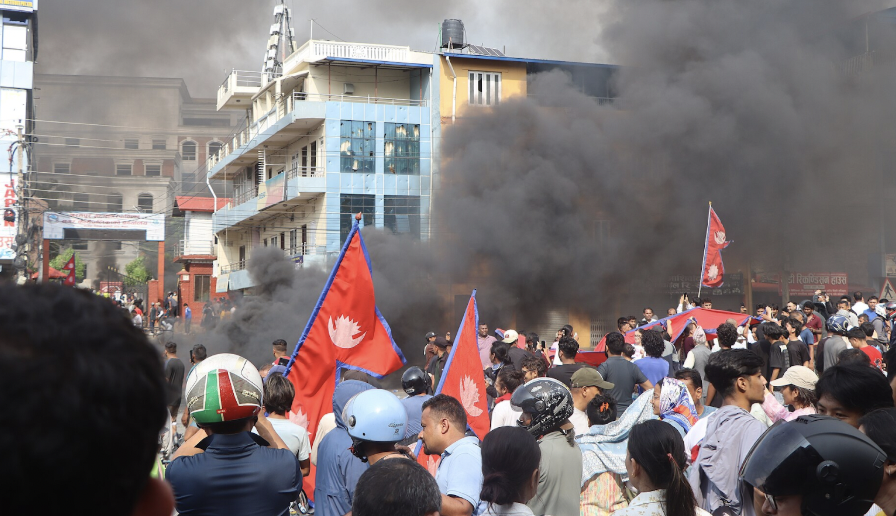
However, the strictly political focus of the Hungarian Revolution that defined its success is also what highlights the limits of Arendt’s conceptual framework in making sense of contemporary upheavals such as the 2025 Nepal Gen Z protests. The protests in Nepal were not against totalitarianism nor about instituting democracy as an entirely new political configuration. Rather, these were spurred by what Arendt would characterize as social issues: economic precarity and the perceived capture of democratic institutions by elites. Moreover, if there were councils or negotiations in Nepal’s case, many of these occurred through social media, fora that fall far from Arendt’s qualifications for directly participatory and deliberative political institutions. If we were to continue along the lines of Arendt’s thought, the dominance of material necessity and the social over the political might just be what explains the dissipation of Nepal’s revolutionary potential—just as what unfolded in France more than two hundred years ago.
At the same time, to exclude the social from the political is at best ahistorical in contemporary conditions, and at worst, depoliticizing politics as a whole. Basing her boundary of the social on an understanding of economic activity as that of the household,10 Arendt overlooks the fact that economic activity—especially from a national perspective—is never self-contained. Power over the most basic conditions of life is truly power, and thus can be contested; material deprivation, while experienced on an individual and personal level, is also an experience that many share—and is thus a basis for solidarity. We also live in a time in which there are more formally democratic countries than existed in Arendt’s time. The problem at hand today is, therefore, ensuring that democratic institutions are truly democratic: that they are based on a pluralist conception of the population, and that they are able to respond to the demands of their citizens. If ‘democracies’ are corrupt, exclusive, and unresponsive, the formal space that exists for the political in Arendt’s understanding is already restricted, leaving the articulation of demands and potential for change to the social. Demands for material security and social justice are also demands for equal citizenship: political demands.
What ‘politics’ means today
Considering the above, does the dismissal of the social imply that Arendt’s framework is entirely invalid in understanding what the realm of politics—the nucleus of revolution—may be today? Not necessarily. Arendt’s ideas are focused on maintaining the core of what it means to engage in politics: acting in concert with others to build a world in common. Arendt tells us how to maintain political vitality and secure our equality as citizens by writing laws and constitutionalizing democracy.
Arendt’s theory of totalitarianism can also help us to understand how liberalism might be deficient, and in turn, how to address these deficiencies. It’s worth reiterating that Arendt explains totalitarianism as a solution to liberalism: modern liberal societies engender political freedom, but also the freedom to retreat into private life, producing social atomization. Totalitarianism ‘solves’ this mass loneliness by offering a sense of belonging, participation, and meaning through a grand ideology that is capable of explaining everything.11 However, while twentieth-century style totalitarianism may seem for some to be looming on the horizon, this is not necessarily what threatens liberal democracy today. With the existence of social media, the possibilities for community are endless, participation is open to virtually anyone with an internet connection, and the ways in which we make sense of the world can be localized in echo chambers of our own creation. The wealth of choices we have at our fingertips can be paralyzing, and atomization can entrench itself in perpetuity without lending itself to totalitarianism.
With the obvious and urgent relevance of the social—and connective—power of social media, the terrain for political contestation is more vast than it has ever been, a condition of twenty-first-century modernity that liberalism’s inherent weaknesses must continue to contend with. Arendt’s theory of revolution, a mechanism for the construction of durable freedom, allows us to focus on the overarching goal of political change, and her ideas on totalitarianism act as a sharp reminder of the dangers of liberalism left neglected. We are undoubtedly in a new age of (social) revolution, but rather than trying to mark the time at which we ‘begin’ to have freedom—a question unsuited to the complexity and urgency of the need for political change—the more important thing to ask is: Who has freedom and how can they nurture it?
Edited by Martín Rojas Remolina
The argument defended in this article is solely that of the author and does not reflect the position of the McGill Journal of Political Science, the Political Science Students’ Association, or the McGill Department of Political Science.
Featured image by हिमाल सुवेदी

- Hannah Arendt, On Revolution (Penguin Books, 2006), 11. ↩︎
- On Revolution, 24. ↩︎
- On Revolution, 19. ↩︎
- The Human Condition (University of Chicago Press, 1958), 177-8. ↩︎
- The Human Condition, 200. ↩︎
- The Origins of Totalitarianism (Harcourt, Brace, and Company, 2004), 599. ↩︎
- On Revolution, 49. ↩︎
- On Revolution, 58, 55; Arendt glaringly overlooks the fact that the most ‘laborious’ people in America at this time were slaves, who were entirely excluded from politics, and were definitely miserable and wanting. ↩︎
- On Revolution, xvii. ↩︎
- viz. the Platonic understanding of economy as οικονομια (household management explains) ↩︎
- On Revolution, xxvii. ↩︎


