 0
0
 0
0
Leadership in parliamentary democracies is often precarious. A Canadian prime minister’s ability to stay in government and complete their policy agenda depends directly on their ability to manage their caucus of usually well over a hundred members of Parliament (MPs)—a task that can present various challenges. MPs often have their own ideologies and community mandates, which can put them at odds with their party, who, if they are in government, need their MPs’ support during confidence votes to stay in power. But, members of Parliament in the Westminster system are intended to be representatives of their communities’ needs within the federal government and while they usually belong to political parties, their official responsibility is only to their constituency, not to their party leader. Because of this conflict, party leaders have various levers to enforce discipline onto their caucus in order to ensure party unity—that all of their members are acting as a bloc and presenting the same message to the public.
Nevertheless, this enforcement of discipline onto the caucus has varied historically, and MPs have been occasionally allowed to break with the party bloc in order to represent the interests of their constituents through public advocacy or through voting across party lines for smaller pieces of legislation. Over the past few decades, however, the increasing media scrutiny on politics and the restructuring of the Privy Council and the Prime Minister’s Office (PMO) have centralized power in the prime minister, restricting the ability of MPs to act autonomously.
During the period from the 1950s, when most Canadians were buying their first TV sets, to the early 2000s and the spread of the internet, the ability of Canadians to access current information about their government increased dramatically. A crucial development in this process was the start of publicly broadcasted parliamentary and committee sessions by the Canadian Broadcasting Corporation and later by the Cable Public Affairs Channel. The broadcasting of parliamentary proceedings, combined with the movement towards entertainment journalism—an evolution forced by market pressure in an attention economy—changed Parliament from a private governing process into a public affairs opportunity. Whereas before, parties would present their platform during a campaign, now—to grab attention from an audience—they needed to present a unified vision of their party in every parliamentary session.
The second development that affected the organization of political power within the party were the consolidations of the Pierre Elliot Trudeau era. During his time in government, Mr. Trudeau grew frustrated with the lack of control the federal government exercised over various departments. To improve the government’s ability to quickly enact policy changes, Mr. Trudeau centralized power in the Privy Council Office, the Finance Department, the Treasury Board, and the PMO. This act of centralization elevated the role of the prime minister to be far greater than the role of Cabinet, whereas before, the prime minister’s decision-making capabilities were more equal with that of a Cabinet minister.
These two changes led to a political process in which appearances increasingly took precedence over policy and party leaders were more dominant than ever before. The confluence of these evolutions marked the beginning of a shift from members of Parliament being able to some extent to act in the interest of their constituents, to them being increasingly instructed to not contradict the party line publicly to maintain the image of the leader’s excellence. It has become increasingly normal in past decades for party whips—the officials responsible for organizing caucus—to enforce stricter protocols around public appearances and to punish MPs through restricting time in Parliament and withholding positions in Cabinet or committees.
Pierre Poilievre’s Conservative Party is known to be abnormally strict when it comes to their MPs’ autonomy. Whereas under the leadership of Erin O’Toole, it was normal for Conservative MPs to chat with reporters in the hallways of the Parliament building and for MPs to have some freedom when it came to collaborating with other parties, all of these practices have now been disallowed. Radio Canada’s Christian Noel reported that many Conservative MPs have described being monitored by party officials, having their public activities, political or otherwise, recorded. Noel also claims that Mr. Poilievre has been punishing MPs if they don’t use his slogans or if they are too friendly with opposing MPs, removing them from committee chair positions and giving them less time to speak in the house.
The severe enforcement of party discipline came to hurt the Conservatives at the beginning of November after Politico reported that Chris d’Entremont, a Conservative MP from Nova Scotia, was considering crossing the floor to join the Liberals. D’Entremont told the CBC that following this reporting, house leader Andrew Scheer and chief whip Chris Warkentin burst into his office, berating him and calling him a “snake.” Mr. Scheer and Mr. Warkentin’s actions—in line with a focus on the importance of unity behind the leader—drove d’Entremont to finalize his decision to join Mark Carney’s Liberals, creating a publicity crisis for the Conservatives. Concerns with the Conservative leadership are also rumoured to be the reason for Conservative MP Matt Jeneroux’s resignation, although he denies that Poilievre’s leadership style had any influence on his decision.
Although the extreme example of discipline within the Conservative caucus may take focus away from the Liberals, it is important to note that the two parties operate similarly. Justin Trudeau emphasized the importance of party unity following his victory in the Liberal leadership race in 2013, and some attribute his delayed resignation from the Liberal leadership to his caucus’ complete deference towards him. Mr. Carney might also feel compelled in the future to rein in his caucus. It is thought that many Liberal members are more ideologically aligned with Mr. Trudeau than Mr. Carney, and as Mr. Carney continues to bring forward Red Tory policy, he will have to make sure everyone is in line.
Canada is a geographically large country, with diverse regional cultures and industries, and two official languages. This context may make the country seem ungovernable, but because of constituent-based representation in parliament, there has historically been some level of synthesis that has allowed the needs of different Canadians to be looked after. While it is understandable that parties want to be elected—and are thus driven to maintain their image publicly—constant projection of party loyalty restricts MPs’ ability to represent the interests of their communities as they see fit. Party leaders on both sides of the aisle need to evaluate whether they are willing to sacrifice the strength of Canadian democracy and the freedom of their MPs just to avoid being sensationalized in the press. As Chris d’Entremont’s departure from the Conservatives has shown, party cohesion doesn’t necessarily imply party uniformity.
Edited by Catriona Hayes Morris
The argument defended in this article is solely that of the author and does not reflect the position of the McGill Journal of Political Science, the Political Science Students’ Association, or the McGill Department of Political Science.
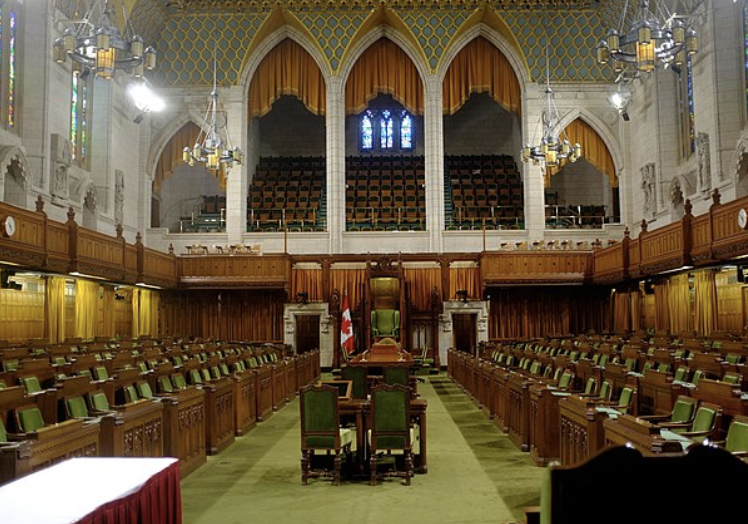
Featured image by Johnathankslim from Wikicommons.


