 4
4
 0
0
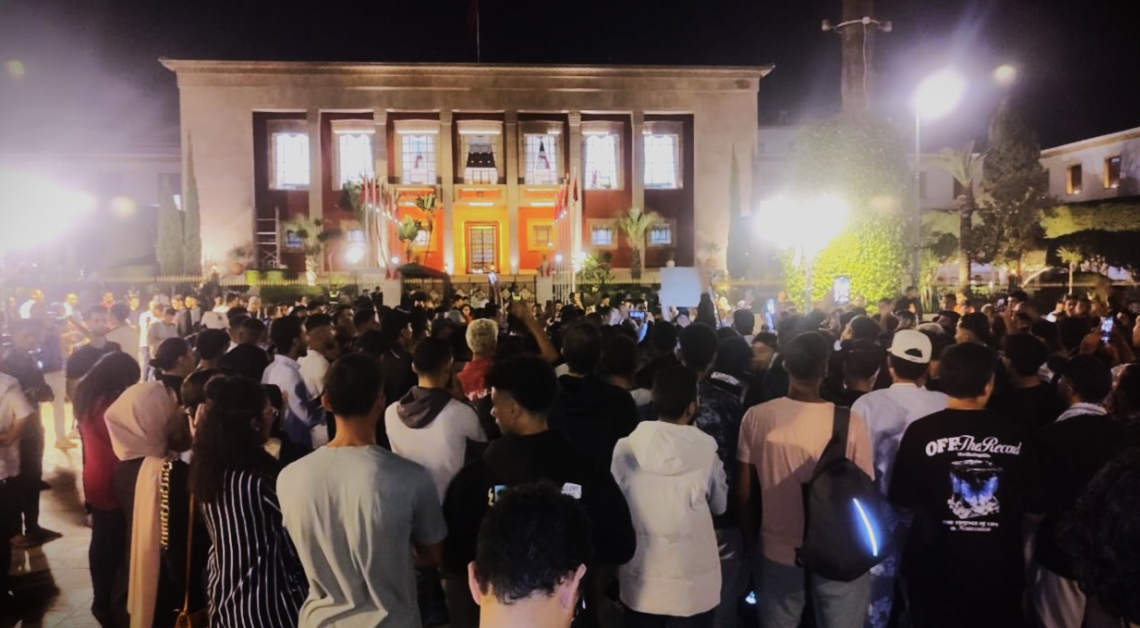
In December 2010, a two-year-long wave of protests in the Middle East and North Africa began, challenging entrenched authoritarian regimes. Today, a similar pattern is reemerging among Morocco’s Gen Z, who are taking to social media and the streets to mobilize against corruption and inequality. Morocco’s recent protests over healthcare and education, sparked by eight maternal deaths resulting from routine C-sections, brought increasing attention to the failures of the country’s public healthcare system.
The Arab Spring marked the beginning of a new era of digital resistance, and its influence endures in the recent global Gen Z-led protests, where young citizens continue to explore what grassroots democracy looks like in the digital age. This endurance is demonstrated through Gen Z’s adaptability to modern social media platforms, leveraging the stereotype of being the “social media-addicted generation” to push for political resistance and mobilization.
The Arab Spring (Substantive Digital Resistance)
The Arab Spring was a period of time from December 2010 until December 2012 known for its high concentration of pro-democracy protests in the Middle East and Africa. The fire was incited when local officials in Tunisia confiscated Mohamed Bouzazi’s fruit cart and proceeded to harass and humiliate him. In protest of the systematic treatment of Tunisian citizens by their government, Bouzazi self-immolated in front of the local governor’s office. This incident drew attention to the broader issues faced by Tunisian citizens as a result of their government, such as unemployment, food inflation, and lack of political freedoms. The ability to garner widespread attention was primarily due to the usage of social media as a tool to mobilize groups across the region.
Multiple people who bore witness to Bouzazi’s act of self-immolation filmed the demonstration and posted the video publicly to Facebook, resulting in a virality that carried a message beyond national borders and resonated with countries such as Tunisia, Egypt, Morocco, and others. The emphasis of the power that social media has regarding mobilization can be seen when comparing the traction gained from Bouzazi’s self-immolation to that of Sidi Bouzid’s, who similarly protested through self-immolation three months prior to Bouzazi yet did not receive widespread attention. The reason behind Bouzid’s self-immolation being generally overlooked compared to Bouzazi’s is protestors’ strategic use of social media to show the world what they as citizens wanted to show, not the narratives that state-controlled media pushed forth. Through the sustained usage of social media to spread information, organize, and mobilize, the Tunisian government became the first country from the Arab Spring demonstrations to undergo a peaceful transition of power between democratically elected governments.
Moroccan citizens also participated in the 2011 Arab Spring, deriving inspiration from neighboring areas and heavily using YouTube and Facebook to their advantage. Groups such as the Moroccan Oppositionist Youth Movement posted videos on YouTube expressing their opinions for others to further share, and Facebook helped activists remain in regular communication, forming groups to facilitate collective actions.
Morocco’s Digital Resistance in 2025
More than a decade after the wave of Arab Spring protests, Morocco’s younger generations are once again taking to social media to oppose current forms of government and vocalize their grievances. In early September 2025, after eight mothers tragically passed away during routine C-sections, the public became outraged at the blatant problems within not just the Moroccan healthcare system but the governing body as a whole. Very quickly, an anonymous public Discord server named “GenZ 212” was formed with the intention of providing a space where young Moroccan citizens can communicate with one another, sharing information and opinions as well as organizing assemblies and demonstrations. In less than two months, the server’s membership increased from 1,000 to 180,000 people.
Their demands include a higher quality public education and healthcare, an end to corruption, and “a more dignified life.” This is fueled by popular disapproval of misallocated funds, such as billions of dirhams being put into new stadiums in preparation for hosting two sports tournaments all the while hospitals and schools continue to struggle.
Social Media’s Persistence as an Organizing Space
During the Arab Spring, Facebook and Youtube enabled activists to share stories and footage that state media suppressed. In Morocco today, that same function has migrated to Discord and TikTok. Discord serves as a coordination hub, resembling the Facebook groups that once connected activists, while TikTok distributes information through short, emotional clips that rapidly reach large audiences.
Human Rights Watch recently viewed a video of Moroccan security officers acting violently towards protestors, shared through these networks. Such footage continues to protect the public from state-controlled narratives and builds solidarity across regions.
The spontaneity and decentralization of social media is what led to its successful usage during the Arab Spring. Not only did this start a new chapter of Arab media and politics, but it started a new chapter globally, with the Western world catching on and even joining the protests (e.g., Occupy Wall Street). This set the stage for how Gen Z has continued to use social media to enable real-time coordination, rapid info sharing, and viral symbols that unify diverse groups globally—done by swapping the previously used platforms of Facebook and Youtube for Discord and TikTok.
The Enduring Digital Uprising
The Arab Spring demonstrated that digital tools could be instrumental to pursuing grassroots democracy. More than a decade later, Morocco’s Gen Z is proving that this model not only persists but evolves alongside technology. What began as “Facebook Revolutions” has matured into a more adaptable, decentralized, and multi-platform digital resistance with a new generation at its core.
While the Moroccan youth movement may not have yet fundamentally reshaped the regime, it has reclaimed the agency to narrate its own struggles and break the barrier of state-controlled media. In doing so, it has reignited a virtual flame sparked nearly fifteen years ago with only time to show how brightly it will continue to burn.
Edited by Nuala O’ Connell
The argument defended in this article is solely that of the author and does not reflect the position of the McGill Journal of Political Science, the Political Science Students’ Association, or the McGill Department of Political Science.
Featured image by Mounir Neddi on Wikimedia Commons


