 5
5
 0
0
In the aftermath of authoritarian rule the execution of transitional justice risks becoming an instrumentalized spectacle rather than a tool for reconstruction–simultaneously challenging the state and international community to ensure brutality does not go unpunished.1 This is the dilemma–distetangling symbolic from transformative justice–with which one should approach the Syrian political context as they navigate an ongoing regime change following the collapse of Ba’ath party authoritarian domination.
Syria was emancipated from its former regime when its dictator, Bashar al-Assad, was ousted in December, 2024 – and fled to Russia for refuge. The former head of state orchestrated mass killings of civilians, imprisoned thousands without due process, engaged in bombing campaigns using chemical munitions, and committed various other atrocities during the Syrian civil war. Over 100,000 people remain missing in the wake of the conflict. The international community–the United States and European Union in specific responded with sanctions oustingSyria from the Arab League. For over a decade, Assad had been a pariah of the international community due to the sheer brutality of his crimes. The human rights transgressions for which he was responsible became the widely publicized reason for his isolation and disgrace. Following his rulership, the question of justice is heavy among the Syrian populace – does institutionalized brutality conclude once the dictator has fled?? Will the violence be cyclical until the establishment of a pluralistic democracy?
Bashar al-Assad was usurped by Ahmed al-Sharaa, former head of the militant Islamist group –and al-Qaeda splinter faction– Hay’at Tahrir al Sham (HTS). While the new head of state dissolved HTS shortly after consolidating power in the Syrian government, HTS had maintained de facto sovereignty over the Syrian governorate of Idlib during the last decade of the civil war. During that time, HTS committed human rights transgressions which included honour killings2 and the public executions of civilians. Yet, for the past year, he has positioned Syria to reenter the global liberal order and publicized his goals for democratization and restorative justice in the direct aftermath of the former dictatorship and civil war.
The new Syrian administration has brought great attention to their endeavours as they aim to prosecute remaining members of the former government. However, the manner in which Al-Sharaa’s government –consisting of hand-picked loyalists– has been consolidating power is a troubling sign of reemerging authoritarianism. Grand displays of condemnation for the oppressive Assad regime thus ring hollow in the wake of resurgent authoritarian approaches to governance. The tension between the need for established democratic freedom and a vulnerable populace –that can therefore be strategically divided3 – is intensifying.
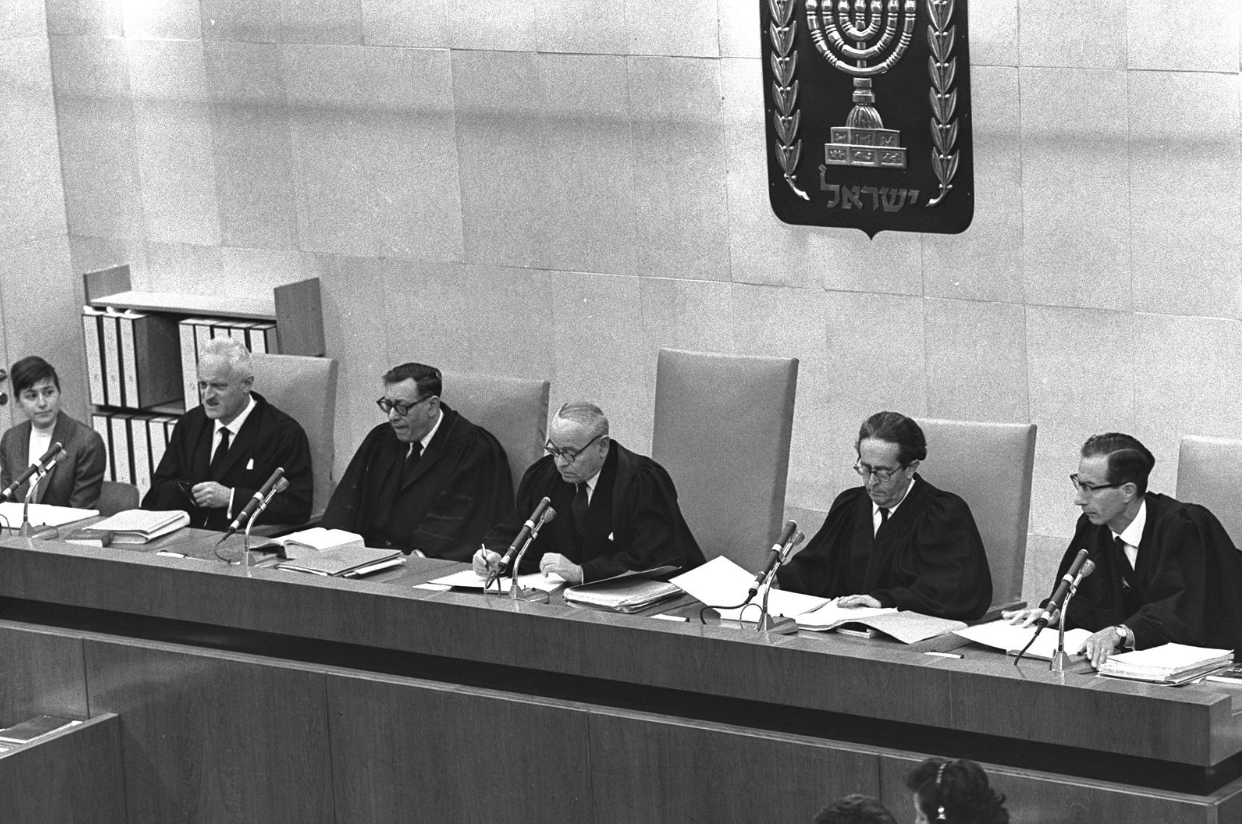
Opportunities for restorative justice in the wake of crimes against humanity have been manipulated to become more preformative than substantial, and there is no better precedent of this phenomenon than the one Hannah Arendt chronicles in Eichmann in Jerusalem. Arendt documents her observations of the trial of Adolf Eichmann, a former Nazi official, in the aftermath of the Holocaust. Her criticism focuses on what she refers to as a “show trial”4, depicting the actions led by the then-budding state of Israel, presided by Ben-Gurion. Her analysis illustrates Ben-Gurion’s use of Eichmann’s trial as a spectacle seeking to promote a specific ideology – a Zionist ideal of Jewish statehood that could never be undermined and harmed again. In doing so, the essential understanding of prosecuting a Nazi for transgressing human rights, became a publicized prosecution for the harm of specifically Jewish rights.5 In Arendt’s view, this presents a grim detraction, from a state striving for democratization and the protection of human rights, to a foundation that would prioritize ethnonationalism over democratic values.
Decades later, Israel is now indeed an ethnostate that does not put into practice equal freedoms for its citizens. Its Nation-State Law of 2018 officially codified a hierarchy of civil rights between Jewish and non-Jewish citizens, designating Jews as the sole demographic with the right to national self-determination in Israel. This law is only one instance of decades of intentional displacement of Palestinians and increasingly restrictive legislation of Palestinian life in the militarily Occupied West Bank. These are the consequences Arendt cautioned against; that evil governance does not end with publicly vanquishing an individual figure, especially in a trial utilized for a particular political message.
Arendt’s warnings should be necessarily heeded in the Syrian case. Utilizing justice as theatre without addressing the roots of injustice absolves political actors from the more burdensome work of dismantling the authoritarian machinery that stripped victims of humanity, and instead can lay the foundations for new authoritarian leadership. In Syria, the intentional focus on the Assad regime as a time of bygone oppression obscures the rising probability of an oppressive system to repeat the same cycle, only with a new face at its head. Confronted with victims awaiting justice, new Syrian political actors capitalize on the formers’ vulnerability to create the sense that the evil of war crimes and oppressive governance can be eradicated simply through the virtue of a widely publicized condemnation. This conditions the masses to look for evil not in Arendt’s sense of banality– the everyday systems that upheld cruelty– but nominally in the members and proponents of the former regime, as though it cannot be repeated again.
Edited by Tristan Hernandez & Margaux Zani
The argument defended in this article is solely that of the author and does not reflect the position of the McGill Journal of Political Science, the Political Science Students’ Association, or the McGill Department of Political Science.
Featured image by the National Photo Collection of Israel
_-_The_appeal_of_Nazi_war_criminal_Adolf_Eichmann.jpg)
- Leebaw, Bronwyn Anne. “The Irreconcilable Goals of Transitional Justice.” Human Rights Quarterly 30, no. 1 (2008): 95-118. https://dx.doi.org/10.1353/hrq.2008.0014. ↩︎
- Historically, political leaders have instrumentalized the cleavages in sectarian identity in Syria to design hierarchies that benefit their rulership: Stamoglou, Anastasia. (2025). “The Sectarian Populist Playbook: Populism in Iraq, Syria, and Kurdish Regions.” European Center for Populism Studies (ECPS). May 29, 2025. https://doi.org/10.55271/rp0099 ↩︎
- Hannah Arendt, Eichmann in Jerusalem: A Report on the Banality of Evil (New York: Penguin Publishing Group, 2006), 6. ↩︎
- To clarify, Ben-Gurion’s focus on the trial as a transgression of Jewish rights was a strategic decision made to correlate Jewish safety and protection of rights with the state of Israel and Israeli national identity: Ruth Bettina Birn, Fifty Years after: A Critical Look at the Eichmann Trial, 44 Case W. Res. J. Int’l L. 443 (2011) Available at: https://scholarlycommons.law.case.edu/jil/vol44/iss1/21 ↩︎
- Beginning with the mass dispossession and massacre of Palestinians in 1948, Israeli forces have continued a pattern of political repression- whether by force or codified into law:
Nadera Shalhoub-Kevorkian. “Necropolitical Debris: The Dichotomy of Life and Death.” State Crime Journal 4, no. 1 (2015): 34–51. https://doi.org/10.13169/statecrime.4.1.0034.
“Apartheid, Israeli Style.” Journal of Palestine Studies 11/12 (1982): 270–73. https://doi.org/10.2307/2538374.
Penny Green, and Amelia Smith. “Evicting Palestine.” State Crime Journal 5, no. 1 (2016): 81–108. https://doi.org/10.13169/statecrime.5.1.0081.
Said, Edward W. The politics of dispossession: The struggle for Palestinian self-determination, 1969-1994. Vintage, 2012.
Finkelstein, Norman G. Image and reality of the Israel-Palestine conflict. Verso, 2003.
Tilley, Virginia. Beyond occupation: apartheid, colonialism and international law in the occupied Palestinian territories. Pluto Press, London, 2012.To clarify, Ben-Gurion’s focus on the trial as a transgression of Jewish rights was a strategic decision made to correlate Jewish safety and protection of rights with the state of Israel and Israeli national identity: Ruth Bettina Birn, Fifty Years after: A Critical Look at the Eichmann Trial, 44 Case W. Res. J. Int’l L. 443 (2011) Available at: https://scholarlycommons.law.case.edu/jil/vol44/iss1/21 ↩︎


