 0
0
 0
0
On January 7 2026, Americans across the country had digital front-row seats to the fatal shooting of Minneapolis resident Renée Good by ICE officer Johnathan Ross. Neighbors captured several angles of the scene, documenting the interaction between the ICE officers on site, Good and her wife, and the movements of their car directly before Ross fired three shots into her driver-side window. As the footage spread across social media, digital citizens—or “netizens”—moved quickly to examine the videos, offer commentary, and take sides on the perceived legitimacy or illegitimacy of the actions on display. Following two other heavily publicized shootings in Oregon and the infamous assassination of Charlie Kirk, it appears worthwhile to ask why netizens feel compelled to watch these instances of politicized violence, and how this consumption affects political realities outside the screen.
Michel Foucault’s concept of biopolitics offers one way to make sense of this dynamic. Biopolitics can be loosely defined as the politics of bodily control over health, productivity, and human relations as enacted by the state or other such governing bodies.1 Digital landscapes can act as devices of social ordering; the American public is subject to mandatory, captured discourses that empower and justify the government’s policy choices. By engaging in the drip-feeding of ‘this-just-in’ content regarding Good’s death, netizens are made productive by the state and habituated to standards of behaviour turned toward political outcomes.
Instances such as Good’s death, analysed from a biopolitical perspective, reveal the American government’s willingness to exploit digital infrastructures that force netizens to engage in a narrow set of conversations and actions that ossifies governmental authorship of ‘correctly performed’ citizenship.
The First Footage and Neoliberal Democratic Participation
Foucault’s reasoning is steeped in a deep appreciation for economic ordering, upon which social control hinges. Foucault sees individual identity as inextricable from the labour the human body produces. Man and his productive capacity can never be separated from one another. Defined as Homo œconomicus, every citizen is an entrepreneurial “partner of exchange” seeking to generate capital through their relations to other Homo œconomicus and the institutions they share.2 Modern neoliberal societies, Foucault recognizes, are structured to exploit the individual entrepreneur as a site of human capital, the sum of one’s skills and social positions, which can be used by the state to maintain control of the body politic. By enticing the Homo œconomicus to behave in a given way, the state enforces predictable and manipulable “transactional realitie[s]” that contribute to regime stability.3
Just as “Liberalism in America is a whole way of being and thinking,” economic liberalism is adapted as a mode of digital ordering.4 Embedded in capitalist logics of accumulation, social media sites like X and Instagram rely on algorithmic feeds that capture and retain the attention of their users in order to remain profitable.5 Seeing the initial footage of Good’s shooting, netizens are ripped out of the contexts of their material lives and compelled to respond—be it watching the video, commenting on the post, sharing it, or even clicking ‘not interested in this content.’ One cannot not have an opinion, as digital commentary has become an increasingly accessible way through which Americans experience democracy. Digital democracy in modern America is predicated on patterns of creation and consumption of a shared political culture. To act in this scenario, even if the act is as simple as acknowledging the existence of a phenomenon, is to try and digitally resurrect the participation-based political activism for which democracies are known.
Biopolitical ordering informs this shared culture through the three-way conversation between the state, the platforms –governing the terms of social reaction– and netizens themselves. These platforms legislate the means of communication, grab attention, and profit as netizens claim the veneer of democratic action. Each actor has been instrumentalized by the state’s intimate understanding of consumption, constructing moments of importance and the direction of user action. This is similar to how Foucault envisions the relationship between mother and child.6 The mother, putting the time and effort into raising their child, wishes for their success and reaps the boons of their accomplishments. The government, surrogate for the mother, interacts and influences the public in order to shape the character of their human capital. By highlighting the information ecosystem surrounding Good’s death in official correspondence, the American government legislates that a ‘good’ netizen is one who performs the labor of consuming the content set before them. If that labor can be rationalized as democratic, the netizen is simply a better ‘product’ for the state to employ. Whether a netizen is looking for news, entertainment, or relaxation in online space, they unwittingly consign themselves to disguised productive work in a system too big to see.
Additional Footage and Cyclical Debate
Good’s shooting did not simply happen once, but is digitally reproduced through every performance of consumption and piece of information that comes to light. Several days after her death, phone footage from the perspective of Officer Ross was released by conservative reporting outlet Alpha News. The recording has been used by Vice President JD Vance to defend the officer’s decision to shoot, and by DHS Secretary Kristi Noem to depict Good’s driving of her car as an “act of domestic terrorism.” While the provenance of the recording conveys inherent politicization, the manner of its delivery remains its most crucial feature. The internet is notoriously poor at sustaining a shared informational baseline: each notification, repost, or clip reaches audiences at varied moments. As a result, netizens participate in shared online discussion while operating with radically different understandings of the events at stake. What’s more, the introduction of ‘new’ variables brings the twofold possibility of individual doubt or confirmation bias into the equation. Here, digital democracy-as-consumption lacks an end goal in mind. Perpetually asymmetrical debate is the point, deemed the most suitable way to labour in relation to the events of the day. This way, the state’s biopolitical ordering in digital space disinhibits the actual practice of democratic debate and habituates the homo œconomicus to truncated and captured resistances, where it is much easier to fall in line as an ardent supporter of the regime.
Foucault remarks on this ease of complicity in the punitive nature of biopolitics. The designation of reward and punishment for when citizens push the bounds of their action is a key factor in shaping order. From the drip-feeding of content, constant debate regarding the subject material, and some of the nation’s most powerful people saying that Good is a terrorist—that the officer is justified—it becomes easier to accept. It is normalized within the American political ecosystem. One, as a netizen, does not individually have to believe it to be true; it is enough to tacitly engage with the biopolitical order of those who do. Foucault notes that such public edicts define what actions are considered permissible or illegal, even if only by implication. If one, by breaking these norms, becomes homo criminalus, they risk losing accumulated social capital.7 Netizens are reminded to ask themselves who they are outside the paradigm of the state. The choice is personal: feed into cyclical, endless and slanted debates, or opt out and lose the singular kind of leverage the state will recognize?
Can There Be Bidirectionality in Biopolitics?
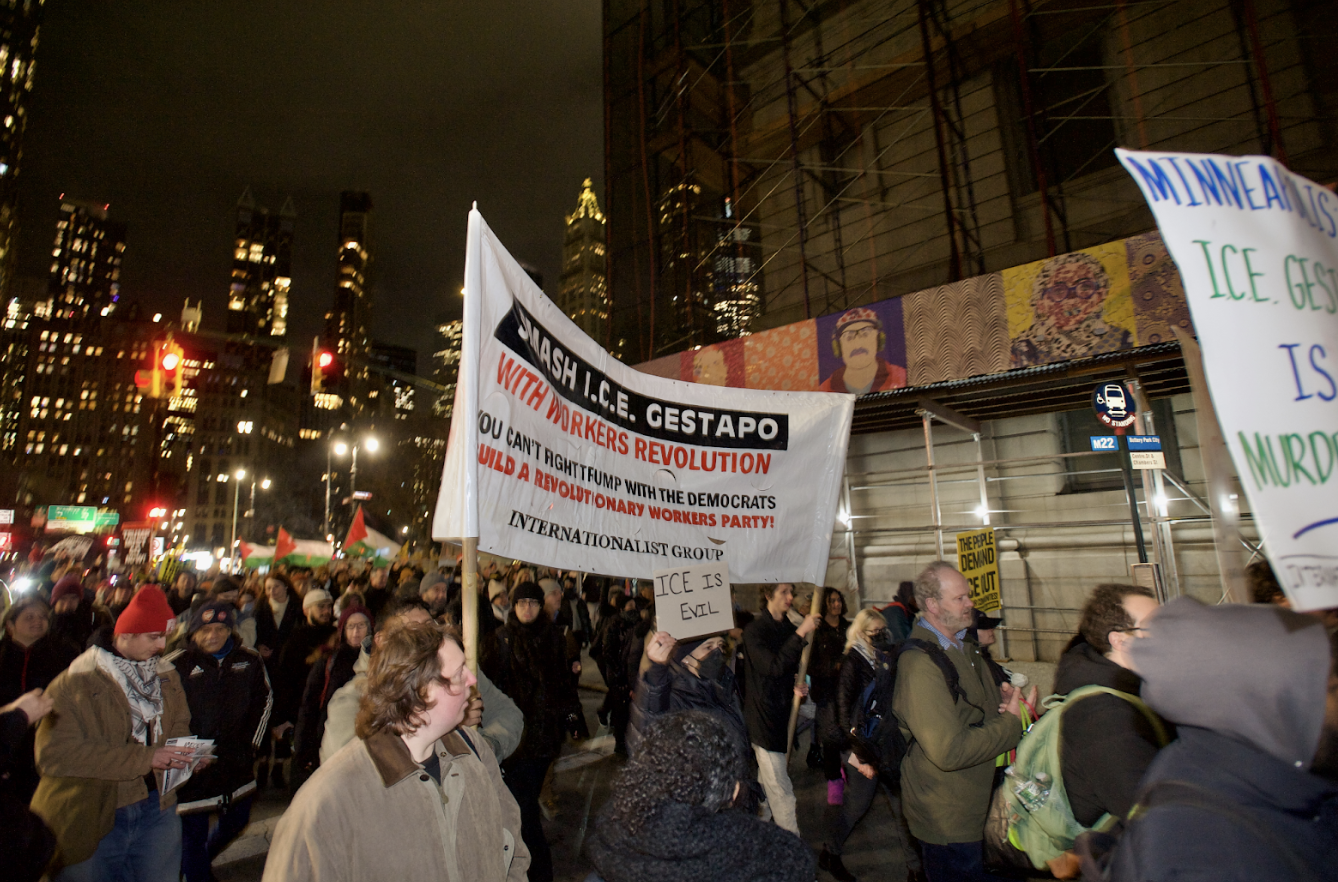
Recognizing how thoroughly digital discourse is captured by neoliberal logics can easily give way to a sense of political hopelessness. Are netizens doomed to do the dirty work of an increasingly unstable government, having their sentiments directed by a power outside their control? Foucault’s insights suggest that this outlook neglects that the market-understanding of social space applies to governance itself. Just as the government attempts to organize the public, the public must confirm their success in governance. After all, Good’s death has spiked a new round of anti-ICE protests around the nation—and such political outbursts unconstrained by digital limits have true potential to force the government to pay attention to their grievances. In fact, six prosecutors have recently abandoned their posts, refusing to investigate Good’s wife as legal proceedings continue.
In these times it is worth remembering that control remains a discourse in and of itself. Imagining the digital realm as selectively separate from the physical is a mistake. Foucault’s conception of biopolitics, though it may explain patterns of social ordering, provides an opportunity for the public to correct the national course on the issues they deem important. Netizens must more consciously inhabit digital environments and be willing to assert ownership of such spaces. Without them, the biopolitical order cannot be sustained, and what is more powerful than collective contestation?
Edited by Martin Rojas Remolina
The argument defended in this article is solely that of the author and does not reflect the position of the McGill Journal of Political Science, the Political Science Students’ Association, or the Political Science Department.
Featured image by SWinxy
- Foucault, Michel, Michel Senellart, Graham Burchell, and Collège de France. 2008. The Birth of Biopolitics: Lectures at the Collège de France, 1978-79. Basingstoke [England]: Palgrave Macmillan. 241-42. ↩︎
- Foucault, The Birth of Biopolitics: Lectures at the Collège de France, 1978-79. 225-226. ↩︎
- Foucault, The Birth of Biopolitics, 296. ↩︎
- Foucault, The Birth of Biopolitics, 218. ↩︎
- Fuchs, Christian. 2021. “The digital commons and the digital public sphere: How to advance digital democracy today.” Westminster Papers in Communication and Culture. 16(1). 12. ↩︎
- Foucault, The Birth of Biopolitics, 243. ↩︎
- Foucault, The Birth of Biopolitics, 254. ↩︎