 0
0
 1
1
On April 15th, 2023, in Sudan’s capital of Khartoum, violent conflict broke out between the Sudanese Armed Forces (SAF) and the paramilitary Rapid Support Forces (RSF), culminating in what the United Nations has described as the “world’s worst humanitarian crisis.” More than two years have passed since the conflict began, and the fighting shows no sign of abating. The situation has worsened considerably, as the UN Human Rights Office has reported a significant rise in the number of civilian killings with cities that have been surrounded and starved by the RAF now facing famine.
Who is financing the fight?
The Sudanese conflict may appear to be strictly internal – yet it is very much fueled by external states, who have been backing either the SAF or RSF in exchange for Sudan’s abundant natural resources, primarily its gold and gum arabic (a key industrial food ingredient), as well as its access to the Red Sea.
The RSF’s recent build-up of a heavier arsenal, with its acquisition of drones, guided missiles, and air defence systems, has been enabled by sustained military support from the UAE. The Emirates have not only been providing weapons, security technologies and financial support to the RSF, but have also built diplomatic ties in central and east Africa to expand support for the Sudanese paramilitary.
On the other hand, Egypt has been backing the SAF. Its support is grounded in years of military cooperation between these governments. According to the Institute for the Study of War, it is probable that Egypt has sent fighter jets and Turkish drones to the Sudanese military. With their shared access to the Nile River and Red Sea shipping lanes, Egypt’s support is aligned with its key strategic interests.
However, neither the UAE or Egypt has admitted their involvement in Sudan’s civil war. Despite the expansion of the RSF’s arsenal coinciding with regular cargo flights departing from the UAE, Abu Dhabi strongly denies any involvement. Further, Egypt refutes claims that it is providing arms to the SAF, with Egyptian Foreign Minister Badr Adbelatty even claiming that there is “no military solution” in Sudan, despite records of arms transfers.
A humanitarian crisis: famine and systemic violence
Despite Mr. Adbelatty’s statement, there is no denying that foreign influence fuels the conflict – which has escalated into the world’s gravest humanitarian. Famine has been declared in multiple cities, and the UN reports that 24.6 million people are now facing acute food insecurity while 19 million people lack access to safe water and sanitation. This crisis has been exacerbated as both the SAF and RSF have been targeting health facilities, markets, energy infrastructure, water sources and humanitarian convoys.
On October 26th, 2025, the city of El Fasher was captured by the RSF. An estimate of a quarter of a million people have been killed. A UN Human Rights report also points to patterns of conflict-related sexual violence. The aftermath of the El Fasher massacres have been visible from space, as satellite imagery depicts streets covered with bodies and stained with lakes of blood – irrefutable evidence of how vast the scale of violence is.
With the circulation of graphic videos depicting RSF soldiers killing unarmed captives and laughing as they film the bodies laying around them, the UN and the International Criminal Court have issued grave warnings about severe violations of international human rights law. The UN Special Adviser on genocide prevention has “rung the alarm,” signalling that the atrocities have moved beyond the critical threshold of human rights violations. The Sudan Doctors Network has also described the situation as “true genocide,” and U.S. senator Van Hollen has pointed a finger at the UAE, accusing it of “aiding and abetting genocide.”
Why won’t the international community condemn foreign backers?
Although accusations of genocide have been raised following the El-Fasher massacre, the international community has yet to formally condemn the UAE and Egypt for fueling the civil war in Sudan.
Despite the UAE violating the European embargo on Sudan by delivering French and British-made weapons, the EU has turned a blind eye. What’s more, the US, UK, and other western powers have been conspicuously silent about external interference. Although the U.S. Secretary of State Marco Rubio has asserted that Washington is aware of who is arming the UAE, claiming that they “must stop immediately”, the UAE remains an important U.S. ally.
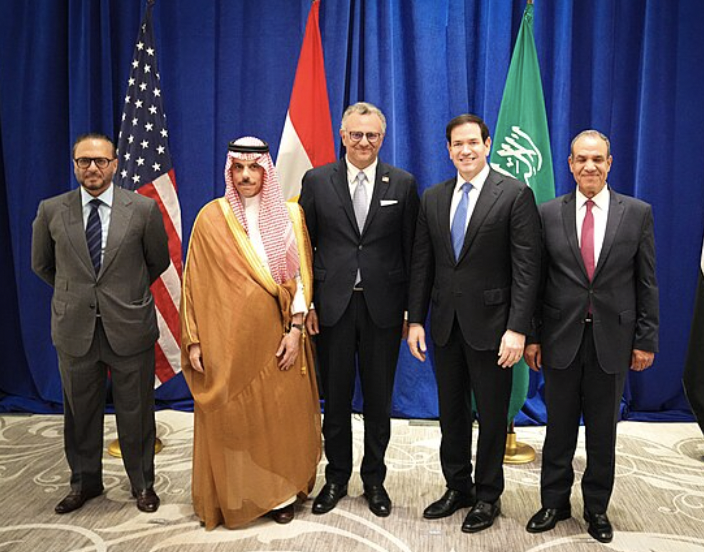
In September, the U.S. brought together the UAE, Egypt and Saudi Arabia, the latter of whom diplomatically supports the SAF, to work towards ending the war. However, these negotiations amount to little more than performative diplomacy: their peace plan calling for a three-month humanitarian truce and nine-month political process, although agreed to by the RSF and (partially) by the SAF, has in no way been effective. Such a reunion would have been the perfect opportunity for the U.S. to hold the UAE for its aid to the RSF – yet when asked if Washington was pressuring the UAE to stop supporting the RSF, the Trump administration’s point person did not answer – showing the U.S. is no longer leading, but reacting.
The UAE’s involvement in Sudan has been much more mediatized than Egypt’s, mainly because of the scale of the RSF’s increasing arsenal and the mass crimes against humanity this has enabled the militia to commit. But if the international community fails to actually condemn the UAE, then won’t Egypt only be encouraged to continue fueling the conflict through its support of the SAF?
Real influence over Sudan’s diplomatic track therefore no longer lies with the West, nor with the RSF and SAF – but with the regional powers. Instead of engaging in performative diplomacy, the international community needs to start actually showing Egypt and the UAE that their destabilizing intervention will come at a high cost, by imposing sanctions, suspension of economic military aid, and reputational costs.
Edited by Patrick Armstrong
The opinions expressed in this article are solely those of the author and they do not reflect the position of the McGill Journal of Political Science or the Political Science Students’ Association.
Featured image by U.S Department of State, public domain.


