 8
8
 0
0
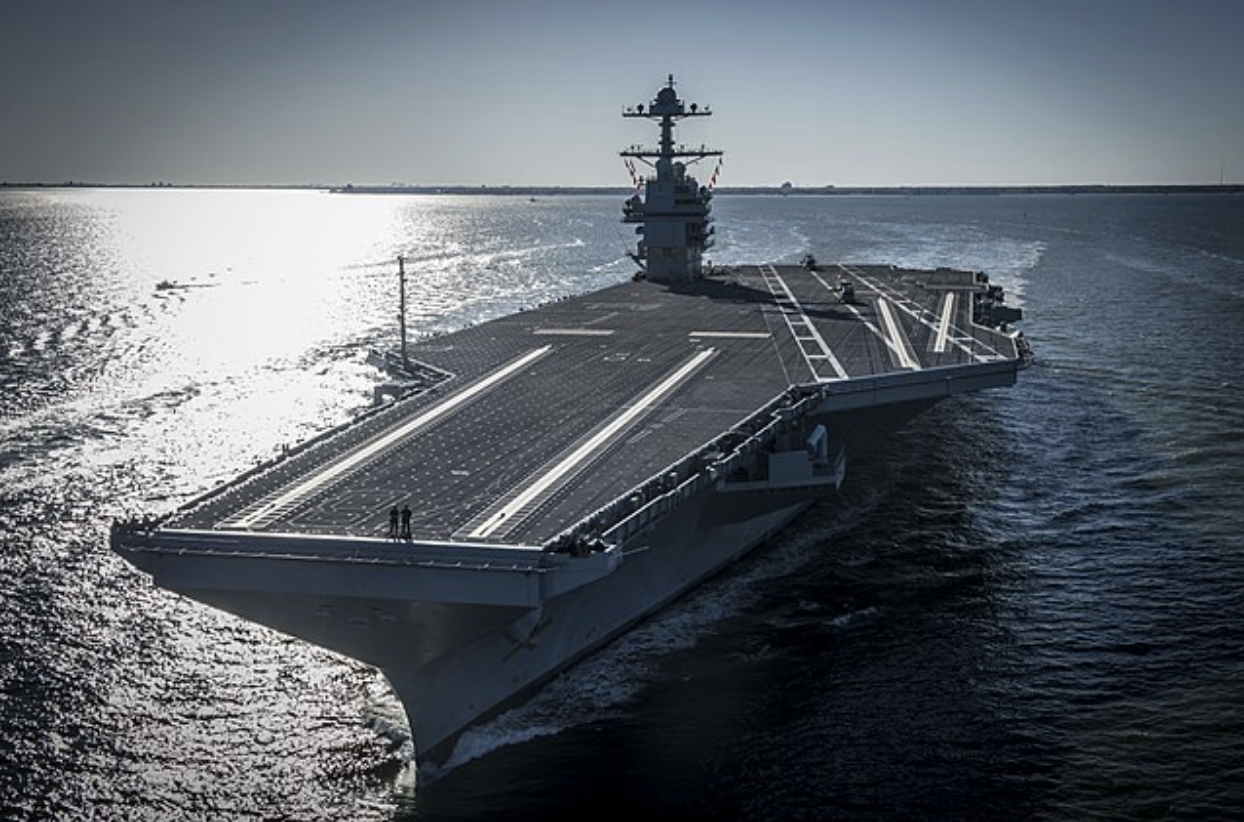
On Friday, October 24, the Pentagon announced the deployment of the USS Gerald R. Ford, one of the United States’ premier aircraft carriers, to the Caribbean Sea. This decision followed a recent uptick in Donald Trump’s battle against drug traffickers and cartels, with the U.S. conducting a series of airstrikes on boats in the Caribbean and pledging to expand operations onto Latin American soil. Venezuela has taken the brunt of this increased pressure, with President Trump accusing Venezuelan President Nicolas Maduro of being a “drug lord” and authorizing the deployment of covert forces into the nation. Following the ordering of the USS Gerald Ford to Venezuela’s coast, President Maduro has accused the U.S. of “fabricating a new war”, and questions have sprouted regarding President Trump’s motives for singling out Venezuela. Are Washington’s measures truly in the interest of defending American security interests, or are they tools for a potential targeted regime change, bringing Latin America closer to the American international order?
Consequences of a Tumultuous History
American-Venezuelan diplomacy has long been marred by sour sentiments emerging from both parties. Despite the death of longtime leader Hugo Chavez and the ascension of Nicolas Maduro to the presidency in 2013, relations between the U.S. and Venezuela have remained consistently poor due to alleged human rights violations and drug trafficking, with the Obama administration sanctioning the Venezuelan government as early as 2015. President Maduro responded with repeated claims of U.S. sanctions being designed to topple his government over the following years, even severing all diplomatic ties in 2019 following American recognition of an opposition leader. Since 2019, the U.S. has refused to recognize President Maduro as Venezuela’s legitimate leader, dismissing the recent elections in 2024 as neither free nor fair. President Trump has also accused President Maduro of being the leader of a drug-trafficking organization, with a $50 million bounty for information leading to his arrest. The historic tensions between Washington and Caracas have provided a backdrop for suspicions of the Trump administration’s intentions in military mobilization, especially given the relatively minor role Venezuela plays in the Latin American drug trade.
Uncertainty From Many Fronts
Even within Washington, discussions about the legality of the U.S. actions, particularly the strikes, have swept Congress. Recently, Democrats forced a vote to halt the strikes until congressional approval could be obtained, which was ultimately blocked by the opposing Republican majority. However, two Republicans voted in favor of the measure, potentially signaling the development of bipartisan doubts on the matter. Additionally, other Latin American countries, which have traditionally been proponents of U.S. drug policy, have critiqued President Trump’s actions, with the Mexican and Colombian administrations believing the American strategy to be “breaking the norms of international law.”
Much of the concern directed towards the U.S. – whether internally or internationally – has been centered around its claims of “narco-terrorism” to justify its campaigns. The term “narco-terrorist” has sparked widespread debate within studies of terrorism, as many perceive its use as a tool allowing governments to be more aggressive towards criminal organizations. While terrorism is generally defined as utilizing violence on a publicized scale to achieve certain political goals, profit-driven drug cartels are not necessarily always looking to gain political leverage. Furthermore, while the right to retaliation against an armed attack by other states is clear in international law, the legality of using self-defense against non-state actors is more ambiguous, with no clear definition in the U.N. charter. The frameworks for self-defense in international law were traditionally defined to allow states to protect and deter attacks on their territories, leaving self-defense against non-state actors, who often lack territorial control within the defending state, contextually dependent. The International Court of Justice has also defined armed attacks as “the most grave forms of the use of force”, distinguishing them from other smaller-scale uses of force, establishing a threshold that needs to be crossed for states to be able to act in self-defense. In their strikes against suspected smuggling boats, the Trump administration has referred to the individuals on the boats as combatants in “narco-terrorist” organizations perpetrating an “armed attack against the U.S.”. However, due to vague evidence that a grave use of force had been perpetrated, many officials have expressed this to be far-fetched.
A Hegemonic Norm-Breaker?
The recent American actions towards Venezuela and in the Caribbean as a whole have called into question the importance of international norms to the Trump administration. According to the Geneva Conventions– which regulate state behaviour in armed conflict – combatants are targeted on a status1 basis, while civilians participating in hostilities can also be subject to legitimate uses of force. However, the lines become blurred in the Trump administration’s strikes on Venezuelan ships, and President Trump’s claims that President Maduro is heading an organized crime group called Tren de Aragua, despite the current lack of substantial evidence provided by the President to corroborate this claim. If evidence demonstrates President Maduro as head of the group, the latter could be deemed a state actor, invoking the U.S.’s authority to act in self-defense if an armed attack occurs. However, without this proof, the individual smugglers on the struck ships would continue to be treated as non-state actors, complicating the legality of American action in the eyes of international justice. Furthermore, the U.S. has implemented additional measures for the protection of civilians in armed conflict through the Department of Defense’s Civilian Harm Mitigation and Response Action Plan, a plan that links operational success to minimizing civilian harm through risk assessment and military response. These measures put additional constraints on Washington’s range of options, even if evidence of an armed attack is procured.
Ulterior Motives – Regime Change?
In addition, the striking of Venezuelan boats may reflect ulterior motives behind the guise of a war on drugs. The majority of narcotics smuggled into the U.S. comes through the southern border with Mexico, with Venezuela’s role in the trade being negligible comparatively. Combined with reports of struck boats not even heading to the U.S., with one shockingly turning back to Venezuela before being hit, it seems highly unlikely that Washington’s sole purpose for the strikes is to crack down on maritime narcotics trafficking. Some have theorized that the true motives behind the strikes were to instill fear into the Venezuelan leadership and military, in hopes of an eventual ousting of President Maduro. The $50 million bounty on President Maduro, set by the U.S., adds credibility to the theory that President Trump’s claims could have been fabricated to mask his intentions of instigating regime change in Venezuela.
Regardless of the U.S.’s true intentions behind increasing its presence in Venezuela and the Caribbean, its direct military actions must be held accountable, both domestically and internationally. Until concrete evidence shows that the boats’ passengers are active armed militants, Washington’s actions will be regarded as a violation of international law. Moving forward, the pressure is on Congressional members to alter their decision and create a bipartisan movement to provide checks and balances to President Trump’s actions – and on international organizations to monitor any future American non-compliance. Until these parties take action, the White House is likely to continue its faintly rationalized operations around Latin America, catalyzing further tensions and increasing civilian casualties.
Edited by Matteo de Campos Mello Grijns
The argument defended in this article is solely that of the author and does not reflect the position of the McGill Journal of Political Science, the Political Science Students’ Association, or the McGill Department of Political Science.
Featured image by wikicommons
_underway_on_8_April_2017.JPG)
- All members of the armed forces of a party to the conflict are combatants, except medical and religious personnel. Geneva Convention Relative to the Protection of Civilian Persons in Time of War (1949) 75 UNTS 287, article 3. ↩︎


