 2
2
 0
0
Nicolas Maduro, president of Venezuela since 2013, was extracted by the U.S. on January 3rd in Caracas. Maduro’s kidnapping has been deemed unlawful by experts; United Nations special rapporteur Margaret Satterthwaite said that “one state cannot enforce its law on the territory of another state unless that state gives its consent.” Despite this, he is currently awaiting trial in New York, charged with cocaine-trafficking and partnership with cartels designated as terrorist groups.
In his place, his vice-president Delcy Rodriguez has been left to govern Venezuela. Yet if Maduro’s authoritarian regime remains intact, then what, if anything, has changed for Venezuelans?
Delcy Rodriguez on a tightrope:
Although this wasn’t the first time the U.S. government intervened in a foreign regime with direct military action, this case is unprecedented: the U.S. does not appear to seek regime change, allowing Vice President Delcy Rodriguez to govern as interim president. This means that Maduro authoritarian Chavista regime – the left-wing nationalist ideology rooted in Hugo Chavez’s rule – is likely to remain intact, and so will the repression against Venezuelans.
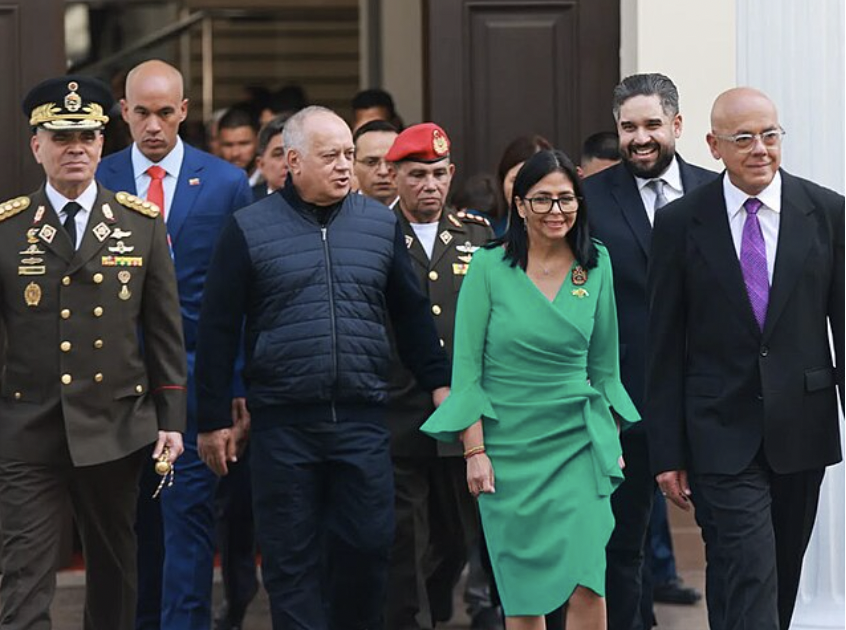
Washington seems to favor Mrs. Rodriguez’s governance, rather than a change in regime: they deem it more advantageous to keep her in power, along with Minister of Justice Diosdado Cabello and Minister of Defense Vladimir Padrino, because they are loyal to the Chavista regime and control the military and police forces – therefore ensuring stability.
Washington’s choice to leave Delcy Rodriguez in power has, however, created an unstable situation, as she now faces a dilemma: Washington has threatened to cut off Caribbean oil exports if she does not comply with U.S. demands to expand the role of American oil companies in extracting Venezuelan resources. On the other hand, Mrs. Rodriguez’s government is allied with Russia, China and Iran, and positioned the nation as an important transit country for Colombian cocaine; if she complies with U.S. demands, she risks being portrayed as a traitor by her allies.
Indeed, Rodriguez seems to have tried to establish warm relations with President Trump, who claimed after a long phone conversation with her that she was ‘acting like an ally.’ But her compliance with the U.S. has led certain chavistas to accuse Rodriguez of having sold out Maduro and of betraying the revolution.
For instance, it is unclear whether Diosdado Cabello will tolerate Mrs. Rodriguez’s deal-making with the U.S, as he has expressed his anger at Maduro’s kidnapping. Despite Cabello giving his public support to Rodriguez, Carrie Filipetti, former US deputy assistant secretary for Cuba and Venezuela in the first Trump administration said that the two “were at odds with each other.”
Cabello and his colectivos: why Rodriguez should watch her back
Experts say that Diosdado Cabello poses the greatest threat to the interim president. Indeed, Mr. Cabello is an influential actor within the Venezuelan government: he is in charge of Venezuela’s police and paramilitary forces, which amount to 220,000 soldiers spread out across the entirety of Venezuela’s territory. With such forces, Cabello has the power to create significant political instability.
Experts say it is unlikely that Mr. Cabello will adopt a negotiation stance with the U.S. His disdain for Washington could be felt on Wednesday 7th of January, when Diosdado stared into the camera with a giant club and demanded that the U.S. return Nicolas Maduro, claiming that “this decision by the US government is going to come back to bite them.”
His opposition to the U.S. goes to show that Delcy Rodriguez as president isn’t the stable choice Washington thought they were making, as Diosdado Cabello poses a significant threat to anyone who moves away from Maduro’s chavisto government.
The Opposition
Washington’s decision to keep Delcy Rodriguez in power has barred the Chavista government’s opposition, notably led by the Nobel Peace Prize laureate Maria Corina Machado, from governing. This has not stopped her from trying.
Mrs. Machado said she plans to return to Venezuela as soon as possible, claiming that the opposition has a “mandate” to take over the presidency after Maduro’s removal. Indeed, during the October 2023 opposition primary, Machado earned 92 per cent of the vote and was a leading candidate in the 2024 Venezuelan presidential race. Yet, the government did not publish the voting tallies that appeared to show the opposition winning a landslide victory, instead backing Maduro’s claim to a third six-year term.
Mrs. Machado appears keenly aware of the importance of securing Washington’s support, and has praised Donald Trump for removing Maduro. On January 15th, Machado and Trump met over a private lunch in Washington, during which she gave him her Nobel Peace Prize medal – a gesture much appreciated by Trump, despite the Nobel Committee clarifying that the prize is non-transferable.
Despite her flattery, Trump has disqualified Machado as a possible leader for Venezuela, arguing that she lacks popular support – even though surveys conducted by The Economist, Bloomberg and El Tiempo show that Venezuelans overwhelmingly approve of Maduro’s extraction and wish for elections to take place in the near future.
Democracy after Maduro?
Already institutionally weakened during Hugo Chavez’s presidency, Venezuela’s level of democracy further declined under Maduro’s authoritarian rule, making Venezuela one of the least democratic countries in the Western hemisphere. Thus, will Maduro’s removal increase the possibility of democratic freedom?
For now, the answer seems to be no. The government has grown more repressive, arresting journalists, suspending the right to protest, and deploying paramilitary forces. Further, colectivos, bands of armed, masked men on motorcycles, have been searching citizens’ phones for any sign of support of Maduro’s removal, support which was explicitly forbidden by the government.
The opposition claims that while the U.S. ‘took away the dictator, the dictatorship persists.’ During his phone call with Mrs. Machado, she told him that democracy was needed in Venezuela – to which Trump answered that he preferred ‘dictating’ decision-making in Caracas for the time being.
This shows how little the democratic freedom of Venezuelan citizens is being considered by Washington in deciding on a new government.
Venezuelans: no better off than before?
There is overwhelming popular support for Maduro’s extraction, with Venezuelans remaining hopeful that elections will take place in the near future. But his removal has only altered who governs, not how Venezuela is governed: the same Chavista ideology and repression remain in place.
With Washington holding the reins, both paths to change are blocked: the regime remains intact, and the opposition, despite popular backing, is sidelined. What’s more, public opinion is not being considered in Venezuela’s post-Maduro government, showing that Maduro’s removal has not translated into improved political freedoms.
Furthermore, Delcy Rodriguez’s efforts to maintain elite and foreign support seem to have been prioritized over human rights: indeed, the United Nations Human Rights Council found that, with Mrs. Rodriguez in power, grave human rights violations persist, and it has stressed the urgent need to end all persistent repressive practices in Venezuela.
Overall, Venezuela’s current situation illustrates the limits of the U.S.’s intervention, which has led to the entrenchment of authoritarianism in a new form, resulting in a Venezuelan population that is not necessarily better off.
Edited by Patrick Armstrong.
The argument defended in this article is solely that of the author and does not reflect the position of the McGill Journal of Political Science, the Political Science Students’ Association, or the McGill Department of Political Science.Featured image by Presidencia de Venezuela, public domain.


