 4
4
 0
0
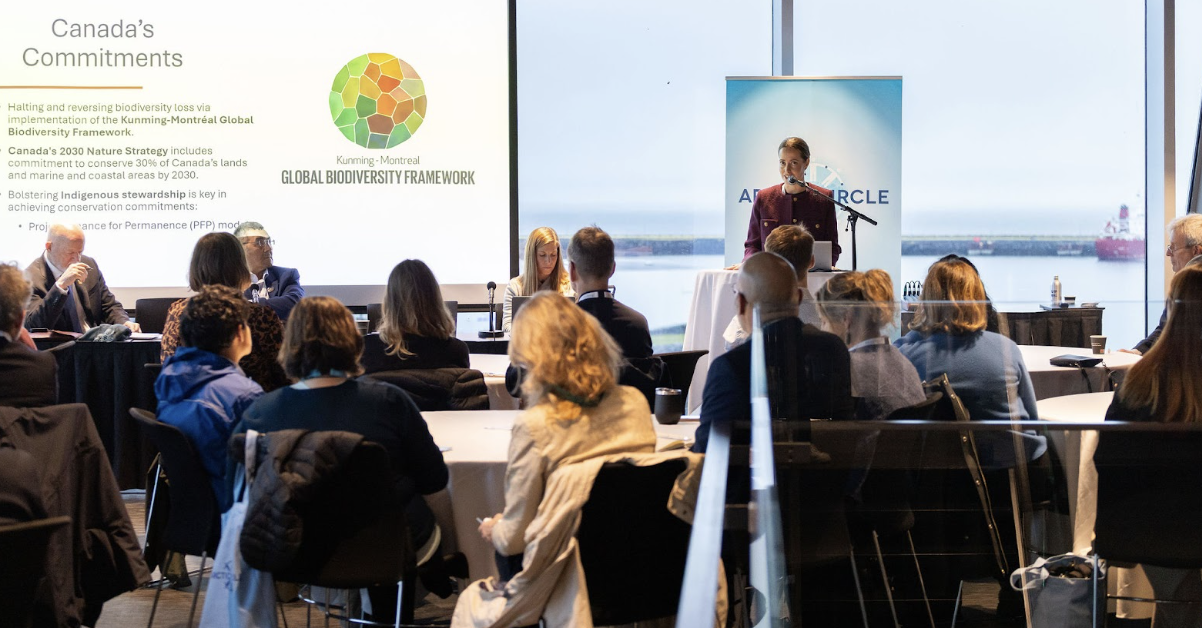
Sovereignty has returned to the center of Canada’s Arctic discourse, revived as both a moral consideration and a strategic concern. During the October 2025 Arctic Circle Assembly, northern policy was framed around the Kunming-Montreal Global Diversity Framework1, which requires governments to treat Indigenous peoples as “partners” and rights-holders in conservation decisions to integrate ecosystem-based climate solutions into the country. However, beneath the rhetoric of cooperation lies a more profound contradiction, as Canada’s northern authority rests on Indigenous communities– whose sovereignty it continues to override. This article argues that Canada’s Arctic strategy disguises dependency as cooperation, invoking inclusion while consolidating control. True sovereignty, this analysis argues, will arise not from symbolic displays on the world stage but from the self-determination of northern communities.
The Geopolitics of Arctic Sovereignty
Canada’s renewed focus on Arctic sovereignty reflects a pressing concern at the intersection of climate change mitigation, geopolitical security, and domestic nation-building. As melting ice opens new shipping routes and resource frontiers, the Arctic has emerged as both an arena of strategic considerations and a domain of identity politics. Yet this new geostrategic focus also illustrates a Western gaze that reduces sovereignty to de jure and de facto control rather than to the active recognition of the authority exercised by northern communities.
From NORAD modernization2 to expanded Operation NANOOK3 initiatives, successive governments have pursued sovereignty through deterrence and continental defense, reflecting a framework still closely intertwined with U.S. strategic priorities. Nicolien van Luijk et. al., in Inuit Perspectives on Arctic Sovereignty, note that this “state-centric” approach privileges security and extraction over Indigenous and environmental realities. Meanwhile, the Yellowhead Institute likewise observes that the Carney government’s One Canadian Economy Act4 extends this pattern by linking Arctic development to economic security and national unity. By merging resource policy and defense strategy, the North remains a space of federal management rather than land defined by the political authority of its communities.
Indigenous Conceptions of Sovereignty
Indigenous political thought reframes sovereignty as fundamentally relational, grounded in stewardship, kinship, and collective responsibility rather than territorial control. Mowatt et al. argue that settler states such as Canada continue to restructure governance and political science around colonial hierarchies that marginalize Indigenous authorities and sustain an illusion of state supremacy. Within their framework, sovereignty is not a possession but a relationship sustained through care, reciprocity, and accountability to land and community.
Inuit leaders such as Mary Simon and Aaju Peter similarly emphasize that Canada’s Arctic legitimacy rests on Inuit “use and occupation,” rather than federal jurisdiction. The country’s ability to assert sovereignty in the Arctic Circle and to have that be recognized internationally is contingent on Inuit homelands and legal rights, which predate the Canadian state itself. Canada, therefore, depends on Inuit oppression, which it rarely acknowledges in governance. Indeed, the systems governing the North – including federal decision-making frameworks, resource-management initiatives, and land-claims administrations – remain designed to centralize control in Ottawa.
Therefore, even as Inuit presence forms the basis of Canada’s Arctic claims, the laws regulating Indigenous peoples continue to consolidate authority in the federal state. Section 91(24) of the Constitution Act of 1867 grants the federal government exclusive jurisdiction over “Indians, and Lands reserved for the Indians,” while Section 35 of the Constitution Act of 1982 merely recognizes and affirms existing Aboriginal treaty rights. Indigenous organizations are offered a seat at the table, but the state retains the power to mediate, interpret, and administer laws. Even modern land claim agreements, affirmed under Section 35(3), remain negotiated through the state’s mandates and funding mechanisms rather than Indigenous legal orders. Participation becomes permission rather than an exercise of power, resulting in a sovereignty project that claims partnership, but operates on the assumption that absolute authority must remain within the federal government.
Local Realities
At the McGill Roundtable on Arctic Sovereignty, held on September 17, just weeks before Canada’s delegation to the Arctic Circle Assembly, participants underscored a truth often missing from federal strategy: “you can’t have national security without human security.” Sovereignty in the North is not tested through diplomacy or defense capacity, but through the state’s ability to sustain its citizens’ everyday lives.
Brigadier General Dan Rivière noted that Indigenous communities are “foundational to operations,” yet continue to face inadequate housing, unreliable transportation, and chronic underinvestment in local infrastructure. As Dakota Erutse argues in his Yellowhead Institute Brief, the persistence of “northern squalor”5 reflects how Ottawa continues to treat material well-being as secondary to geopolitical image-making. Canada’s Arctic credibility, therefore, should depend less on its military presence and more on translating rhetoric into tangible improvements for those who live in the North.
Ottawa’s Rhetoric vs. Northern Voices
The gap between policy discourse and lived experience becomes clear when examining how northerners themselves articulate sovereignty. A recent Policy Options Arctic Survey found that while eighty-five per cent of respondents supported asserting Canadian sovereignty, most defined it through local empowerment, partnership, and sustainable development rather than federal control. They prioritized procurement for local companies, community-led climate monitoring, and improved connectivity as the clearest markers of sovereignty. The North is seeking material capacity, not epistemic symbolism.
Yet Ottawa’s frameworks– from the Arctic and Northern Policy framework to its latest defense plans– continue to equate sovereignty with visibility. Military bases and patrols replace the more challenging task of governing alongside those who live there. A study published in Inuit Perspectives on Arctic Sovereignty found many respondents felt uneasy about the “unknowns” of shipping traffic and the lack of say over marine areas, thus revealing a form of sovereignty enacted on communities rather than with them. Ottawa may speak the language of partnership, but until decision-making genuinely shifts northward, that partnership remains rhetorical.
Sovereignty as Dependency
The tensions between rhetoric and reality reflect a deeper structural feature of Canada’s Arctic governance. Mowatt et al. note that Indigenous sovereignty continues to be measured against state-defined standards, reinforcing Canada’s colonial logic that equates the legitimacy of Indigenous governance to compliance with Canadian guidelines. Political scientist Kevin Bruyneel calls this the “third space of sovereignty”: Indigenous nations navigate between autonomy and dependence within the boundaries of settler institutions. Canada’s Arctic policy operates in this space by drawing legitimacy from Indigenous participation to strengthen its moral authority abroad while restricting it domestically.
Sovereignty in Canada thus functions as a system that sustains federal control while appearing to share it. The dynamics of housing and infrastructure investment in the Northwest Territories reveal this logic on the ground, where steps toward reconciliation mask enduring hierarchies of governance.
The Price of Presence
Ottawa’s renewed investment in Northwest Territories housing demonstrates how sovereignty and federal legitimacy are increasingly intertwined. Long treated as a social issue, it now operates as a political instrument, proving that the federal government can “deliver” in the North. Yet, as Etruse observes, investment often functions as a “credibility mechanism” through which the federal government can demonstrate control and competence to both domestic and international audiences, rather than enabling self-governance. Funding decisions and procurement remain centralized, reinforcing federal control over the pace and scope of development.
Sovereignty is thus expressed through optics, in which housing projects symbolize federal presence without redistributing power. Legitimacy, therefore, is constructed not through accountability to northern residents but through performance before the global stage.
Toward Northern-Led Sovereignty
A truly northern-led vision of sovereignty will depend less on who stands guard in the North and more so on who holds jurisdiction over its land, water, and resources. As emphasized at the McGill-led roundtable on Arctic sovereignty, universities, Indigenous governments, and private actors share a collective responsibility within a “whole of society” framework to distribute decision-making power in ways that replace hierarchy with reciprocity. Authority over land and sea, therefore, must be grounded in safekeeping rather than administrative reach.
This shift echoes Mowatt et al.’s call to treat indigenous sovereignty as “relational, contextual, and grounded in place,” capable of reconfiguring what political authority means in settler states. Ottawa must now act as a facilitator rather than a guarantor of sovereignty, transferring authority to northern peoples capable of defining governance on their own terms. Such a shift requires embedding Inuit legal orders into territorial governance to ensure that development agreements are negotiated directly between Indigenous governments and Ottawa as equal political authorities, rather than federal intermediaries that dilute Indigenous power.
Indigenous voices have too often been acknowledged symbolically only to be excluded from the decisions that shape their homelands. A country that claims to lead in the North must first recognize those who have sustained it, whose presence, wisdom, and care laid the very foundations of the nation. Canada’s arctic future will not be measured by how visibly it governs, but by how deeply it remembers whose stewardship made that governance possible.
Edited by Catvy Tran & Margaux Zani
The opinions expressed in this article are solely those of the author and do not reflect the position of the McGill Journal of Political Science or the Political Science Students’ Association.
Featured image by the 2025 Arctic Circle Assembly
- For the official text of the Kunming-Montreal Global Biodiversity Framework, see decision 15/4. ↩︎
- NORAD (North American Aerospace Defense Command) modernization refers to ongoing joint Canada-U.S. investments in early-warning radar systems, air defense, and satellite surveillance designed to enhance Arctic security. For an overview, see McGill Roundtable on Arctic Sovereignty and Security. ↩︎
- Operation NANOOK is Canada’s primary northern military and sovereignty initiative, led by the Canadian Armed Forces in partnership with the Coast Guard, federal agencies, and northern communities. For an overview, see McGill Roundtable on Arctic Sovereignty and Security. ↩︎
- One Canadian Economy Act, S.C. 2025, c. 5 (approved June 26, 2025) is a federal legislation that creates a single national framework for trade and labour mobility, allowing goods, services, and professional licenses approved in one province to be recognized across Canada. For an overstate’s mandates and funding mechanisms see Parliament of Canada Bill C-5. ↩︎
- The term, “northern squalor” is used to signify the enduring material neglect underlying Ottawa’s claims of Arctic authority. For an overview, see Reflections on “Northern Squalor” Survey and Sovereignty. ↩︎


