 2
2
 0
0
An ambitious environmental turnaround
Almost 3 years ago, Lula da Silva was sworn in as Brazil’s president. With the ambitious goal of eliminating deforestation by 2030, he has cast himself as a “champion” in combating climate change.
This bold objective is best understood in light of the deregulatory policies of his predecessor, Jair Bolsonaro, which created a climate that emboldened illegal mining and logging in the Amazon. From 2019 to 2022, Brazil’s Amazon suffered its most severe destruction since 2008. Its average annual deforestation rose by 75.5 per cent from the previous decade. Brazil’s National Institute for Space Research (INPE) showed that 11,088 km² of rainforest was destroyed between August 2019 and July 2020.
There was no denying the early promise in Lula’s new policies: he reinstated environmental funding programs, such as the Amazon Fund and National Environment Fund (FNMA). He also revoked decrees that facilitated illegal mining, reinforced the limits on carrying firearms, and increased the use of satellite imagery to identify illegal logging, ranching, and mining operations.
Brazil has also contributed $1 billion to the Tropical Forests Forever Fund (TFFF), an innovative model designed to give participant countries four dollars per hectare of preserved tropical forest – a large sum if we take into account the 1.1 billion hectares of tropical forests spread across 73 developing countries.
In the first six months of Lula’s presidency, his policies seemed to have a positive effect, as deforestation fell by around a third and has continued to decrease.
Why Lula’s environmental agenda falls short
However, Lula’s status as a climate leader is in jeopardy, as his ambitious goals face significant roadblocks and domestic climate optimism is drying up.
Already Mr. Da Silva has had to make trade-offs. Last August, he signed a controversial environmental bill, which critics said could make it far too easy for companies to bypass environmental regulations.
What’s more, Lula will have to negotiate his agenda without a majority in congress, which is dominated by legislators linked to former president Jair Bolsonaro’s party and the “ruralist” movement who promote agribusiness and mining in the Amazon. The absence of military support for Lula’s government is another obstacle: the military has refused to endorse the government’s efforts to remove thousands of illegal gold miners from Yanomami territory in the Amazon. This highlights the army’s lingering loyalty to former president Jair Bolsonaro, whose administration was marked by a close alliance with the military.
Some of Lula’s policies stand in direct contradiction to his climate commitments. For instance, Brazil is the eighth-largest global oil exporter, but the government seeks to move up to become the fourth and to cooperate with OPEC nations. According to a report from INESC P&D Brazil, a nonprofit scientific institution, there were five times more subsidies for the production and consumption of oil and gas, than for renewables.
Environmentalists are criticizing this move, pointing out the contradiction in his policies: can Lula claim to be a climate leader if he also aims to massively invest in one of the main contributions to global greenhouse emissions? Researchers from SEEG, a Latin American greenhouse gas monitoring platform, contend that if Brazil moves forward with exploiting its oil reserves, the emissions from their burning would cancel out the progress made through efforts to slow Amazon deforestation.
Chief Raoni’s Stand for the Amazon and its Indigenous Communities
Deforestation in the Amazon is not only an environmental problem: countless Indigenous groups in the Amazon have suffered devastating consequences, particularly from exposure to mercury, which is used to extract gold. For instance, studies show that in the state of Pará in 2021, six out of every ten residents had levels of mercury above safe limits. According to Chief Raoni of the Amazon Kayapó people, there has been an increase in children born with defects across various villages.
In addition to health impacts, illegal loggers and miners have been attacking Indigenous peoples. According to Greenpeace in 2021, both the Munduruku and Yanomami people of the Brazilian Amazon were violently attacked by armed illegal miners. As retaliation for efforts to end such illegal activities, the criminal miners terrorized people with gunfire and set fire to the homes of community leaders.
Lula has cast himself as the environmental leader Raoni was looking for – but Raoni sees the shortcomings in his policies, and various Indigenous communities of the Amazon are growing skeptic. Their disappointment materialized when, in April 2024, Lula did not receive an invitation to attend the Terra Livre camp in Brasilia, Brazil’s largest indigenous gathering.
Can Promises Turn Into Progress?
Their skepticism reflects the central question of whether Lula will achieve his goal of zero deforestation by 2030, and the true depth of his dedication to the environment. The domestic resistance he faces, as well as his conflicting priorities of wanting to protect the Amazon while expanding oil production, are very likely to impede on any meaningful climate action. Full commitment to ending deforestation in the Amazon is essential for both the well-being of the forest’s Indigenous peoples, and the global climate.
Edited by Patrick Armstrong.
The opinions expressed in this article are solely those of the author and they do not reflect the position of the McGill Journal of Political Science or the Political Science Students’ Association.
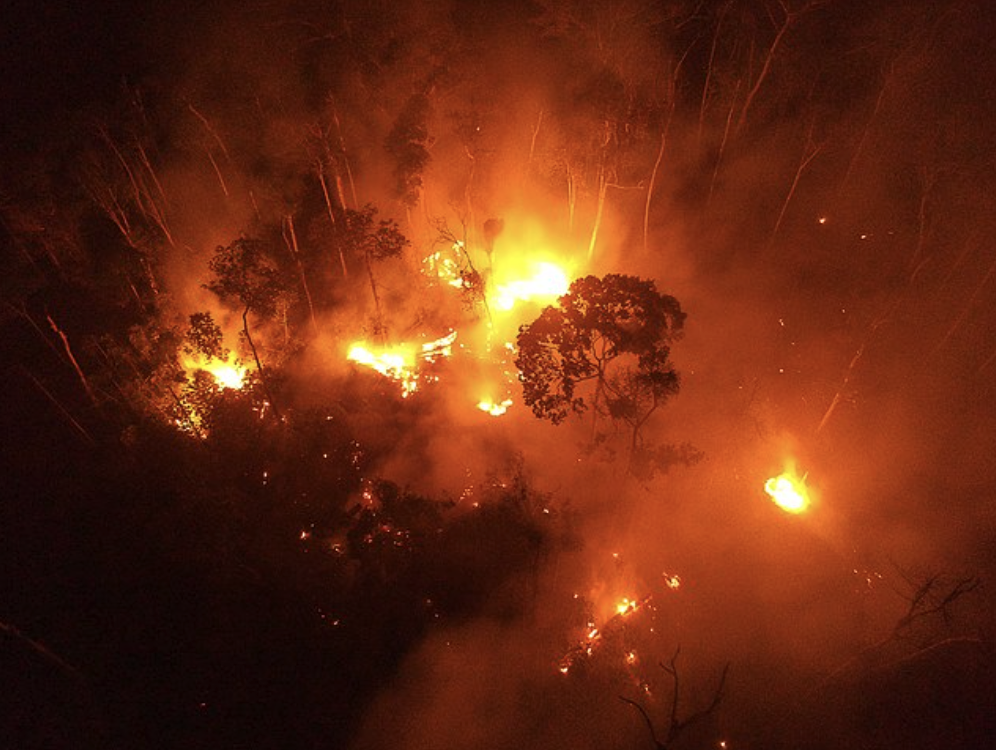
Featured image by Bruno Kelly, from Amazônia Real, Creative Commons Attribution 2.0.


