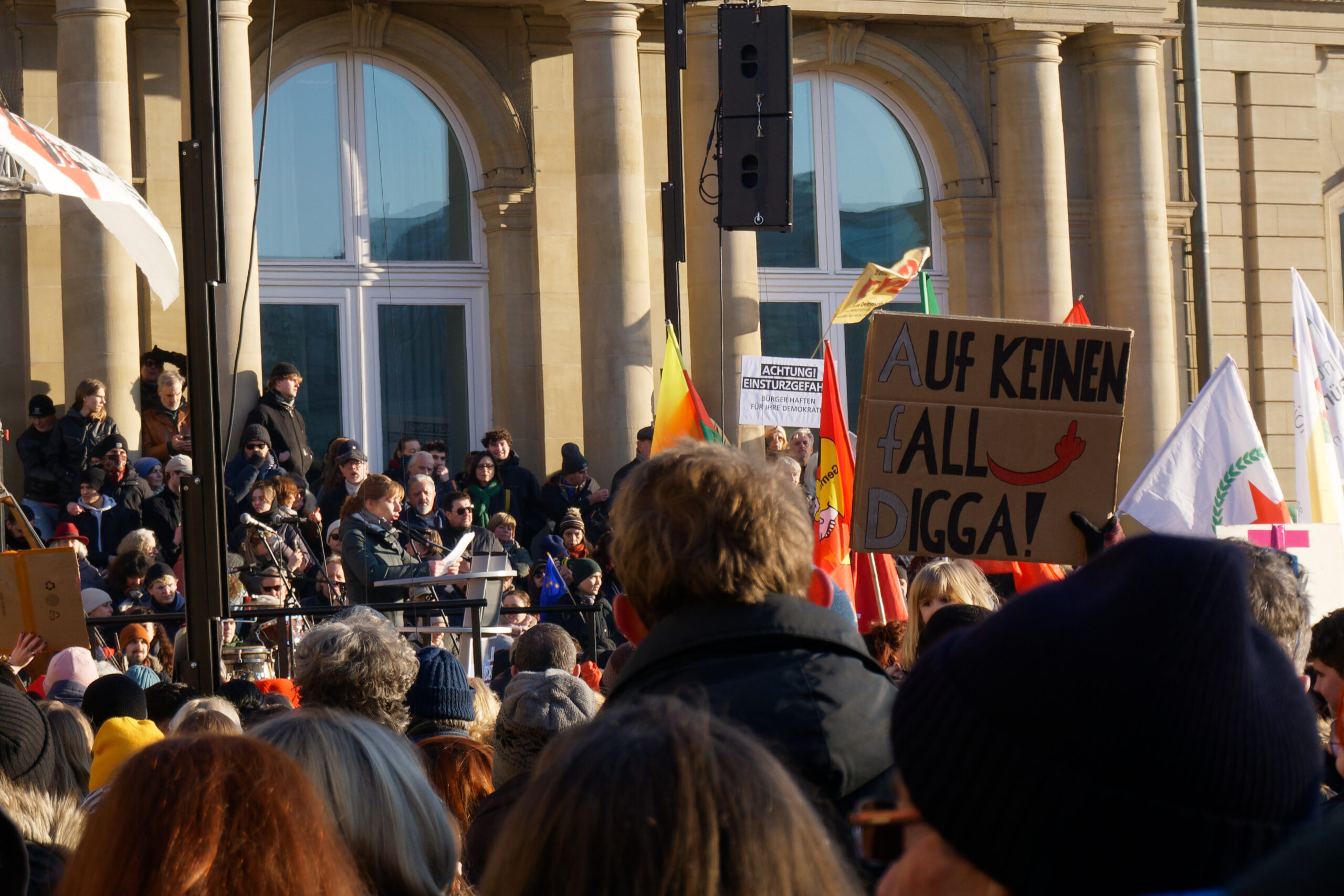
One Wall Has Fallen: Another One is Built

On the 8th of November, 2024, the eve of the 35th anniversary of the fall of the Berlin Wall, Dr Götz Frömming, an AfD member of the Bundestag since 2017, took the floor of the German parliament. “One wall has fallen,” he declared, “but others have been erected, and one is known today as the ‘Brandmauer’”, referring to the “firewall” mainstream parties maintain against cooperation with the AfD — a German cordon sanitaire. This firewall, he went on, showed “no respect for East Germans, who are not stupid, little children in need of being ‘educated’, but people who consciously choose to vote for the AfD.” Frömming was not alone in this sentiment: the claim that the establishment looks down on its voters has become a staple of AfD rhetoric. A more uncomfortable question remains: whether Frömming has a point.
Frömming speaks of two walls: the one that fell in 1989, and the Brandmauer. I want to argue that there is a third wall, one that receives far less attention, that stands between the AfD supporters and the rest of the democratic public. It is built from words like “Wutbürger” and “Rattenfänger”, or the prevalent stereotype of AfD supporters as uneducated, old, or East-German. Whether the Brandmauer should stand is a contested question that deserves its own debate. The third wall is not the Brandmauer, nor the mainstream’s opposition to the AfD as a party, which is legitimate and some might argue, necessary. It is the wall between the mainstream and the AfD’s voters and it stems from the antagonistic characterisation of the AfD base. Unlike the Brandmauer, the third wall does not protect democracy, and it is one we can begin to take down. Because it is made of rhetoric rather than political strategy, it lies entirely within the mainstream’s control, and I will argue, it should be taken down, since it advertently strengthens the future prospects for an AfD controlled German government.
Two things can be true at once: the AfD exploits the idea of East German humiliation for its own ends, and the mainstream really does talk down to the people who vote for it. The words that build this third wall treat AfD supporters as a monolithic, irrational, extremist mass of Wutbürger. Yet populism, as the political philosopher Ernesto Laclau argues, grows out of legitimate demands, and dismissing those demands on the basis that it is populists who voice them only makes them more tangible. Drawing on Laclau’s treatise, On Populist Reason, this article argues that such antagonistic typification does not contain the far right but strengthens it; by dismissing voters’ varied grievances en bloc, it links them into an equivalential chain that the AfD can define and claim as “the people” against a hostile establishment. An appropriate democratic response does not require bringing down the Brandmauer, but it does require contesting the AfD’s positions politically and addressing its voters’ legitimate grievances one by one, rather than dismissing them all as one.
The Problem With Dismissing Populism
Laclau sees populism as “a political logic”: a way of forming a ‘people’ out of different demands, whether on the left or the right.1 Since populism is a logic of politics, for Laclau, dismissing it involves the “dismissal of politics tout court,” and amounts to a kind of elitism: the belief that society should be run by an administrative power whose authority rests on knowing what a “good community” is, a vision Laclau later rejects as a reductionist fantasy of politics.2 If politics is imagined as rational actors negotiating clear interests, it is no wonder then that people who rally around populism can only look like “an expression of irrationality.”3 Measured against this ideal, populism can only ever fall short, and Laclau observes that critiques of populism have often been based on what it lacks compared to this ideal: “its vagueness, its ideological emptiness, its anti-intellectualism, its transitory character.”4 But these characterizations tell us only what populism is not. They describe it from the outside, measuring it against an ideal, and overlook what it grows out of: legitimate demands that have gone unaddressed.
How these demands translate into populism depends on how they are treated. To elucidate this, Laclau distinguishes between two logics. Under the logic of difference, each demand is dealt with separately, through institutions, and stays isolated: what he calls a democratic demand.5 Under the logic of equivalence, however, demands that remain unanswered start to matter less for what makes them different and more for what they share, which is that the same authorities have failed to answer them.6 Requests harden into claims, and the linked demands form what Laclau calls an equivalential chain.7 With it comes a dividing line, splitting society into two camps, understood as an “us”—those who have undergone abuse—and a “them”—those who have perpetrated.8
The drawing of this line is not limited to a strategy of populism. For Laclau, there is no “us” without a “them”: even projects built on institutional—or administrative—problem-solving, such as the welfare state or Thatcher’s market reforms, ended up naming enemies when they faced pushback.9 This matters, because it means that those who dismiss populism do not stand above the divide. They help draw it, setting ‘reasonable’ citizens against those they treat as unreasonable, while presenting themselves as rational. Underneath the linked demands lies a deeper feeling: not just that particular problems haven’t been solved, but that the community itself is broken, that something has been lost—“an experience of lack”—and because demands are always addressed to someone, that loss is blamed on those in power.10 The frustrated group comes to see itself as the whole and exclusive people, and those it blames as illegitimate persons in society.11
There is No Alternative (Until There Is)
Let’s start with Laclau’s first point on the dismissal of populism, which he contends rests on the belief that society should be run by administrators who know what a “good community” is. Seen this way, the ends of society are not something to be fought over in a political contest, but a fact to be deduced. Those with the right knowledge define what is good, and politics is reduced to putting this good into practice. This ideal rings especially true in German political culture, with its roots being traced back to the very inception of the Federal Republic of Germany.12 In fact, one of the most famous political slogans of Konrad Adenauer, the Federal Republic’s first chancellor, was “Keine Experimente!” (“No experiments!”), emphasising the extent to which stability was at the forefront of political culture. After the emotional mobilisation of the Nazi years, the Republic built a political culture on sobriety, consensus and stable institutions—a culture that is built into the institutions themselves. As German political scientist Nathalie Behnke notes, proportional representation and the Bundesrat make broad coalitions the norm, thereby fostering an environment where laws can only pass after long negotiations, in which, in her words, “hard edges are cut” from proposals. By reducing real political differences to technical problems, the German model ends up embodying the very administrative control Laclau critiques.
Furthermore, Angela Merkel can be argued to epitomise this ideal. Her political style was characterised by a “technocratic, ‘problem-solving’ approach and an orientation towards consensus.” Under her, problems became technical tasks to be solved, and her description of the euro bailout as “alternativlos” (without alternative) is a case in point. This rhetoric depoliticises decisions by presenting them as the only reasonable option and putting them beyond political contest. This is the vision Laclau warns against: an administrative power whose authority rests on knowing what a “good community” is. Jörg Michael Dostal describes her chancellorship as a “reactive style of policy making” that managed crises rather than pursuing a political project, and he finds the same logic in the current CDU/CSU-SPD coalition, which presents its reforms as the “only way out.” Once again, echoing Merkel, politics is presented as necessity rather than choice.
For Laclau, this hope of reducing politics to administration is a fantasy. If there is only one rational answer, demands that do not fit it cannot be expressed within that framework at all, and so they begin to link with one another outside it. When the main parties look alike, those whose concerns go unheard turn to someone new to voice them. Writing a year before the AfD’s establishment, British political scientist Mark Leonard warned that German politics placed many questions “outside the realm of political competition”, and that because the establishment “turns [dissenters] into outcasts rather than arguing with their view”, popular frustration would only grow. In hindsight, Leonard’s warning seems to have come true: shutting out those who disagree by dismissing their arguments as baseless—reducing them to Wutbürger—rather than arguing with them, is how the third wall began to be built.
Building the Third Wall: Word by Word
The first clue that points us to the AfD being the product of this politics-without-alternatives is in its name itself: Alternative für Deutschland (Alternative for Germany) is a direct reference to Merkel’s “Alternativlosigkeit” (“alternativeless-ness”). The party was founded in 2013 by a group of economists and conservatives, in opposition to the euro bailout Merkel had described as “alternativlos”, and its early programme called for the orderly dissolution of the eurozone. From its very first day, the party presented itself as the alternative the government claimed did not, and could not, exist. It was only after 2015, what Moritz Ege and Alexander Gallas call the “Summer of Migration”, that the AfD diverged its focus from the eurozone to migration. Many of us are familiar with the AfD, or with similar populist parties elsewhere, labelling migrants and political opponents in dehumanising terms. “Good-for-nothings,” “invasive species,” and “passport Germans” are only few of the terms the party and its members have used for migrants, while mainstream parties and media are dismissed as “Traitors of the People”, “Lying Press”, “Cartel Parties.”13 Charged and insulting rhetoric isn’t new, but it isn’t exclusive to the far right either. The labels are in no way equivalent in severity: the AfD’s language targets vulnerable groups and dehumanises them in a way mainstream rhetoric largely avoids. However, this does not necessarily negate the harm done when the mainstream answers contempt with contempt, a harm that, in my observation, is discussed far less.
Mainstream explanations of AfD support follow a pattern of dismissal: they aim not at the party’s programme, but at its voters, and locate the cause of the vote in the voters themselves rather than in their demands. AfD support is routinely explained as emotional (the “Wutbürger” or “Angry Citizen”), pathological (East Germans that have been “diktatursozialisiert” or “socialised by dictatorship”), or manipulated (lured by “Rattenfänger” or “pied pipers”). Laclau describes the same accusations in the long tradition of dismissing populism, calling it the result of irrationality, abnormality or manipulation.
The labels rest on a familiar stereotype: the AfD voter as poor and uneducated, or as old, male and East German. The sociologist Céline Teney writes that “simplifying stereotypes” (“vereinfachende Stereotype”) dominate how AfD voters are portrayed, either as socially left-behind protest voters or as a closed radical-right milieu. Her own data suggests that these stereotypes do not paint the full picture: the most radical, authoritarian group is only about a fifth of the AfD electorate, and contrary to expectation, is more common in the West than in the East.
The third wall also exists outside of speeches and in the public realm. Marc Helbling and Sebastian Jungkunz’s research suggests that supporters of mainstream parties reject AfD supporters far more strongly than the reverse, and that citizens take on their parties’ hostility as their own. Teney warns that blanket labels marking all AfD voters as far-right could make some of them more defensive towards democratic parties instead of pushing them away from the AfD. For Laclau, there is no “us” without “them”, and that holds for the mainstream as much as for the AfD: the mainstream has increasingly relied on its antagonistic opposition to the AfD to define itself.
The AfD Says Danke
This antagonism is precisely the wall the AfD needs to legitimate its own political project. Recall Frömming’s speech: East Germans, he insisted, are not “stupid little children in need of being educated.” When Marco Wanderwitz described East Germans as “diktatursozialisiert”, the AfD’s eastern spokesman Jürgen Pohl responded by calling him an “Ostbeleidigungsbeauftragter”: a commissioner for insulting the East. Wanderwitz had handed Pohl the AfD’s central story, that the establishment looks down on ordinary people, and every other label that outsiders use to categorise AfD supporters only strengthens this story.
Laclau’s idea of a chain of equivalence between otherwise separate grievances helps explain why this works. AfD supporters vocalise many distinct grievances, for example, rising energy prices, crumbling infrastructure and the fear of immigration. This range of concerns is not necessarily intrinsically related, and some could be met while others should be contested. A logic of difference would take each of these on its own terms. But once all three are labelled in the same way—part of the AfD’s political agenda—their differences disappear, and they become increasingly defined by the one thing that they do share — the experience of being dismissed. In Laclau’s terms, the logic of difference gives way to the logic of equivalence, and as I have shown, the forging of this chain can be seen, in no small part, in the discourse of the mainstream. This is not to say that the mainstream is responsible for the AfD’s rise, only that it is not entirely innocent either: its pejorative labels make the AfD’s work easier.
The AfD only has to name what the labels have already created. Because demands are always addressed to someone, the frustration they produce from being ignored needs a target, and the AfD supplies one: a condescending establishment that has stopped listening. In doing so, the AfD effectively presents itself as the antidote, the voice of “the people” against that establishment, forming exactly the frontier Laclau describes, in which the frustrated part of society comes to see itself as the whole. Another implication of this frontier is that the ‘them’ —mainstream parties and media— are seen as illegitimate. The AfD’s rhetoric does exactly this, and every label the mainstream uses for AfD voters makes the frontier ever more convincing.
Tearing Down the Third Wall: Wir Sind Das Volk, Too
Laclau does not see populism as inherently antithetical to democracy; some radical conceptions of democracy even depend on populist strategies. However, his analysis still points to what a democratic response to the AfD’s particular, exclusionary populism would require. If the AfD’s “people” is forged from grievances dismissed together, overcoming the threat of the AfD and its populism means taking those grievances seriously one by one—breaking the AfD’s chain of equivalence. This is the opposite of legitimizing the AfD’s political project; breaking a chain of equivalence pulls apart what the AfD has bundled together.
Some grievances are legitimate, and can and should be addressed: the gap in wages and wealth between East and West, declining rural services and infrastructure, and the practical strain on municipalities managing migration and integration, just to name a few. Others must be opposed: “remigration”, ethnic definitions of the nation, attacks on democratic institutions and minority rights. Telling the two apart will not always be easy, and a more complete framework for doing so may still need to be developed. But the Basic Law offers a good starting point: it guarantees human dignity (Article 1), forbids discrimination on grounds of origin, race, language or faith (Article 3), and commits Germany to being a democratic state under the rule of law (Article 20). Every legitimate grievance addressed on its own terms, as a specific problem with a specific answer, in the spirit of Laclau’s logic of difference, removes a link from the AfD’s chain. In practice, this means investment, representation and visible local presence that lasts beyond campaign visits.
But absorbing demands one by one is not enough if politics remains pure administration. The establishment parties must also compete for democratic support, and argue for their positions openly, in parliament and in public. This means debating migration openly and contesting the AfD’s positions on their merits, and it means presenting choices as choices, with the trade-offs explained, instead of declaring them alternativlos as Merkel did. Mainstream parties must also change their language, dropping derogatory labels and addressing the AfD voters as citizens with views, albeit views they strongly reject.
None of this requires cooperation with the AfD or adopting its framing, and the Brandmauer is, in itself, an entirely separate question. It requires only that the establishment parties stop building a wall of their own between ‘enlightened’ voters and Wutbürger. In the autumn of 1989, crowds in Leipzig chanted “Wir sind das Volk” (“we are the people”), and helped bring down the first wall. Today the AfD claims those words for itself. The first wall fell in 1989. The second may stand. The third is built from words, and it can be taken down the same way.
Edited by Anyue Zhang
The opinions expressed in this article are solely those of the author and they do not reflect the position of the McGill Journal of Political Science or the Political Science Students’ Association.
Featured image by Zinnmann via Wikimedia Commons
- Ernesto Laclau, On Populist Reason (London ; New York: Verso, 2005), 117. ↩︎
- Ibid., 225. ↩︎
- Ibid., 12. ↩︎
- Ibid., 13. It is interesting to note here that Laclau observes a link between the dismissal of populism and the older denigration of ‘the masses’: both rest on the same prejudice, a defence of order and institutions against the people acting collectively. ↩︎
- Ibid., 73-74, 78. ↩︎
- Ibid., 78.
↩︎ - Ibid., 73-74.
↩︎ - Ibid., 74, 77. ↩︎
- Ibid., 78-79. ↩︎
- Ibid., 85-86 ↩︎
- Ibid., 86. ↩︎
- One could trace this pattern further back, to Germany’s long tradition of a powerful, legally trained bureaucracy: German public administration has been described as having a “monopoly of jurists” since the nineteenth century, rooted in a specifically German conception of the rule of law (Rechtsstaat). One might even look back to the Prussian state and Bismarck’s Realpolitik, with its preference for pragmatic statecraft over ideological contest. But whether such a direct causal link can be drawn is contested, and tracing it would require a historical analysis beyond the scope of this article. ↩︎
- The terms “Traitors of the People” (“Volksverräter”) and “Lying Press” (“Lügenpresse”) have origins in Nazi-era propaganda, where they were used to vilify political opposition and the free media, respectively. ↩︎