On the 29th of September, this year, U.S. President Donald Trump signed an executive order titled “Inaugurating the Era of Super Intelligence” enforcing that all executive departments and agencies refer to Artificial Intelligence (AI) as Super Intelligence (SI). Just a few months earlier, the Director of the White House Office of Science and Technology Policy, Michael Kratsios, released a 123-page document: “Science: A New Golden Age,” detailing a roadmap for the future of the United States in scientific innovation. The report, which was the first of its kind since 1945, places AI at the centre of Kratsios’ vision, proposing that federal grant funding be removed from academic projects and instead funneled into high-risk, high-reward projects. Kratsios released the document mere hours before he was scheduled to testify in front of the U.S. House of Representatives Committee on Science, Space, and Technology, offering little time for Members of Congress to properly comb through the document before the hearing.
The Trump administration has adamantly worked to integrate AI into the American economy; in monopolising scientific discovery and propelling investment in AI, what kind of technological nation will the United States become? The 1974 work of political economist Harry Braverman on the aftermath of the Industrial Revolution provides an illuminatory framework through which the effects of AI investment can be understood. Contemporary research by Astra Taylor and Naomi Klein corroborate Braverman’s fears of scientific management applied to the Trump administration’s so-called golden age of AI—a golden age that risks driving the wealth gap further and consolidating control of powerful AI systems in the hands of the few.
Braverman on the Devaluation of Labour
In 1974, Labor and Monopoly Capital: The Degradation of Work in the Twentieth Century by Harry Braverman was published in order to make sense of the effects of increasing economic automation and provide an analysis for the associated effects on labour and production.Over fifty years later, his work provides surprising structural insight as AI creates new and more efficient pathways for automation—the power of the labourer risking a similar diminishment in the contemporary setting.
Braverman describes scientific management as “an attempt to apply the methods of science to the increasingly complex problems of the control of labour in rapidly growing capitalist enterprises.”1 In order to tighten control of management and cheapen the price of the worker, scientific management divides the ‘conception’ and ‘execution’ of tasks into two entirely separate spheres.2 If workers are able to conceive the ways in which labour is undertaken, they will fight too earnestly for their own best interests and for the best interests of their coworkers. By keeping conception and execution removed from one another—“freed so far as possible”3—labour processes are structured in such a way that polarizes “those whose time is infinitely valuable and those whose time is worth almost nothing.”4
Beyond the disconnection between the knowledge that facilitates work and the labour that does work, Braverman argues this process is key to the “destruction of craftsmanship” which “systematically destroys all-round skills where they exist.”5 In other words, this process ‘deskills’ the working class, training labourers to perfect broken apart skills that, on their own, hold no worth. Not only is the holistic training of labourers treated as unnecessary, it is a threat to the capitalist mode of production that risks giving way to the liberation of the work. Scientific management thus embodies a foundational argument: a worker need not be productive or competent in a holistic sense to be valuable for the company in general. In fact, it may be argued that a labourer is more valuable, or at least more desirable, if they are compartmentalized sufficiently so as not to threaten the tightly regimented separation of ownership and production in the firm.
A Golden Age for Who?
The use of AI, on its own, does not necessarily raise suspicions for the rights of the worker or the escalation of the wealth divide. However, the vigorous race to control and hastily proliferated AI by some of the wealthiest billionaires in the U.S. may lead to the complete displacement of the conception of tasks altogether; AI may fill the previous role of managers, the ‘knowledge-holders’. Whereas Braverman raised concerns about the disconnection between the conception and execution of tasks, arguing that such a cleavage would remove one from autonomy in their workplace and strip the ability to generate knowledge, continued investment in AI may only further alienate the worker from the conditions in which they work: human labour will be replaced, but so will human judgement.
Political scholars Astra Taylor and Naomi Klein have recently warned: the “more deeply generative AI burrows into our public infrastructure and personal lives, inundating us with automated systems and synthetic media, the more authority those who own the machines will yield.”6 While Kratsios may claim that his vision for a new golden age of science in the U.S. will benefit all Americans, the U.S. National Science Foundation (NSF) has already promised $1.5 billion in funding to X-Labs in order to “enable breakthroughs to accelerate new forms of AI integration in physical systems.” Prioritizing the funding of private partnerships over scholarly research, the transformation of AI into the physical reality risks removing the demand for the human labourer completely. In one particular X-Labs project, research is being conducted to create an AI-powered military with robotic soldiers.
On his first day back in the West Wing, President Trump announced Project Stargate, a public-private AI infrastructure partnership with a budget of $500 billion to develop five new AI sites that would consume 12 per cent of the nation’s electricity by 2028. As the Trump administration attempts to push AI from the digital to the physical sphere, and score points in the AI ‘arms race’, there is no telling how the reverberations may ripple. Moreover, as the demand for the human labourer decreases, research funding is monopolized into projects the president desires, and growing AI infrastructure may generate more power requirement than entire U.S. cities. Alongside the administration’s dismantling of the federal government and reduction of minimum wages, the president has shown lack of care for the working class; extending past Braverman’s observation of the destruction of craftsmanship, the integration of AI into the physicality may result in the destruction of the craft altogether.
Taylor and Klein argue that the accelerated attention on AI is rooted in the elite desire to replace the “disposable”7 working class with “a new class of ‘greater beings,’”8 assuming that superintelligence—artificial intelligence that supersedes the human-level—will create an almost “Godlike wisdom.”9 To Taylor and Klein, the hyperfixation on AI among the Trump administration and the tech world rings eerily similar to rhetoric yearning of a messianic, religious saviour. Citing the mere 17 per cent of adults who think that AI will have a positive effect on the U.S. in the next two decades, Taylor and Klein emphasise that this blind hope is not felt by the very population who it affects. Superintelligence will be whose saviour?
Funneling both the ‘conception’ and ‘execution’ of labour into the ownership of few—all while diminishing the capacity of critical thought10 and effectively expediting the effects of global warming—risks reducing the working class to a state of obsolescence. But, given the Trump administration’s apparent apathy for the increasing plight of the everyday labourer, it seems that might just be the point of their ‘golden age’ of superintelligence.
Edited by Jaya Choudhry
The argument defended in this article is solely that of the author and does not reflect the position of the McGill Journal of Political Science, the Political Science Studentsʼ Association, or the Political Science Department.
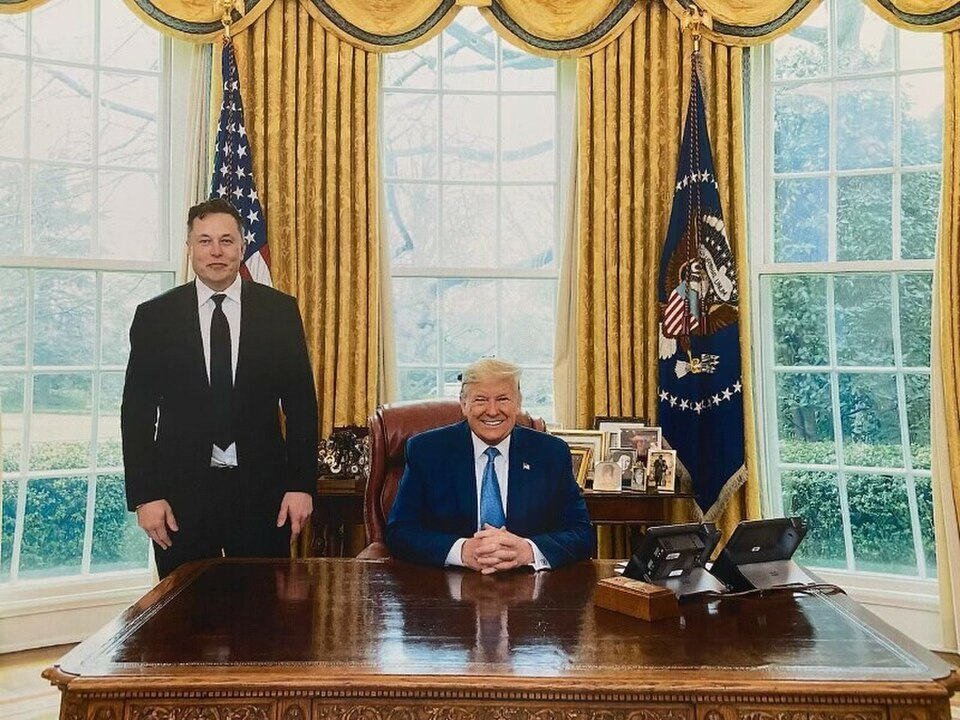
Featured photo from The White House (Wikimedia Commons)

- Harry Braverman, Labor and monopoly capital: the degradation of work in the twentieth century, (Monthly Review Press, 1998), 59. ↩︎
- Braverman, Labor and monopoly capital, 81. ↩︎
- Braverman, Labor and monopoly capital, 57. ↩︎
- Braverman, Labor and monopoly capital, 57. ↩︎
- Braverman, Labor and monopoly capital, 57. ↩︎
- Naomi Klein and Astra Taylor, End Times Fascism: And the Fight for the Living World, (Farrar, Straus and Giroux, 2026), 87. ↩︎
- Klein and Taylor, End Times Fascism, 90. ↩︎
- Klein and Taylor, End Times Fascism, 90. ↩︎
- Klein and Taylor, End Times Fascism, 90. ↩︎
- Klein and Taylor, End Times Fascism, 98. ↩︎