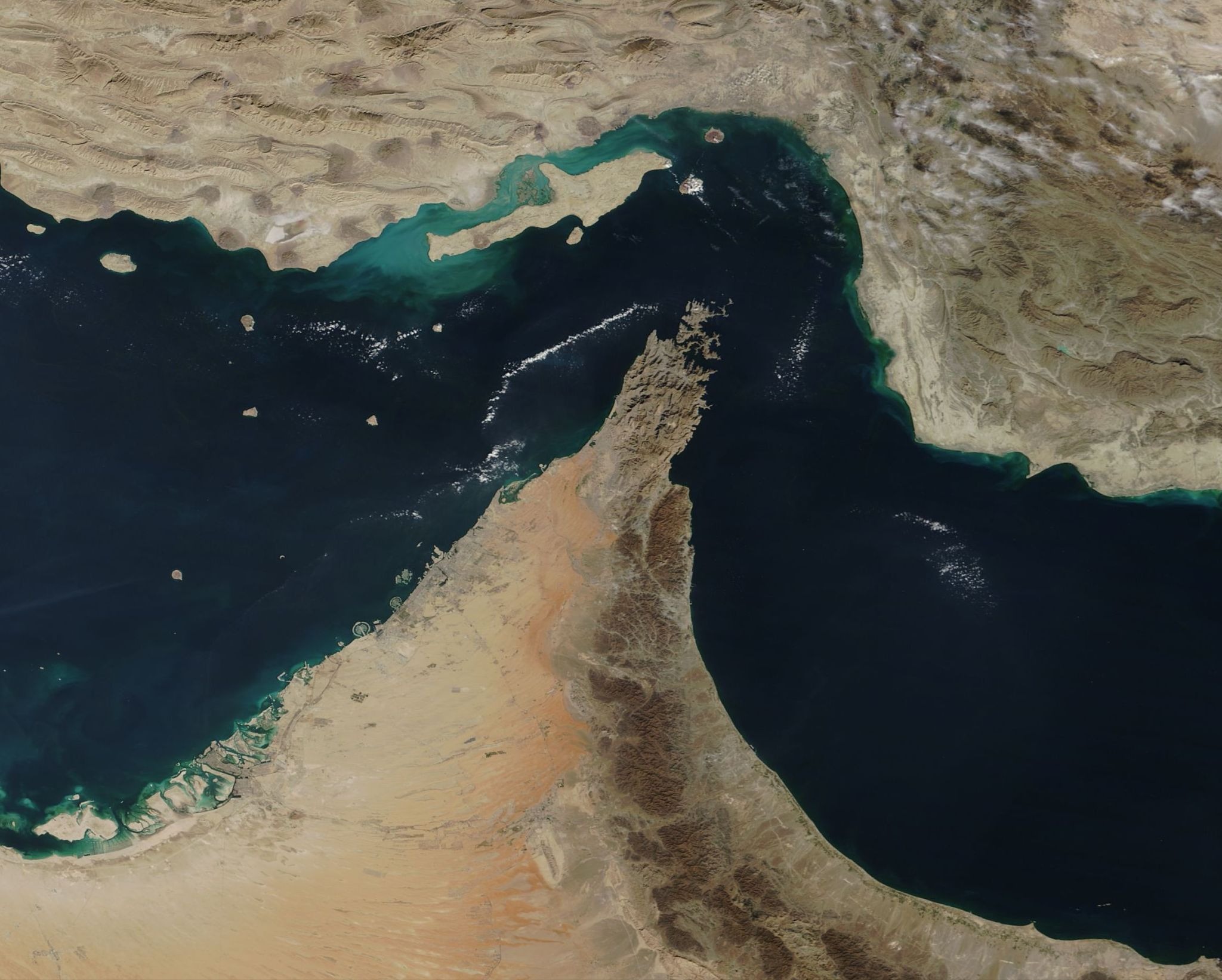
The Strait of Hormuz, situated between the coasts of Iran and Oman, connects the Persian Gulf to the Gulf of Oman and the wider international maritime system. According to the U.S. Energy Information Administration (EIA), approximately 20.9 million barrels of oil passed through the waterway daily in the first half of 2025, representing about one fifth of the world’s petroleum liquids consumption. This concentration of international trade within a small geographic passage creates a unique strategic vulnerability for the global community.
For Iran, this vulnerability has historically provided a means of exerting pressure on nations with significantly greater conventional military and economic capabilities. However, the strategic importance of Hormuz creates a paradox: Iran’s leverage depends on the maritime traffic that it threatens to disrupt. Threatening maritime traffic can impose costs on stronger rivals, but long-term interference risks inciting retaliation, harming Iran’s own economic interests, and encouraging other states to develop alternative trade routes that threaten to erase this leverage entirely. Iran’s geographic advantage is ultimately self-limiting. While its position along the Strait allows Tehran to challenge more powerful adversaries, aggressively exploiting this advantage risks weakening its economic and strategic position without necessarily securing lasting political gains.
Geography as an Asymmetric Advantage
International power is frequently assessed through military capabilities, economic resources, and technological development. By these indicators, Iran faces significant disadvantages relative to its most current adversary, the United States. However, such comparisons overlook the influence that geographic vulnerabilities have on strategic decision-making.
Hormuz provides a particularly important example. As there are few comparable alternative trade routes, the waterway is crucial to the export infrastructure of many major Gulf energy producers. In the event of an interruption, the EIA estimated that pipelines in Saudi Arabia and the United Arab Emirates could supply around 4.7 million barrels per day of available capacity to bypass Hormuz. This is considerably less than the volume that typically transited the Strait before the 2026 conflict. Iran’s advantage, therefore, does not necessarily depend on having a fleet that can defeat the U.S. in conventional warfare. Instead, its proximity to the waterway and ability to threaten commercial shipping create opportunities to impose disproportionate costs. Here, Iran is able to leverage a strategy of asymmetric coercion, where a less powerful actor takes advantage of a weakness that its stronger adversary cannot easily eliminate.
It is crucial to distinguish between defeating an opponent and influencing its calculations. Iran does not need to establish permanent military control over Hormuz to influence the decisions of governments and shipping companies—or the behaviour of oil markets. Instead, the credible threat of disruption creates enough uncertainty over secure maritime passage that other actors must account for its potential economic and security costs. However, this leverage should not be confused with lasting strategic control. While Iran can influence the calculations of stronger adversaries, its ability to turn maritime disruption into meaningful political concessions remains limited.
The Power of Disruption
Following the outbreak of war in February of this year, commercial shipping through Hormuz was severely restricted, contributing to what the International Energy Agency described, in March of 2026, as the largest supply disruption in the history of the global oil market; oil flows through the Strait fell from approximately twenty million barrels per day before the conflict to a fraction of their previous levels. The immediate disruption of oil shipments was not the only consequence—growing uncertainty surrounding the security of commercial vessels affected shipping companies’ willingness to approach the area.
In July, the Associated Press reported that Iran’s ability to threaten vessels with drone and missile strikes continued to complicate the United States’ attempts to resume maritime traffic. The very possibility of successful attack deterred commercial passage even in the absence of strikes on all vessels. More recently, on October fifth, the United Kingdom Maritime Trade Operations Centre (UKMTO) claimed that Iran’s Islamic Revolutionary Guard Corps had ordered a tanker entering Hormuz to turn back or risk being targeted. This episode demonstrates how the credible threat of force can influence maritime activity without the actual destruction or seizure of a ship. However, the ability to discourage commercial shipping should not automatically be interpreted as a strategic victory for Iran. Although these threats demonstrate Tehran’s capacity to impose costs on stronger adversaries, they do not establish whether such pressure can secure meaningful political concessions. The distinction matters because disrupting an opponent’s economic interests is only strategically valuable if the resulting pressure helps achieve broader political objectives.
When Geographic Leverage Becomes a Liability
The greatest limitation of Iran’s geographic advantage is that exploiting it can ultimately undermine its own position. While threatening Hormuz allows Tehran to impose costs on stronger adversaries, sustained disruption also exposes Iran to retaliation, economic losses, and efforts by other states to reduce their dependence on the Strait. These consequences suggest that geographic leverage is not just a source of strength, it is also a potential liability. The economic fallout from the 2026 conflict illustrates how Iran’s ability to threaten maritime traffic can come at significant costs to its interests.
In September, Reuters reported that Iranian oil exports have been significantly restricted by the U.S. naval blockade, depriving Tehran of a vital source of foreign income. Iran had shown that it could pose a threat to regional shipping, but it was unable to stop the U.S. from imposing major economic costs in retaliation. Meanwhile, other Gulf producers started to adjust. Despite ongoing security risks, regional oil exports have recovered substantially by early October, as producers extended the use of other routes and modified shipping arrangements.
This creates a more profound strategic problem for Iran: the more it relies on threatening Hormuz, the greater the incentive for other states to reduce their dependence on the waterway. Although alternative routes cannot fully replace the Strait’s capacity, efforts to diversify shipping arrangements and energy infrastructure could gradually weaken Iran’s leverage. The fact that these alternatives remain costly and imperfect does not eliminate this problem. Instead, it suggests that Iran’s advantage may diminish over time as other states become willing to invest in reducing their vulnerability. Even as exports recovered, Reuters reported that high transportation costs and logistical challenges continued to affect international oil markets.
The resulting relationship is neither total Iranian control nor the ability of the United States’ greater military might to completely offset geographic disadvantage. Rather, traditional military supremacy is insufficient to eliminate expenses for both parties.
What Hormuz Reveals About International Power
The Strait of Hormuz calls into question the assumption that conventional military and economic superiority inevitably results in unchecked strategic influence. Iran’s position shows how a comparatively weaker nation can exploit vulnerabilities brought up by global economic interdependence. However, the more important lesson of Hormuz may be that the ability to impose costs on stronger adversaries does not necessarily translate into lasting political influences.
The 2026 conflict illustrates this distinction. Iran’s ability to obstruct shipping through Hormuz strengthened its bargaining position despite its conventional military disadvantages. The June ceasefire framework, which included provisions for lifting the U.S. naval blockade and resuming Iranian oil exports, demonstrated how maritime pressure could contribute to securing limited concessions. Nevertheless, these developments did not resolve the underlying conflicts regarding Iran’s nuclear program and sanctions or regional security. Iran’s leverage therefore proved more effective in raising the costs of confrontation and influencing negotiations than in guaranteeing long-lasting political agreements.
Ultimately, Iran’s position along the Strait of Hormuz reveals the limits of geographic power rather than simply its advantages. Although threatening maritime traffic can force stronger states to account for Iranian interests, repeatedly exercising that threat risks provoking retaliation, damaging Iran’s economy, and encouraging other states to reduce their dependence on the waterway. The paradox is that Iran’s greatest strategic asset may become less valuable the more aggressively it is used. Hormuz demonstrates that while geography allows weaker states to challenge more powerful adversaries, it cannot guarantee the political outcomes they seek.
Edited by Léa Karam
The argument defended in this article is solely that of the author and does not reflect the position of the McGill Journal of Political Science, the Political Science Students’ Association, or the Political Science Department.
Featured image by Wikimedia
