Since the Reagan administration’s War on Drugs campaign in the 1980s, the issue of curbing the trafficking and use of illicit substances has been a cornerstone of government policy around the world. However, in the broader scope of the international system, actions to address these concerns often face coordination problems, with domestic instability in some states giving rise to robust, underground institutions facilitating the production and distribution of drugs. Among the most prominent regions of this nature is the Golden Triangle, a hilly, remote region at the confluence of the Thailand, Laos, and Myanmar borders. In 2024, methamphetamine seizures increased by 24% in East and Southeast Asia. With opium poppy cultivation also on the rise in producing regions, there are clearly unresolved, underlying incentives for the continued expansion of drug trafficking in the region. This article will outline the historical instabilities that have plagued the Golden Triangle, leading to its development as a drug hotspot, and detail the impacts of these illicit markets on Southeast Asia’s future.
The Genesis of a Triangle
The history of drug production in the Golden Triangle was initially sparked by shifting power dynamics in East Asia, specifically in China. Following the defeat of the Kuomintang (KMT) nationalist forces by the communist People’s Liberation Army (PLA), the new Chinese government implemented widespread reforms, such as crop substitution, to curb the nation’s longstanding opium dependence. The widespread migration of KMT loyalists to northern Burma, coupled with a continued demand for opium by Chinese diasporic communities, made the present-day Golden Triangle a hotspot for opium production and trafficking across Indochina, especially to urban centers like Saigon and Bangkok. Under the context of continual instability and military corruption, regional opium production–particularly in Myanmar’s Shan State–has been steadily increasing even in the present day, with lower-class peasants forced into the trade to make ends meet. However, the recent boom in methamphetamine production in the Golden Triangle has also signalled a modern shift towards less labour-intensive, synthetic drugs, spawning a new dimension to the region’s role in global illicit drug markets.
From Fields to Labs
In the present day, the Golden Triangle has continued to spiral into lawlessness, largely due to the economic and political motives of its constituent countries. In Myanmar, a 2021 military coup ousted Aung San Suu Kyi’s government and ended civilian rule, sparking infighting between ethnic and pro-democratic forces. The economic disruption due to this ongoing civil war has forced militants and civilians alike to turn to the drug trade as a means to an end, whether to support daily life or combat efforts. Coupled with the breakdown of the rule of law in the drug-producing Shan state following the regime change, civilians, ethnic militia, and government-aligned forces have all developed a reliance on the drug trade to fund their efforts.
Since the 2021 coup, the price of a kilogram of raw opium has more than doubled in some areas, making poppy cultivation attractive for local farmers. However, for military groups, the synthetic nature of methamphetamine makes the drug more lucrative, as it can be produced in bulk in relative secrecy. In the Golden Triangle region, the average quantities of meth seized per case have significantly increased since 2021, while the overall number of seizures has decreased due to regional instability. This has been complemented by the price of meth pills, colloquially known as “yaba”, decreasing in other Southeast Asian countries, especially in Thailand. At the same time, the purity of sold drugs has remained consistent, pointing towards an overall increase in production, which has primarily been traced to the Golden Triangle region.
The Special Economic Zone: A Trafficking Hub
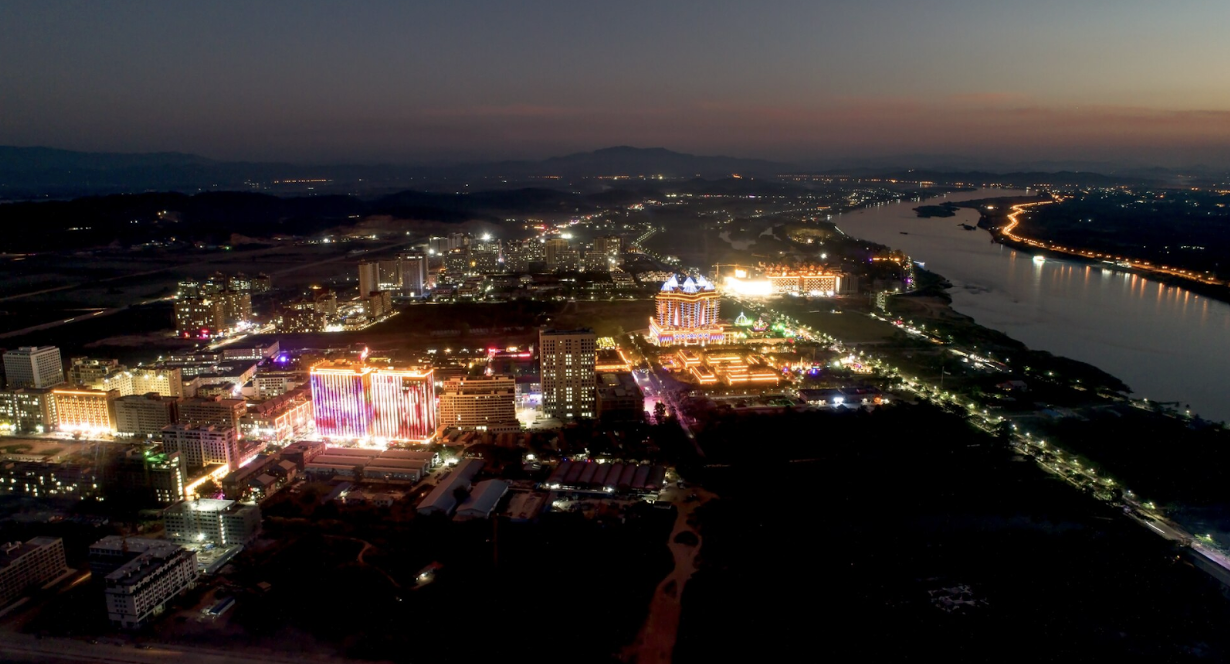
Across the border in Laos, the drug trade can be understood in a more structured context, with operations primarily focused on trafficking rather than producing. The Laotian government has designated its portion of the Golden Triangle as a Special Economic Zone, building casinos, resorts, and malls seeking to attract economic expansion through tourism and recreation sectors. The development in this area has largely been funded by Chinese tycoon Zhao Wei, who invests in the region under the facade of helping Laotians. However, due to its weak rule of law and lease to foreign businessmen, the region has also been implicated in widespread scam centers, human trafficking, and drug smuggling since its creation, with Zhao and his organization being under sanction by the United States Treasury Department since 2018. The relatively porous border between Laos and Myanmar has allowed significant drug flows through the Golden Triangle zone, making it a major gateway for narcotics and methamphetamine to be sold to international markets.
Future Outlooks
As the status quo currently stands, the drug trade in the Golden Triangle will likely continue to grow in magnitude. The Special Economic Zone in Laos is leased to Zhao and his company for 99 years, and law enforcement outside of border crossings is privatized, ensuring that the artery of the drug trade to global markets remains intact. Similarly, despite Thai initiatives to tighten security on their side of the Golden Triangle and a call for unilateral action by former Prime Minister Thaksin Shinawatra, the chaotic environment and weak rule of law across the border in Myanmar and Laos have rendered these efforts relatively insignificant on a broader scale. In the context of the civil war in Myanmar, the source and transport routes of drugs in the Golden Triangle are likely to persist, especially considering the entrenchment of production in the funding of militia forces and the leverage crime syndicates hold in production regions. This points towards the necessity of resolving the Myanmar civil war and the reestablishment of the rule of law for Golden Triangle drug production to truly stagnate, as the true root causes lie within longstanding economic and political fractures that have continuously made illicit trade lucrative. Until these underlying issues are addressed, the drug trade in the Golden Triangle is likely to continue to flourish, perpetuating a cycle of instability and disorder whose shockwaves are absorbed by the entire region of Southeast Asia.
Edited by Matteo de Campos Mello Grijns
The argument defended in this article is solely that of the author and does not reflect the position of the McGill Journal of Political Science, the Political Science Students’ Association, or the McGill Department of Political Science.
Featured image courtesy of wikicommons
_-_night_view_2021.jpg)