Political theory as a discipline relies upon a lively series of debates regarding the philosophy of knowledge. Ph. D candidate Godesulloh Bawa’s Youtube miniseries explores the shape of African philosophy readily intersected with politics through the examination of the language that structures epistemology. In saying “hunting difference is not the aim of philosophy,” Godesulloh raises deeper questions about the political outcomes of unquestioned epistemology—specifically regarding the desire to categorize philosophy as ‘African’ and ‘Western’. What thought processes are utilized, and what do they hide when employed? What is privileged by demarcating units of analysis like ‘Africa’ and ‘Europe’ and what do these distinctions imply for the practice of political theory?
The purpose of this article is to participate in the wider discussion on the ways our attempts to create knowledge encode and enact difference. It adapts Godesulloh’s critique of metaphysical and historical realities to Fred Moten and Harney Stefano’s “Undercommons,” challenging the boundaries of what is normatively accepted as ‘African’ ways of thinking. Rather than rejecting difference entirely, this article seeks to examine how it is managed, here cutting across several social categories that disrupt overly simple language. In the process, it hopes to offer a clearer definition of what ‘African thought’ can mean, as well as with whom and where it is to be found.
Godesulloh on Difference and Contingency
In Godesulloh’s first video installation, “what is African Philosophy?” he reviews the analyses provided by African philosophers Paulin Houtondji and Kwasi Wiredu, respective authors of African Philosophy: Myth and Reality and Philosophy and African Culture. These scholars criticize “ethnophilosophy,” defined as belief or knowledge systems with “philosophical relevance… but which have not been consciously formulated as philosophy.” Godesulloh’s analysis relies upon treating philosophy as a science; it is not enough to engage with ideas, concepts, or one’s surroundings — one must operate from a foundational methodology. Ethnophilosophy fails to meet Godesulloh’s parameters. Focusing upon ‘people groups’ evades easy categorization. It is difficult—if not impossible—to produce operational, universal definitions of culture, ethnicity, or tradition to which all can agree upon: “they are appealing to things we cannot falsify.” Therefore, ethnophilosophy, labeled as a separate ‘African’ philosophy, cannot operate on the same playing field as Western philosophies. He echoes Wiredu in advocating for a universal view of philosophy, one in which people choose what is kept and what is discarded as the core of understanding and applying knowledge—that is, for this process to not be moored to a specific culture or region.
This view looks to universalize an understanding of knowledge, simultaneously collapsing and honoring how differences in ‘Western’ and ‘African’ thought is considered. Political exercises deal with culture, as they depend upon actors debating and making arguments about the world around them. This affords agency, regardless of an individual’s positionality, and ways of thinking provide avenues to navigate subject matter such as colonization, modernity, and the construction of race. Houtondji’s assertion that ‘African traditional philosophies do not exist’ at first glance may appear reductive. He argues philosophy is contingent upon geographically-bounded historical coincidences, such as the European Enlightenment of Confucius’s teachings. Through processes of imperial accumulation and experimentation, philosophy and its epistemic patterns may better be understood as confluential, contributing to an overarching, imperfect study. Though one may contend that Africa does not have philosophy, it does not mean Africans are not allowed to practice philosophy. Rather, philosophy is accessible to all, a dialectic embedded within or perhaps preceding transnational debates and correspondence. It is a science that all, regardless of ethnicity or race, have equal claim to.
The second installation, “African Philosophy ‘vs.’ Western Philosophy” elaborates upon the nature of contingency and the predilection for essentializing difference. Godesulloh notes the ease with which ‘Western’ is linked to individualism, and ‘African’ with communalism. Particularly, Ubuntu is upheld as something ‘authentically African’ through its focus on human relationality: “a person is a person through other persons.”1 Politically, it is often claimed as a tool to return to a ‘traditional’ African way of being, interrupted and silenced by colonization. Motsamai Molefe, in her work Ubuntu Ethics, engages with Leonhard Praeg’s assertion that Ubuntu today is truly a lowercase “ubuntu,” filtered through Western “epistemicide” that has irrevocably changed its nature. She instead holds that it should be understood as a spiritual idea, literally archived through the maintenance of African languages.2 Their discourse is defined by essentializing difference between Ubuntu and Western philosophies. As a strain of philosophy, what they choose to emphasize are narratives of an eternally colonized or potentially liberated Africa—replicating Wiredu’s fears of non-operationalizable subjects. Through either path, Africa is fit into a dichotomy with the West; it is what the West is not.
Godesulloh challenges this dichotomy in the application of metaphysical and historical realities, where the search for something unique in African philosophy is a fruitless chase. What is typified as a ‘Western’ or ‘African’ way of thinking is built upon historical contingencies that are not innate to one’s being. He points out Igbo ideas of Chi, where people foster personalized relations with their perceptions of divinity, and Aristotle’s basis of humanity being confirmed by community. By doing so, he seeks to demonstrate that humans, as inherently relational creatures, cannot have patterns of thought essentialized easily as ‘individual or communal’ without something being lost in the process — whether by the West or not. These “strands” of individual or communal foci are interwoven through everyone, with historical contingencies amplifying and silencing their prominence.
His argument, moving away from monolithic views of philosophical difference, allows political architects greater grace. Difference is, in fact, always going to be present. By reckoning with the ways definitions “illuminate” and “obscure,” the comprehension of real difference becomes a far more manageable task.
Rethinking African Philosophy Through The Undercommons
Godesulloh’s analysis can be extended to Harney Stefano and Fred Moten’s notion of the Undercommons for two primary reasons: difference focusing on the categories people and “things,” and the geographical locality of said theory. The Undercommons refers to the space within the university where marginalized individuals engage in transgressive forms of learning and gathering. Stefano and Moten theorize the university context as a direct extension of Black enslavement and exploitation within the United States. It is a “place of refuge” that can never fully satisfy a student’s desire for “enlightenment,” as it is a tool of bureaucratic capitalism: The university is an industry of teaching, where the human desire to share and cultivate knowledge is relegated to an “other face” subsumed within the extraction of intellectual labour.3 To enter into the university, then, is a contradiction for many racialized or otherwise othered people, where one must “steal what one can,” “the life stolen by enlightenment and stolen back….”4 Here, Harney and Moten speak to an environment at odds with itself, one capable of producing meaningful human connection, but often directly against its superstructure.
What is most interesting here is the direct relation drawn between enslavement— the Triangle Trade—and those who escape it, the students of the university. To Moten, the Undercommons are always at war, always in hiding.”5 The ‘disobedience’ the university invites upon itself through student discourse is compared to the undoing of plantation societies through maroons reasserting their humanity through escape. Harkening to an American-Caribbean context of chattel slavery and exploitation, the two authors link wider social institutions to histories of African experience inside and outside of Africa. This manoeuvre does two things of interest by considering its philosophical lineage as African and transnational, perhaps Pan-Africanist, yet not solely applied to Africans.
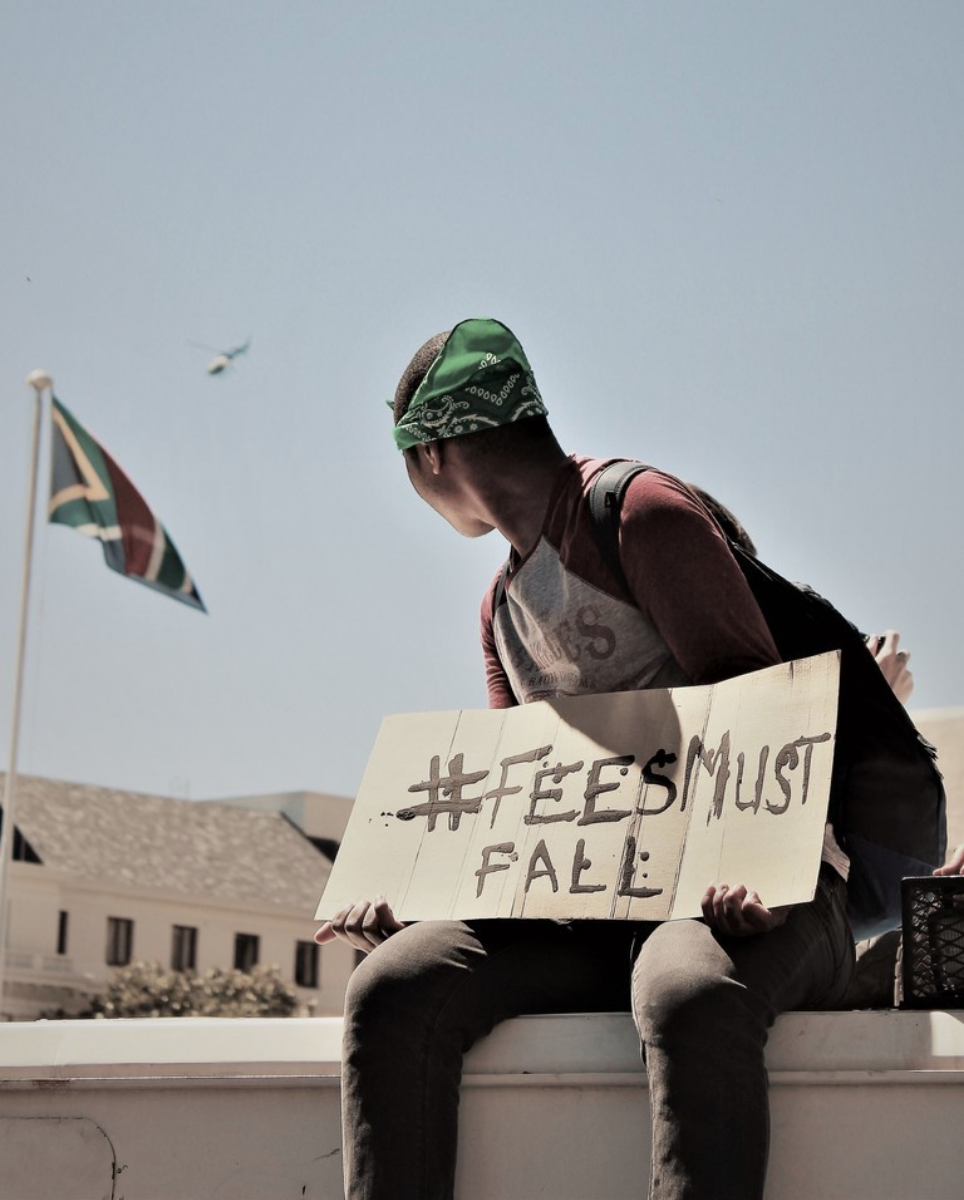
One may strive for an Undercommons-based approach to the #RhodesMustFall and #FeesMustFall campaigns across South African campuses, refocusing analyses on ‘mainland’ African decolonial contexts, or alternatively, maintain a North American view of Columbia student encampments for Palestine as outgrowths of the same historical contingencies. In this light, it is not that African epistemologies are separate from that of the West, but that it is important in highlighting how people share intertwined histories that shape political codes and priorities. The issue, and perhaps the origin of essentialization, is that African contingencies are often silenced or not given proper representation, breeding an insecurity that brings people to cling to difference as proof of value.
Moten names this need A Poetics on the Undercommons. Rather than essentializing difference, he critiques the essentializing of sameness between Black and white Americans. He builds upon Bill Brown’s “thing theory,” where objects are transformed into “things” when they interact with the human body—either through their ascribed social value, utility, or malfunctioning.6 As the Undercommons acknowledges enslavement, Moten argues that the university ‘thingifies’ its students. This dehumanization makes “things” capable of having “content” that in and of itself makes them worth studying.7 The student as a thing becomes representative of systems and relations not readily visible when the student is a person. Recognition of dehumanization becomes a corrosive identification of injustice and repression. The Undercommons, within –and against– the university, allows students to interrogate themselves, the hierarchies enforced between people and things, and how this maintains distinctions between people and people-as-things: “How do we organize ourselves given these constraints in order to obliterate the mechanism that produces them?”8
Relationality, here, is predicated upon differences existing, between people, people-things, and things, but does not indulge within them. They are, instead, a mode of analysis working to expand political thought toward remedying systemic oppression. Modalities of individuality or communality are problematized, exchanged for relation between things. Moten’s theorization of the Undercommons, and when people are things, works to privilege the interaction of African and Western philosophy, grounded in shared contingency as a space where “nothing turns out to be of substance.”9 It is, therefore, through the process of questioning what we know, and how we express what is known, that new ways of thinking are revealed, problematizing the simple labels of ‘Western’ or ‘African.’
Moten elucidates an assertion within A Poetics on the Undercommons reminiscent of Godesulloh’s claim of a universal practice of philosophy. The former contends that the Undercommons produces a form of fugitivity, of rebellion, that is intimately connected to Black identity, or more accurately, Blackness as a mode of being.10 Blackness is taken as a rejection of the colonial binary between Black and white bodies that “Everybody has the right and option to claim.”11 Blackness, then, becomes a relational philosophy of sorts that is universal, or at least could be. Founded in the recognition of exploitation and systemic racism, the Undercommons allows one to occupy and create within a space where “nothing” is meant to be.
‘African/Western’ Philosophy and Inclusive Political Thought
In learning to question ‘how we know what we know,’ it can become enticing to throw politics out entirely. In fact, Moten and Harney exclaim that “politics is radioactive… it matters how long we have to do it, how long we have to be exposed to the lethal effects of its anti-social energy.”12 This argument compels an understanding of politics that rightfully centers the division and use of power—here illustrated as a corruptive force bent against liberatory ideologies. Yet, they emphasize it must be dealt with, if only to be negated. Politics can be picked up, put down, and tossed to the side because, underneath, “the mutual debt that can never be made good” is better than the proposition of institutional order and correctedness.13 Going back to Godesulloh, the epistemic trend of dichotomy is one of these ‘correcting’ institutions that Moten names; it is through the examining of what is shared, of what makes us different and unequal, of resisting categorization, that reveals more robust and intellectually honest ways of imagining a politics in-the-making. The heart of ‘politics without politics’ lies on what grounds one dares to conceptualize it, on who is let into the proverbial drawing-room.
Edited by Martin Rojas Remolina
The argument defended in this article is solely that of the author and does not reflect the position of the McGill Journal of Political Science, the Political Science Students’ Association, or the Political Science Department.
Featured image by David.ritchie.05
- Molefe, Motsamai. 2025. Ubuntu Ethics: Human Dignity, Moral Perfectionism, and Needs. London: Routledge, Taylor & Francis Group. 7. ↩︎
- Molefe, Ubuntu Ethics, 5. ↩︎
- Moten, Fred, and Stefano Harney. 2004. “The University and the Undercommons.” Social Text 22 (2). 101-102. ↩︎
- Moten & Harney, “The University and the Undercommons,” 101, 103. ↩︎
- Moten & Harney, “The University and the Undercommons,” 104-05. ↩︎
- Moten, Fred, and Stefano Harney. 2016. A Poetics of the Undercommons. First edition. Butte, Montana: Sputnik & Fizzle. 13. ↩︎
- Moten & Harney, A Poetics of the Undercommons, 15. ↩︎
- Moten & Harney, A Poetics of the Undercommons, 43. ↩︎
- Moten & Harney, A Poetics of the Undercommons, 35. ↩︎
- Moten & Harney, A Poetics of the Undercommons, 37. ↩︎
- Moten & Harney, A Poetics of the Undercommons, 30. ↩︎
- Moten & Harney, A Poetics of the Undercommons, 18. ↩︎
- Moten & Harney, A Poetics of the Undercommons, 20. ↩︎