Carney’s Lecture on Realism
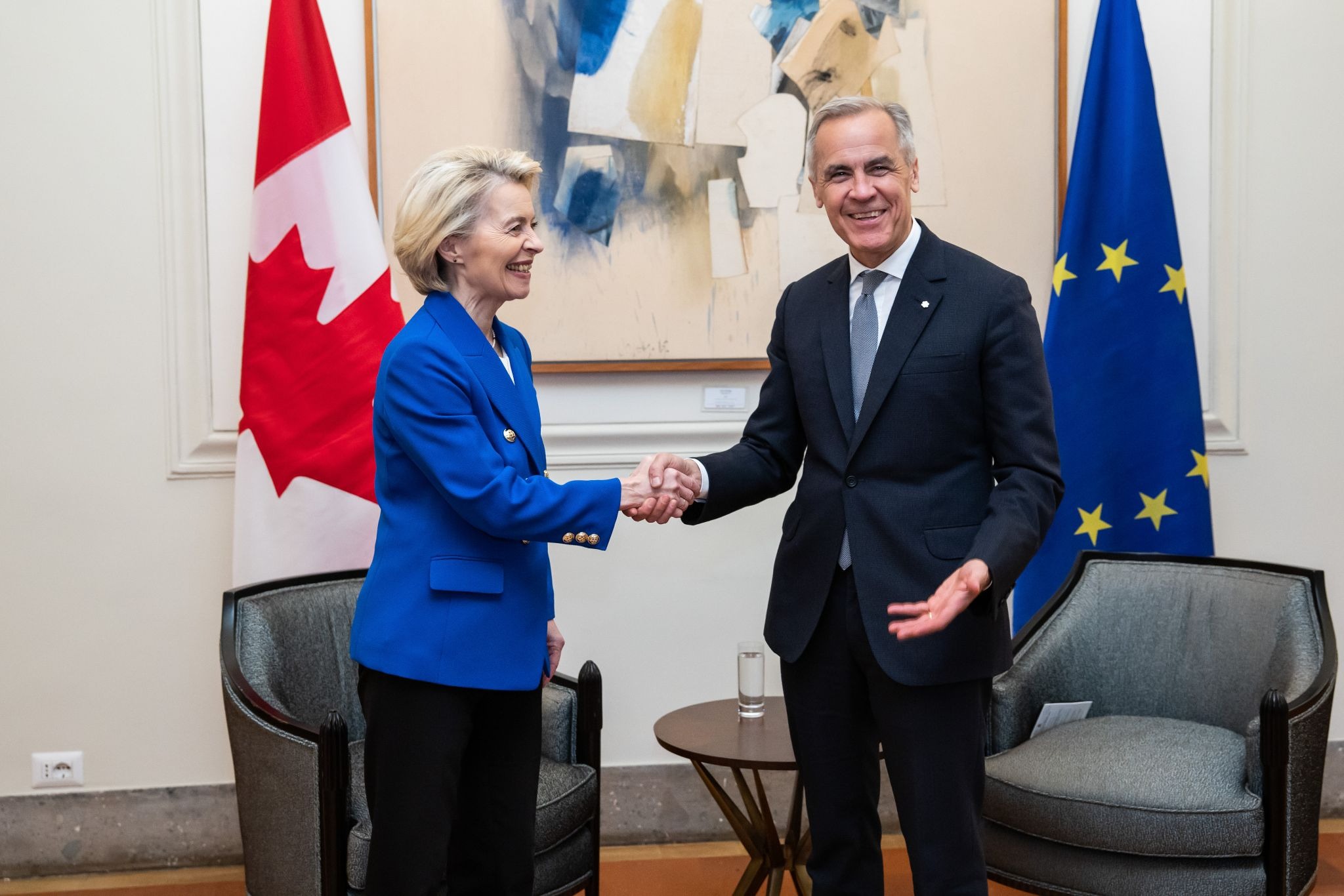
Recent years have seen a shift in the global structures of power, one that was keenly observed by Canadian Prime Minister Mark Carney. On January 20, 2026, Carney delivered a landmark speech at the World Economic Forum in Davos, Switzerland, warning against the breakdown of international norms that were leaving smaller nations at the economic mercy of larger powers. He proposed a coalition of middle powers to counter the arbitrary influence of superpowers and prevent political and economic subordination. Several months later, in September, European Commission President Ursula von der Leyen proposed that Canada become the EU’s first associate member. As the details are being negotiated, this proposal may serve as a first step toward the coalition Mr. Carney envisions, with the EU at its centre.
Mr. Carney’s assessment is very consistent with a specific strand of IR thought. Unlike institutionalism and constructivism, realism places greater emphasis on the material capabilities of political actors. Hard power is traditionally equated with military strength, but in Mr. Carney’s framework, it extends to economic leverage. The use and threat of tariffs by U.S. President Donald Trump are examples of geopolitical tools consistent with realist logic. The Canadian prime minister is no stranger to this new dynamic, as President Trump also tried to extract concessions from Canada under the threat of sweeping tariffs.
An important tenet of the realist framework is that the international system is anarchic. Without a central authority to restrain the behaviour of nations, states are free to use whatever means are at their disposal to pursue their own interests. Realism struggles to explain the persistence of various institutions, such as the UN, and state incentives to comply with international norms. But the theory can explain its failures, particularly in terms of hegemonic theory. Realist historians assert that international institutions “reflect the distribution of power in the world,” such as the victors of World War II, who were the founding members of the United Nations. In his speech at Davos, however, Mr. Carney contends that the postwar order is fading, and the institutions and norms it produced may be eroding with it.
A Diamond in the Rough
Carney’s realist diagnosis aligns with the situation the original members of the European Community faced. Structural concerns of postwar reconstruction and the Soviet-American rivalry encouraged interstate cooperation by delegating powers to a supranational element, the EU. This can be interpreted as an emerging application of rational-choice institutionalism, a convergence of realism and institutionalism. The new approach adopts institutions as a valid tool of statecraft to serve self-interest. Where Western European countries could individually benefit from closer cooperation, so too can a coalition of middle powers with the EU as anchor.
Debates over European integration have long featured a multi-speed structure. Officially, EU membership is a single status, yet the EU is already the product of overlapping treaties with different exceptions and relationships. Poland, for example, is a full member of the EU but not of the Eurozone, since it maintains its national currency. Several scholars have described the EU as essentially arising from multiple multilateral pacts and agreements rather than a single rigid constitution or treaty.
What stops the EU from extending these relationships to countries outside of the continent? The Commission admits that there is no explicit definition of “European” as a qualification for EU membership. Their report notes that definitions overlap historical, cultural, and geographical meanings, as testified by the candidacies of nations like Turkey and Georgia.
Nothing, however, prevents the EU from establishing closer relations with nations outside the European continent. Trade deals with Mercosur, the South American trade bloc, are an example, though they are purely commercial. But these arrangements need not be purely economic in their orientation. Inviting a fellow Western democracy like Canada, which Mr. Carney himself has described as the most “European” of non-European countries, suggests that “European” can carry a more ideological connotation. That opens the door for other Western democracies, like Australia, to aspire to this associate status.
The New Blueprint for a New Order?
Given this flexibility, the EU’s multiple tiers could serve as the bedrock for Mr/ Carney’s coalition of middle powers. As a start, the EU’s recent neighborhood policy with Mediterranean partners could spearhead the lowest tier, with countries pooling their economies in opposition to larger powers. Associate members could form a second tier composed of the closest partners of the EU, such as Canada, the UK, or Australia, falling just short of full membership and subject only to EU market laws and regulations.
Aside from the versatility of EU institutions, the EU also holds enormous global normative power. In a phenomenon called the “Brussels Effect”, the size of the European market compels foreign companies to adopt EU regulations and rules for easier access. This same dynamic could encourage closer governmental relations without the EU needing to compel them.
Another possible tier could then form above EU membership, resembling a federation. Given the logic of coalitions of the willing, it is conceivable that certain EU members, particularly in Western and Central Europe, could consolidate their competencies to field one mega-nation as a decisive representative for the middle powers. This method may be the only viable avenue for realizing hopes of European federalism. A European superstate would certainly tip the balance of power and give middle powers much more leverage. The only caveat is that domestic nationalist politics often constrain the desire for closer integration, so this possibility seems unlikely to materialize in the near future.
All in all, Mr. Carney’s speech at Davos paves the way for a new understanding, or construction, of the global order. One in which middle powers turn to institutions to pursue closer cooperation as a means to compete rather than be subjugated by larger powers. The EU’s institutions and influence appear well positioned to support this new initiative.
Edited by Léa Karam
The argument defended in this article is solely that of the author and does not reflect the position of the McGill Journal of Political Science, the Political Science Students’ Association, or the Political Science Department.
Featured image by Aurore Martignoni