In his conversation with Guy Lawson for a feature in The New York Times Magazine, Prime Minister Justin Trudeau made a radical claim: “there is no core identity, no mainstream in Canada [….] Those qualities are what make us the first postnational state.”
This vision of Trudeau fils for Canada’s identity owed much to the groundwork laid by Trudeau père. Former Prime Minister Pierre Elliott Trudeau was a founding father of sorts – his government drafted The Constitution Act of 1982, the Canadian Charter of Rights and Freedoms, developed Canada’s multiculturalism policy, and federally enshrined bilingualism. Trudeau, like any Canadian, is entitled to his own conception of Canada; however, his assertion that there is no “mainstream” raises questions about how his own Catholic background and French colonial heritage intersect with the historical hierarchies that have shaped Canada’s national identities.
Nevertheless, we have much to thank the Trudeau family for how we define Canada, whether through the institutions they helped forge or through their image as the model family of the Laurentian elite. Despite their undeniable influence, we do not, of course, only have the Trudeaus to thank—lest we forget our greatest aid in defining our country: the Americans.
Canadian national identity is arguably pluralist, as its institutions define the state as a civic community rather than a distinct ethnic or unicultural one. On an American-dominated continent, the U.S. has played a central role in shaping Canada’s pluralist identity.
The Canadian Union Against American Annexation
The U.S. facilitated the very formation of the Dominion of Canada. Confederation was partially motivated by an impending American threat, where the Fathers of Confederation sought unity in the face of the imposition of American tariffs on British North American goods and the subsequent possibility of American annexation. Indeed, as Sir Étienne-Paschal Taché, Premier of Lower Canada, stated in 1866:
“If the opportunity [Confederation] which now presented itself were allowed to pass by unimproved, whether we would or would not, we would be forced into the American Union by violence, and if not by violence, would be placed upon an inclined plain which would carry us there insensibly.”
In July 1866, the U.S. House of Representatives passed an annexation bill that would have resulted in the United States acquiring all of what is now Canada. The American Civil War was also a major factor in Canada becoming a stronger federal state than the United States, as the founding fathers feared the overwhelming violence that the American federal structure had led to.
The Role of American Hegemony on Canadian Multiculturalism
Anchored by the creation of the IMF, World Bank, and U.S. dollar hegemony, the institutionalization of the U.S.-led global economic order fundamentally reordered global capital flows and encouraged unprecedented labour migration from the Global South. In the 20th century, deeply integrated into the American-engineered global capitalist architecture, Canada was forced to restructure its immigration system to meet the labour demands of this international order.
Consequently, Canadian multiculturalism emerged not merely as a domestic response to internal challenges—such as the Quiet Revolution and constitutional debates of the 1970s—but as an economic requisite of the neoliberal globalization prompted by the United States. As the structural pressures of globalization weakened traditional nation-states, adopting official multiculturalism allowed the Canadian state to construct a welcoming ideological and institutional environment for its incoming Global-South workforce. The formation of Canada’s state identity underscores the overarching structural power of the U.S.: by dictating the rules of global capital and international labour mobility, the U.S.-led order ultimately compelled Canada to define its state identity through multiculturalism.
In light of the Royal Commission on Bilingualism and Biculturalism, there was an increase in demands from Canadians belonging to neither French nor British roots—known as the “Other Ethnic Groups”—to be recognized as contributors to Canada’s national identity. There was a confluence of both the demands of these groups, as well as the inescapable demands of Canada’s economic position post-World War II. The development of Canadian multicultural policies was an effort to meet these demands, and importantly to inoculate the dilemma of Canada’s labour supply.
In classic Canadian fashion, the weight of the American might is always part and parcel to policy decisions. In order to sustain economic growth in the long-term, Canada needs migrants as well as the ability to differentiate itself from the U.S. through multiculturalism, in part to attract skilled Global South migrants who might otherwise choose the U.S.
The recognition of certain rights for religious and linguistic groups by the British North America Act “set the tone for a collectivist notion of rights in Canada and would foster the eventual acceptance of a pluralistic society, a precedent whose legacy lasts well into the 21st century. Canada’s multiculturalist, pluralist identity was not just an outcome of domestic cultural development, though that certainly carried considerable weight. The state’s official embrace of multiculturalism served as a tangible reason for potential migrants to choose Canada.
The architects of the policy perceived barriers to migrants’ economic success in cultural and linguistic terms, and their efforts were aimed at facilitating “the ways in which cultural minority groups could fully participate in Canadian society.” The government adopted the position that Canadian identity would not be undermined by multiculturalism. On the contrary, it sincerely believed that “cultural pluralism is the very essence of Canadian identity.”
Now, as the U.S. retreats and the world as it has been known since the Cold War reorders itself, Canada looks towards new horizons. In the 21st century, Canada faces the same threats it did ages ago, as well as shifting tides in international norms and interests. The pressures imposed on Canada by the U.S. have jolted the country into shape, dusted off old habits, and renewed old conversations on continental integration and sovereignty. If it meant confederation in the Victorian age, pluralism and multiculturalism in the Second Elizabethan age, who knows what the world holds for Canada’s identity vis-à-vis America’s attitudes in the Carolean age?
Edited by Willa Merer
The argument defended in this article is solely that of the author and does not reflect the position of the McGill Journal of Political Science, the Political Science Students’ Association, or the McGill Department of Political Science.
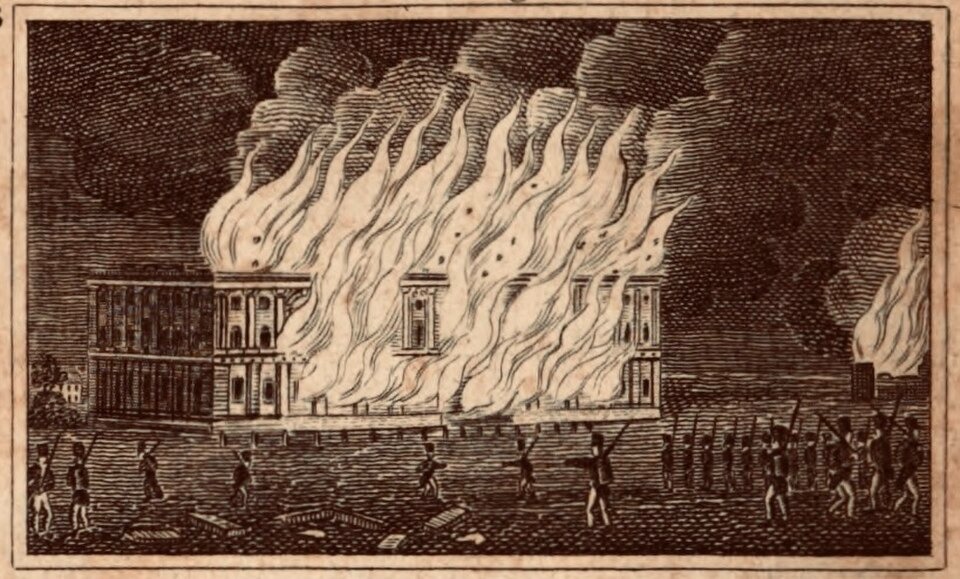
Featured Image by John Warner Barber obtained via Wikimedia
