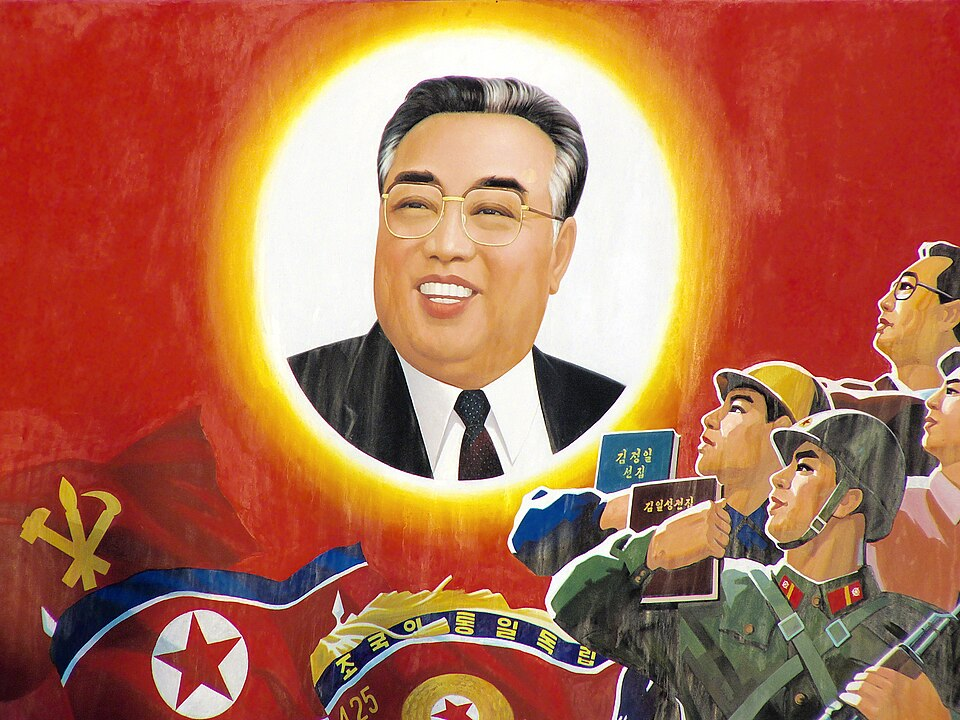
Earlier this month, North Korea published the first “Revolutionary History” biography about Supreme Leader Kim Jong Un’s life, marking Pyongyang’s latest effort to push its state ideology of Juche onto its people. Translated as “self-reliance” in English, the Kim dynasty has long utilized Juche, characterized by revisionist history and propaganda emphasizing their divine right to rule, to influence North Koreans into conformity and restrict their knowledge of the outside world. However, Juche’s greatest strength may also be its greatest weakness. The regime’s legitimacy depends on North Koreans’ lack of information, but as foreign media finds its way into the country, this control becomes harder to maintain. How long can Pyongyang keep the truth at bay? And could the growing cracks in Juche eventually threaten the Kim dynasty itself? As North Koreans gain greater access to the outside world, the regime’s ability to preserve its ideological grip will increasingly depend on how it responds to these challenges.
Origins of the Myth
The implementation of Juche in North Korea was first made plausible by Soviet support for North Korea’s first supreme leader, Kim Il-Sung, before the Korean War. Due in part to the connections Mr. Kim made while serving in the Soviet Army’s 88th Brigade, Soviet forces initially touted him as the “leader of the Korean people”. This backing helped elevate Mr. Kim’s public stature in North Korea, with his portrait placed alongside Soviet premier Joseph Stalin’s in public places and the nation’s flagship university named after him in 1946.
Yet, Juche truly permeated into North Korean society out of necessity for Mr. Kim, as he faced a legitimacy crisis following the ceasefire that halted the Korean War. With his Soviet allies becoming increasingly alienated from North Korea after Chinese assistance to Pyongyang in the Korean War, Mr. Kim was cornered by the Domestic faction within North Korea. To avoid being ousted, Mr. Kim ordered a purge of the North Korean Communist Party in the 1950s based on perceived loyalty. With his legitimacy in place, the stage was set for Mr. Kim’s 1955 speech “On eliminating dogmatism and formalism and establishing Juche in ideological work”, which was the first formal introduction of Juche in North Korean society. In this speech, Mr. Kim argued for blending Marxist-Leninist ideals with traditional Korean culture, marking the beginning of his own communist system, which relied on controlling the information available to North Koreans, allowing for a revisionist history, and gradually re-educating the population around his own accounts.
Challenges in Crisis
Throughout the remainder of the Cold War, Mr. Kim and the ideals of Juche remained central to North Korean political thought, while the country enjoyed support from both the Soviet Union and China as a communist stronghold on the Korean peninsula. Even during the escalating Sino-Soviet split of the 1960s, Kim used Juche to benefit from both powers, remaining largely neutral while playing to each side at different times to maximize aid. However, after the Cold War ended and the Soviet Union collapsed in 1991, North Korea’s pipeline of external assistance was practically cut off overnight. Coupled with the transition of power to Kim Jong-Il following the death of Mr. Kim in 1994, North Korea’s centralized food distribution system essentially halted in place, leaving the nation exposed when large-scale floods destroyed a significant chunk of arable land in 1995. The resulting famine is estimated to have caused up to 3.5 million deaths, nearly 20 percent of the nation’s population at the time.
The newly installed administration of Mr. Kim Jong-Il responded to this catastrophe by leaning further on the Juche ideology, imposing tight restrictions on foreign aid from international relief organizations. Because humanitarian workers were extremely limited in their ability to interact with North Koreans, corruption within the chain of command led to increased suffering for ordinary civilians, especially in urban areas where the defunct food distribution system was indispensable. Despite the death toll, Mr. Kim Jong-Il was also able to use Juche to deflect responsibility from his governance, labeling the famine as the “Arduous March” and portraying it to the masses as a revolutionary struggle against the West rather than a fundamental government failure. With the extremely stringent security measures regarding foreign interference, he successfully restricted the flow of information to his people, preserving both his dictatorship and Juche in the minds of North Koreans.
Despite the Kim family’s historical success in maintaining legitimacy through the Juche ideology, avenues of alternative information have become increasingly available to North Koreans in the aftermath of the famine of the 1990s. In the wake of the public distribution system’s failure to provide basic necessities, North Koreans created the jangmadang system, a black market where excess goods could be bartered. Eventually, the jangmadang came to involve Chinese smugglers, who would bring goods across the northern border to distribute at the markets, creating a new problem of information control for the Kim regime. Contraband merchandise included outside movies, videos, and music stored on USB drives and cell phones, allowing jangmadang customers access to foreign culture that contradicted the teachings of Juche.
Attempts at Retention in the Modern Era
Despite these risks, the Kim regime’s desire to crack down on jangmadang was hindered by the growing network of government bribes involved in the trade, as well as the lack of government infrastructure to offset the population’s dependence on black markets. However, this would change with the onset of the COVID-19 pandemic, which would end up providing the Kim regime an opportunity to regain the relinquished control over both the North Korean economy and the information flow of the populace.
As COVID-19 spread, North Korea began deploying special forces with shoot-to-kill orders to its borders in January of 2020, locking out the Chinese smuggling business over the northern border. This new security measure drastically slowed jangmadang trade in the country, allowing the regime to recapture its power in the North Korean economy. After succeeding his late father in 2011, new supreme leader Kim Jong-Un issued an order requiring all private businesses operating in state-owned spaces to be assimilated into the national commercial network, pushing the jangmadang into the boundaries where proper government oversight could be established and targeting the influx of foreign content into North Korean borders. Despite this measure, the bribery network proved too entrenched in North Korean society to fizzle out, and a new aekbeori subcontracting system emerged to replace lost profits.
The Kim regime must ensure that their government-run mechanisms can fully sustain a comfortable living for the common North Korean civilian, something which will likely take years to implement. Yet, even if Pyongyang finds a quicker solution, the spread of existing foreign contraband will continue to nip at the heels of the Juche ideology, as the internal distribution of information threatens to uproot the Kim family’s legitimacy to rule the country. When civilians gather the truth from external sources and challenge the government’s long-standing misinformation tactics, the entire Juche framework loses credibility and risks collapse.
Thus, the future of Juche is contingent on the Kim regime’s ability to truly embody the ideology; to keep the masses in check, North Korean institutions must themselves be self-sustaining. How the regime responds to the growing cracks in its carefully constructed facade in the coming years will ultimately determine how much longer the North Korean people remain under its oppressive rule.
Edited by Martín Rojas Remolina
The argument defended in this article is solely that of the author and does not reflect the position of the McGill Journal of Political Science, the Political Science Students’ Association, or the McGill Department of Political Science.
Featured image courtesy of wikicommons
