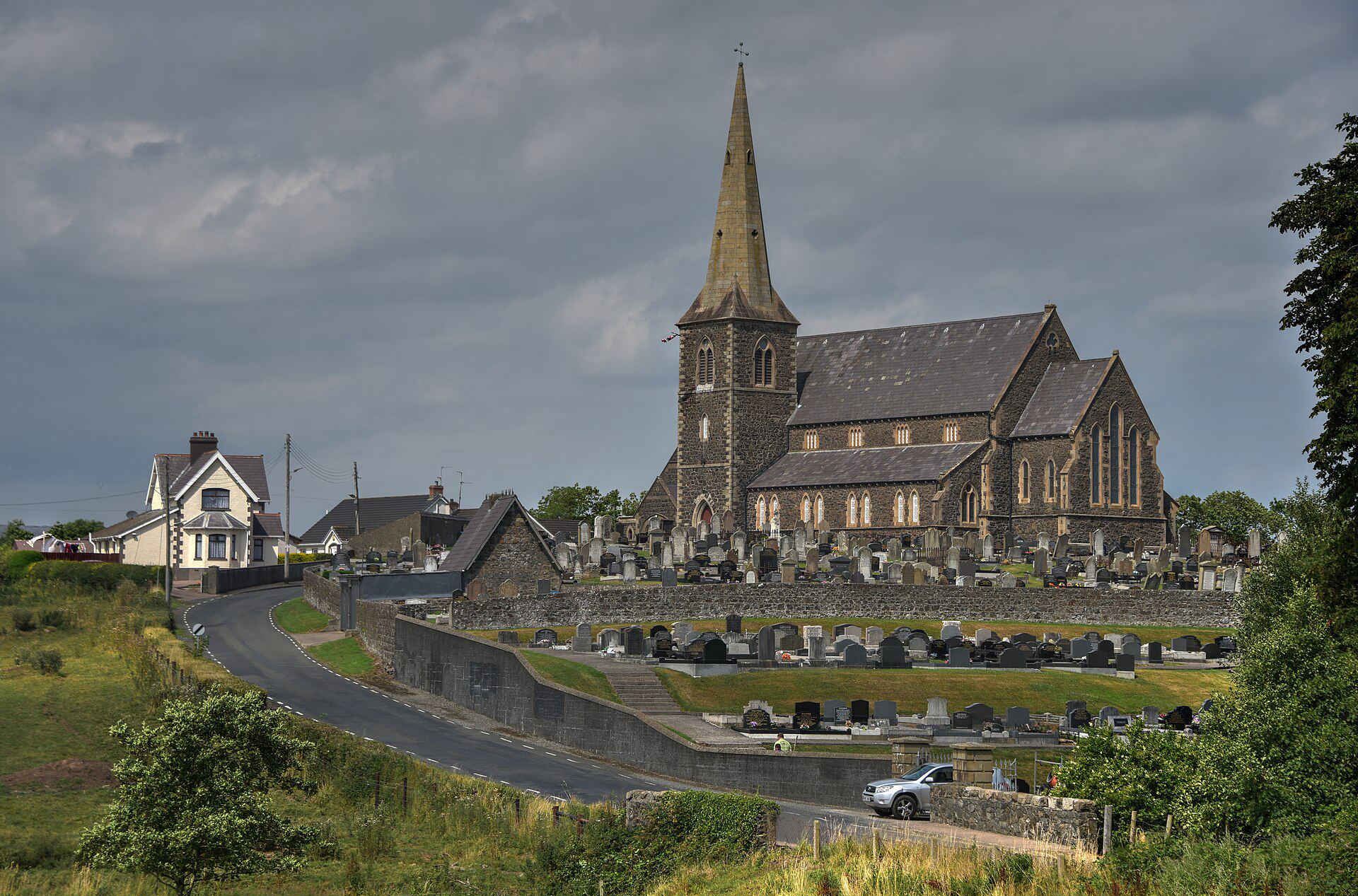
In September 2026, residents of Garvaghy Road in Northern Ireland blocked an Orange Order parade, reviving a dispute that turned violent in 1998. Using this standoff, this article asks whether peace can last when each community’s identity rests on memories the other experiences as an attack. Drawing on Renan and on Cento Bull and Hansen’s modes of memory, it argues that the Good Friday Agreement built an institutional peace while keeping memory antagonistic. Since neither forgetting nor consensus is possible, lasting peace requires an agonistic politics of memory, in which divided pasts are not healed but held in open dialogue.
On the 27th of September 2026, in Northern Ireland, residents of Garvaghy Road, in Portadown, County Armagh, blocked an approved Orange Order parade down their road, the first on the road in almost thirty years. Thirteen days later, the Secretary of State banned the march. Whilst the obstruction of a single parade may appear insignificant, its importance lies in the memory it evokes: in 1998, a dispute over the same march along the same route prompted widespread disorder and violence, only months after the Good Friday Agreement had brought thirty years of sectarian violence – known as ‘the Troubles’ – to an end. That such a dispute can still resurface nearly three decades later reveals how contested the past continues to be and raises broader questions about the relationship between memory and identity: whether a political community requires a shared memory to hold together, why rival memories come to be experienced as threats, and whether divided memories should be reconciled, forgotten or left unresolved. In Northern Ireland’s case, has the Agreement and its prescriptions of consociational governance secured a lasting peace or merely institutionalised historic identity-based divisions? Can conflicting communities find a peaceful resolution if each grounds its identity in opposition to the other? Should memory even aim to be healed—or is Seamus Heaney right in his assertion, addressing the island itself, that “No treaty… will salve completely your tracked and stretchmarked body”?
Political theory on memory, including Anna Cento Bull and Hans Lauge Hansen’s distinction between antagonistic, cosmopolitan, and agonistic memory, and Ernest Renan’s account of forgetting in the making of nations, can help answer these questions. Drawing on these accounts, this essay argues that lasting peace in Northern Ireland requires neither a shared myth nor a forgotten past, but memories that remain plural and are held in open dialogue.
Why Garvaghy Road?
Garvaghy Road’s significance does not lie in the parade itself. Orange Order marches are routine across Northern Ireland, where more than 550 take place each Twelfth of July alone (with others held abroad, from Scotland to Canada), marking the Protestant victory at the Battle of the Boyne. What sets this march apart is its route through a predominantly Catholic enclave in a majority-Protestant town, as well as the particular history that route carries. Beyond the recent cycle of appeals, injunctions and bans, what has returned is a dispute over this road specifically. For the Orange Order, a Protestant and loyalist fraternal organisation, parades are acts of commemoration and affirmations of British identity, and walking this particular route is itself part of the tradition. For many Catholic residents, the same march through their neighbourhood has long been experienced as triumphalist. These feelings are only amplified by the memory of 1998, when the Parades Commission ruled against the march and Orangemen gathered at Drumcree in a standoff that sparked rioting across Northern Ireland, creating the atmosphere in which three young Catholic brothers were killed by loyalist paramilitaries. Where Catholic residents grieve the events of 1998, the Orange Order and its supporters see each ban as an attack on tradition. The dispute is, then, not over the road itself, but what it symbolises, as well as whose past gets to define the present.
The Role of Memory
It is evident from the events at Garvaghy Road that what inflicts even more pain than the present may be the past, and the memory each community has made central to its self-definition. Why, then, does memory bind so tightly to identity? For Renan, an essayist on the nation, “unity is always achieved brutally”, a nation must forget its violent past to feel unified: “the act of forgetting… [is] an essential factor in the creation of a nation.”1 Forgetting alone is not enough, however. A nation must also be sustained by the continued consent of its people, or a shared desire to go on living together.2 While Renan’s memory is monologic—one story held in common and made possible by forgetting whatever divides—memory need not take this form. Theorists of political memory Cento Bull and Hansen distinguish three modes of memory: antagonistic, cosmopolitan and agonistic. Of these three, the antagonistic mode sits closest to Renan’s: both are monologic, allowing only one voice to define the past, whether by erasing the memories that threaten unity or by elevating one community’s myth over the other’s. The cosmopolitan mode, by contrast, looks beyond any one community’s story and focuses instead on the suffering of victims on all sides. It is dialogic, bringing different memories into conversation, but its dialogue is Habermasian, “oriented to achieving, sustaining and reviewing consensus”, and so it still aims for a single, agreed account of the past. In a society as deeply historically divided as Northern Ireland, such consensus would require one community to concede that its memory is somehow mistaken, something no community whose identity rests on that memory could accept.
Cento Bull and Hansen therefore suggest that the change required is not simply in what is remembered, but in how memory itself operates: a move from the monologic memory of the antagonistic mode, and the consensus-seeking dialogue of the cosmopolitan mode, towards a dialogue that is open-ended. This is what they call agonistic memory. Drawing on the Russian literary theorist and philosopher Mikhail Bakhtin, they propose a “dialogic approach which relies on a multiplicity of perspectives”, one that is “open-ended and does not aim at any specific conclusion.” For Bakhtin, this method of dialogue is not just better, but follows from the recognition of the self as fundamentally relational: “I cannot manage without another, I cannot become myself without another.” If identities are formed in relation to one another, then no community can understand its own past by excluding or flattening the other’s. In practice, agonistic memory avoids pitting “good” against “evil” by acknowledging that ordinary people are capable of violence in particular circumstances, draws on the testimonies of everyone involved, treats empathy with victims as a first step towards understanding, and reconstrues the context that led to violence. The aim of agonistic memory is not for memory to be healed, or forgotten as Renan suggests, but for each community to remember alongside the other rather than against it.
The Good Friday Agreement and the Institution of Antagonistic Memory
The fragility of peace in Northern Ireland, exemplified by the Garvaghy Road standoff, must be understood in relation to the Good Friday Agreement, and to what it left unresolved. The Garvaghy Road standoff points to a fragile peace. The Good Friday Agreement was constructed to bring an end to 30 years of violence, and in that it largely succeeded. Its central mechanism was consociation, a power-sharing strategy designed to manage power between divided communities by guaranteeing each a share of government. But in doing so, the Agreement built a formal, institutional peace while neglecting peace at the level of lived emotion and identity. The peace agreed in government did not necessarily match what was experienced by communities on the ground, many of whom had lived through the violence first-hand, and in settling power, the Agreement offered no path forward for dialogic memory. In fact, as the following sections show, it closed off the very avenues through which agonistic memory might have developed.
First, the Agreement made identity foundational to power-sharing, institutionalising identity-based divisions. Consociation’s four main features (shared executive power, self-government for each community, proportional representation and mutual vetoes) all assume that politics is organised around two distinct communities, Irish Nationalist and British Unionist. In treating these identities as fixed and fundamental, the Agreement entrenches the antagonistic mode by defining each against the other. Yet identities in Northern Ireland are multiple and overlapping. Not every Unionist is a hardline loyalist, not every Nationalist a militant republican, and a growing number of people identify as neither Unionist nor Nationalist. Forcing a whole society into two categories is not only inaccurate but harmful by denying the path for agonistic memory to form. Where agonistic memory depends on a multiplicity of perspectives, consociation reduces the past to a false dichotomy.
Second, the Agreement left the past unaddressed—not forgotten, as in Renan’s account, but simply unresolved. The Agreement offered an official silence on what the Troubles meant and who was responsible, leaving memory to be claimed by each community for itself.3 Socially, the remembering continued, and with no shared framework, each community narrated its own account, which is why the same stretch of Garvaghy Road can carry two entirely different pasts. With no ruling on responsibility, victimhood became a weapon in the argument over blame, with each side “downplaying the victimhood of their adversaries.” Agonistic memory would require exactly what the Agreement avoided: a space in which the testimonies of victims, perpetrators and bystanders could be heard side by side, and the context that led to violence reconstructed. Without it, the past was left to the antagonistic mode, where each community remembers itself as the victim and the other as the perpetrator.
Third, these divisions persist because they meet a deeper need. Groups need more than physical safety: they also need a stable, continuous sense of who they are. A long conflict can supply this ontological security, as defining “us” against “them” gives each community a clear identity and story about itself. Breaking free of the conflict can therefore feel threatening, since without a stable opposition to ground it, that sense of self is unsettled. This is precisely what makes agonistic memory difficult. Each community has learned to define itself against the other, while agonistic memory asks it to recognise that it is formed through the other, and to treat that other as an adversary to argue with rather than an enemy to define itself against. Taken together, these choices built a peace that holds at the institutional level but not in how communities remember or see themselves, which is why a dispute over one road can feel like a threat to who people are.
Remembering Alongside
Thirteen days on Garvaghy Road exemplify how nearly three decades after the Good Friday Agreement, the past in Northern Ireland remains unsettled. The Agreement settled who governs, but it left open how the past is remembered. Since neither forgetting nor consensus is possible when each community’s identity rests on its own memory, agonistic memory offers the only path that does not require one past to defeat the other. Applied to Garvaghy Road, an agonistic politics of memory would mean remembering the route’s history through both the grief of Catholic residents over the 1998 Drumcree standoff and the Orange Order’s sense that its tradition has been repeatedly denied, rather than deciding whose account should ultimately prevail.
Admittedly, this is easier said than done. Agonism depends on each community accepting the other’s right to remember differently, and a parade cannot both take place and not take place: decisions will still be made, and either way someone’s memory will still feel denied. What can change is how those decisions are understood — not as one memory defeating another, but as moments in an ongoing dialogue. The Irish poet Eavan Boland’s “The Historians” concerns the private memories of women that official history passes over, yet the task she describes could equally be Northern Ireland’s: “To stop memory becoming history/ To stop words healing what should not be healed.”
Edited by Anyue Zhang
The argument defended in this article is solely that of the author and does not reflect the position of the McGill Journal of Political Science, the Political Science Students’ Association, or the McGill Department of Political Science.
Featured image by August Schwerdfeger

- Ernest Renan, “What Is a Nation?,” in What Is a Nation? and Other Political Writings, (New York: Columbia University Press, 2018), 251. Renan’s wider work includes troubling views that are often regarded as antisemitic and racist, as well as a defence of colonialism. This essay draws only on “What Is a Nation?”, which rejects race as a basis for nationhood (see esp. 255) and remains influential in theories of the nation and the study of collective memory. ↩︎
- Ibid., 261. ↩︎
- Sara McDowell and Máire Braniff, Commemoration as Conflict: Space, Memory and Identity in Peace Processes (Houndmills, Basingstoke, Hampshire, UK: Palgrave Macmillan, 2014), 43. ↩︎