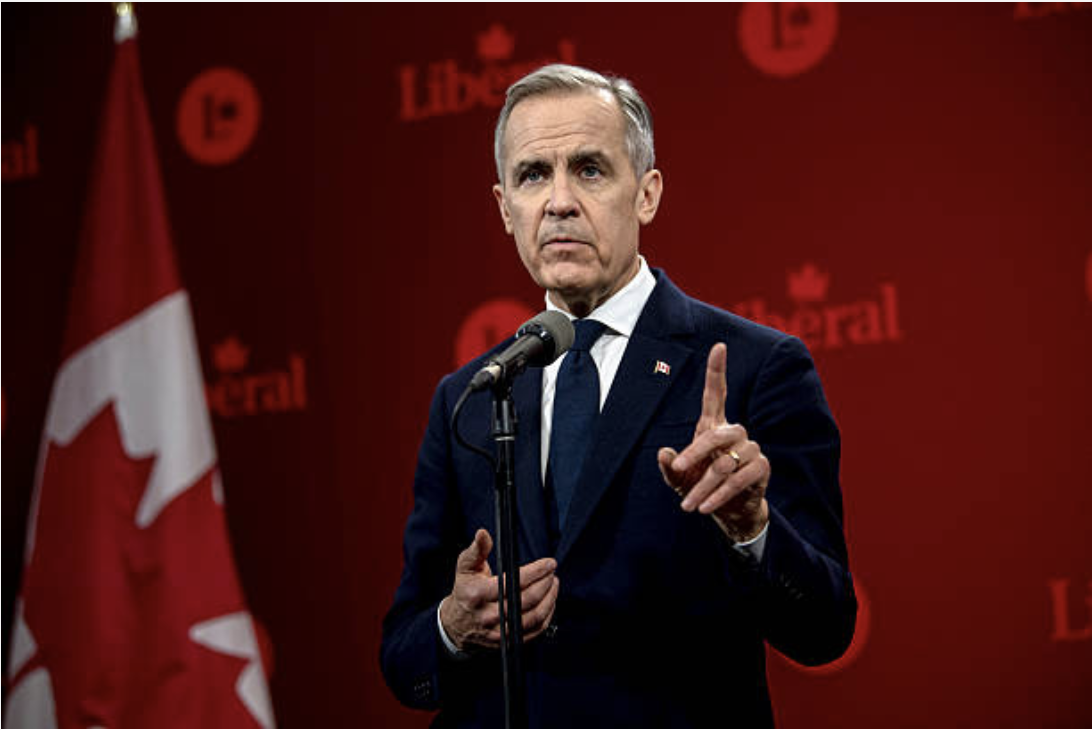
With the Liberals settling into a stable double-digit lead over the Conservatives in recent polls, and electoral support for the Conservative Party dropping to its lowest point in two years at 28%, one thing remains certain: Prime Minister Mark Carney has garnered unprecedented dominance over the Canadian political system. With his personal approval rating jumping to 66% in recent polls— Mr. Carney’s highest since taking office— it’s become apparent that by fundamentally recasting what it means to be an institutionalized liberal in 2026, the new Prime Minister has captivated and retained the attention of the Canadian populace. While many Canadian leaders have utilized the precedent of their political party as a greater call to action in mobilizing voters and ideology, Mr. Carney’s rejection of once foundational assets of the Liberal Party has proven uniquely effective for his ministry.
The Davos Speech: A Conservative view for Global Order
On January 20th in Davos, Switzerland, Prime Minister Carney delivered a provocative speech, setting out the principles by which he would lead Canada through a tumultuous and volatile political struggle with its southern neighbour. Avoiding euphemisms, weasel words, and sycophancy, Mr. Carney named the potential catastrophe of Washington’s policies for global order and signalled that at least one erstwhile ally is willing to hedge against, and if necessary, balance, an unpredictable and predatory United States. The firm outward mosaic he produced— that of restoring faith in international institutions to preserve political order, and his call to shed the passivity that has long subordinated middle powers to a hegemonic international system—has created a strongman aura around the Prime Minister. This aura has become characteristic of his governance: a conservative instinct for order and sovereignty, wielded through technocratic means, and deployed against the grain of traditional Liberal party policies.
For instance, in his speech, Mr. Carney invoked Václav Havel’s greengrocer metaphor to argue that the old order was legitimated not by truth but by a shared performance of belief: countries, invested in the status quo tacitly declining to hold hegemons accountable. This legitimating “fiction” was “useful” and comfortable for countries to assume, but ultimately must be recognized as false. Here, PM Carney’s position adopts a distinctly conservative nature: human beings are complicit in their own deception, and the system’s fragility comes from the same source as its power.
Breaking with Trudeau-era Liberalism
Former Prime Minister Justin Trudeau’s liberalism, and largely the Canadian Liberal Party historically, were built on the premise that “better is always possible”—a positivist faith in human reason and goodwill. Mr. Carney’s speech rejected that liberal ideal by stating that the old story was “partially false,” that “the strongest would exempt themselves when convenient,” and that ultimately “trade rules were enforced asymmetrically,” not by promise.
Further, Mr. Trudeau’s Liberals worked to employ an explicitly values-based and ideological foreign policy that centred on humanitarianism and progressive social programs. PM Carney has since scaled back those commitments, shifting toward “ economic and security guarantees” and “military investments.” This is the conservative pillar of prudence over principle: Mr. Carney is not abandoning values-based liberalism, but instead subordinating these fundamental values to the stability and order that constitute a wholly conservative anthropology.
Domestic Policy: The Carbon Tax Reversal
Although underpinned by foreign relations, the Prime Minister’s antithetically technocratic approach to governance also manifests in a distinctly domestic fashion. The consumer carbon tax—a signature achievement of the Trudeau-era climate agenda—was eliminated in Mr. Carney’s first move as Prime Minister. This reversal makes clear an intrinsic conservative governing instinct founded upon the belief that government should be limited, that taxes should be low, and that the state should not impose burdensome costs on ordinary citizens. The ideological kindling of this decision becomes potent given that conservative leader Pierre Poilievre’s “axe the tax” is a central rallying cry. Therefore, by adopting the Conservative position, PM Carney signals that he is more than willing to govern from the right rather than as a Trudeau-style liberal, despite his party affiliation.
Immigration: From Nation-Building to Border Control
Similarly, under Mr. Carney, immigration policy has shifted toward what his government calls “taking back control” of the system, with international student permits cut by more than half and temporary resident admissions capped at five percent of the population. The phrase “taking back control” is not liberal vocabulary. It is sovereigntist language, borrowed from the Brexit playbook and from conservative critiques of supranational authority. This is especially interesting given that a cornerstone of classical liberalism, particularly in its Canadian expression under Mr. Trudeau, is the treatment of immigration as a nation-building project that should be fundamentally open and expansive. Here, Mr. Carney’s position becomes clear: immigrants are welcome insofar as they contribute economically, not insofar as they need protection or enrich the social fabric of the nation. The Liberal Party, who had once oriented themselves towards a universalism that entailed the rights and opportunities belonging to persons as such, are refuted through PM Carney’s policies, which frame some arrivals as more desirable than others given their economic utility. Mr. Carney’s Liberal Party is not rejecting immigration altogether, but rather is reordering it according to an increasingly conservative logic.
The Carney Formula: Liberal Image, Conservative Substance
Prime Minister Carney is best understood not as a flat-out conservative ideologue, but as a liberal who has adopted conservative instruments—fiscal discipline, border control, military investment, and law-and-order legislation—to pursue the stability and order that the more optimistic left-wing Liberals failed to secure. By reorienting the Liberal Party’s core policy positions, Mr. Carney has amassed political support precisely by opposing or slowing what Trudeau’s Liberals sought to do—and by framing more right-wing policies as the remedy for public frustration with what many voters now read as Mr. Trudeau’s “laissez-faire” liberalism.
It appears undeniable that the Prime Minister has effectively reimagined what party politics means in Canada today. He has positioned himself as “Liberal” enough—in name and association—to keep left-wing support, while using that same Liberal label to justify policies and pass legislation that are indisputably conservative in effect. The result is a deliberate blend of liberal image and conservative substance: a duplicity designed to capture the median voter.
With approval ratings consistently ranging from mid-to-high 60s, numbers unprecedented since former Prime Minister Jean Chrétien, PM Carney’s leadership has become widely accepted as the solution to both international subordination and domestic institutional gridlock, and it is precisely his conservative dogma under a Liberal banner that makes this ideological positioning so electorally successful.
Edited by Lauren Bennato
The argument defended in this article is solely that of the author and does not reflect the position of the McGill Journal of Political Science, the Political Science Students’ Association, or the Political Science Department.
Featured image by Andrej Ivanov