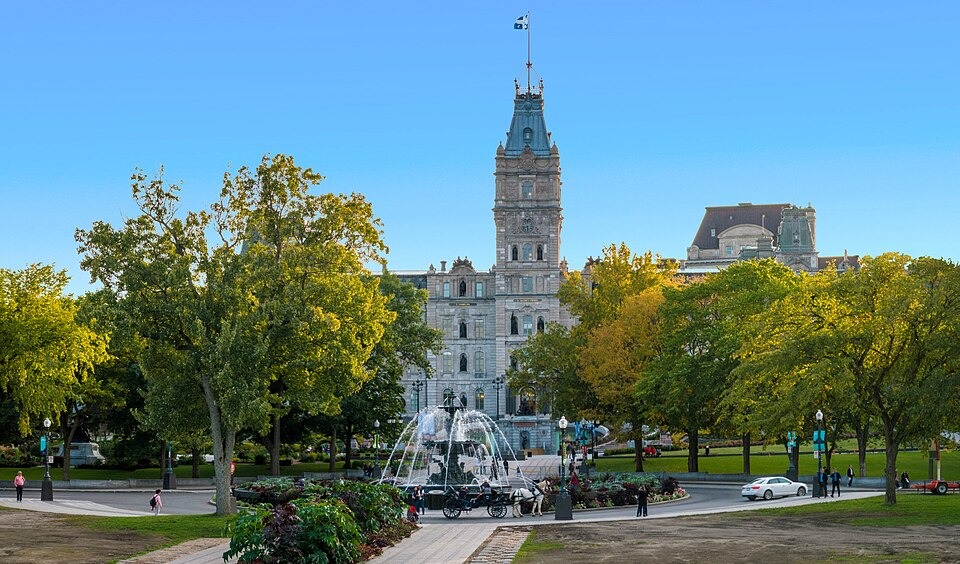
On October 5th of this year, Paul St.-Pierre Plamondon’s Parti Québécois (PQ) secured a landmark electoral victory in Québec’s provincial election—winning a plurality of 59 seats in the Quebec National Assembly. Controversy plagued the incumbent party, Coalition Avenir Québec (CAQ), while unprecedented vote-splitting among the remaining parties created a political landscape that was uniquely favourable for the formation of Québec’s first sovereigntist government since the PQ’s Pauline Marois departed office in 2014.
Mr. Plamondon’s victory presents a distinct threat to Canadian federalism and national unity. The looming referendum in Alberta adds further fuel to the separatist fire. During a period of unprecedented political upheaval, Prime Minister Mark Carney has urged Canadians to remain unified in the face of brazen American aggression. However, growing separatist efforts continue to serve as unwelcome distractions. Separatist rhetoric is particularly counterproductive for Canada, a country whose recent foreign policy has been increasingly defined by depicting itself as a reliable and consistent partner on the global stage. Separatism introduces new domestic tensions that undermine the government’s global strategy by compromising national credibility.
Now, as Alberta and Québec push for greater autonomy, the federal government must consider the potential ramifications of secession referendums in the provinces that respectively rank first and sixth by GDP per capita. In the near future, these dangers to Canadian federalism must be handled with the shrewd temperament that Mr. Carney has sought to display since his first day in office. Therefore, the first question on the federal government’s docket is simple: is secession truly feasible under the constraints of modern Canadian political culture?
Plamondon’s New Strand of Separatism
The Parti Québécois is not an unfamiliar entity in Québec politics, but Paul St.-Pierre Plamondon is certainly a unique addition to the province’s political canon. Mr. St.-Pierre Plamondon (dubbed PSPP by followers of Québec’s politics) was not tipped by pundits as the man to steer the PQ’s ship back into the top rung of provincial politics. Although Mr. St.-Pierre Plamondon undoubtedly flies the same banner as those who carried his separatist “dream,” he is not an exact ideological successor to the PQ’s foundational members.
The Parti Québécois was founded in 1968 by Gilles Grégoire and René Lévesque and was oriented around a grievance-based secessionist platform. The PQ fundamentally operated as a social democratic party, orienting its separatist agenda around the notion of a communitarian Québec ethos. Throughout its history, the party has argued for a mandate to exit Canada to stabilize Québec and fully employ its resources as an independent nation-state. Although the party’s central office has altered the degree to which it emphasizes its nationalist rhetoric, a common tenet of the PQ’s policy has been the affirmation of French identity amid fears that the language is under threat. Yet, Mr. St.-Pierre Plamondon has altered this message and expressed his nationalist politics in a different light.
Mr. St.-Pierre Plamondon fits within a new ilk of separatist leaders. He has inflamed culture war rhetoric and embraced right-wing identitarian nationalism. Through consultation with Alberta’s separatist leaders, he has shifted the central organizing principle of Québec separatism, focusing on opposition to multiculturalism, rather than uniting under a common French identity. In a tangible way, the guiding mission of the Parti Quebécois’ founders has been abandoned by its modern iteration. Ruba Ghazal, leader of Québec Solidaire (QS), may be the true heiress of Lévesque. Under Ghazal, QS won nine seats with a left-wing, sovereigntist platform. Now, the support of Québec Solidaire may be needed for Mr. St.-Pierre Plamondon’s referendum. However, the PQ’s increasingly right-wing policies diverge from Ghazal’s ideology in several key areas, so Québec Solidaire’s consistent support for a separatist movement is not guaranteed.
Mr. St.-Pierre Plamondon is incorporating sovereigntism with a new face. It will be up to the whims of Québec’s voters, and its peripheral parties, to determine whether this strand of separatism is palatable enough to supersede the constitutional barriers in place.
The Illusion of Victory
Despite the victory, the PQ’s election win was not an overwhelming success for the sovereigntist movement. Secession may be the ultimate aspiration for the Parti Québécois, however, their tentative minority government does not mark a drastic reversal of fortunes for Québec separatists; rather, it serves as an indication of the province’s rightward shift.
Given the sheer rarity of the scale of the CAQ’s collapse (a provincial party has not imploded to this degree since the New Brunswick Progressive Conservatives in 1987), Mr. St.-Pierre Plamondon’s failure to reach the 64-seat majority threshold is a damning indictment of his party’s capacity to posit a referendum as the path to a brighter future. The lost support for Christine Fréchette’s CAQ was not vacuumed up by the PQ; rather, it was divided throughout the remaining competitive parties, suggesting that this election resulted from a resounding damnation of the CAQ, not an unequivocal embrace of the PQ’s governance qualities.
The PQ has been at the helm of two secession referendums throughout modern Canadian political history, in 1980 and 1995, each of which came within a 10 per cent margin of triggering the first phase of separation. However, Mr. St.-Pierre Plamondon’s historically low share of the popular vote suggests that this victory does not carry the same resounding threat of prior PQ governments. For the PQ, this result comes with the caveat that it only secured 28 per cent of the vote, the lowest share for a governing party in the history of Québec politics. This election bears all the hallmarks of one driven by deep voter vitriol directed at the CAQ, following the resignation of the highly unpopular François Legault and the subsequent failure of Fréchette to steer the party away from crisis.
For Mr. St.-Pierre Plamondon, this is a tepid, albeit meaningful, step into power—not a complete breakthrough. Votes for sovereigntist parties are often taken by the media to assume a direct vote for separatism, but there is no clear causal mechanism to link these voter behaviours. Even if we take for granted that the twenty-eight per cent of the population that voted for the PQ seeks a referendum during this administration, it is a far cry from the fifty plus one per cent rate that is needed to enact secession. At present, the broader Québec population is fatigued by discussions of a referendum, especially given that secession has been linked with a weaker dollar, falling stocks, and a lower GDP. Additionally, although minority governments have proven to be effective legislatures in the past, Mr. St.-Pierre Plamondon would be unwise to presume that his party has the mandate to justify a referendum.
A Case for Optimism
Until the results of the upcoming Alberta referendum are released, the true scope of the separatist threat cannot be fully understood, although the polls are currently indicative of a fairly comfortable victory for federalism. In Québec, it remains possible that the Parti Québécois under Mr. St.-Pierre Plamondon can successfully translate their minority government into a push for sovereignty, but their ambitions will be constrained by similarly low support for a referendum among the population. The Canadian government must not take the separatist threat lightly, but through decisive political imagination, history suggests that this is a storm that can be weathered. A house divided against itself can indeed stand, and it must do so if Canada is to remain equipped for the tumultuous months ahead.
Edited by Willa Merer
The argument defended in this article is solely that of the author and does not reflect the position of the McGill Journal of Political Science, the Political Science Students’ Association, or the McGill Department of Political Science.
Featured Image by Wilfredor obtained via Wikimedia Commons
