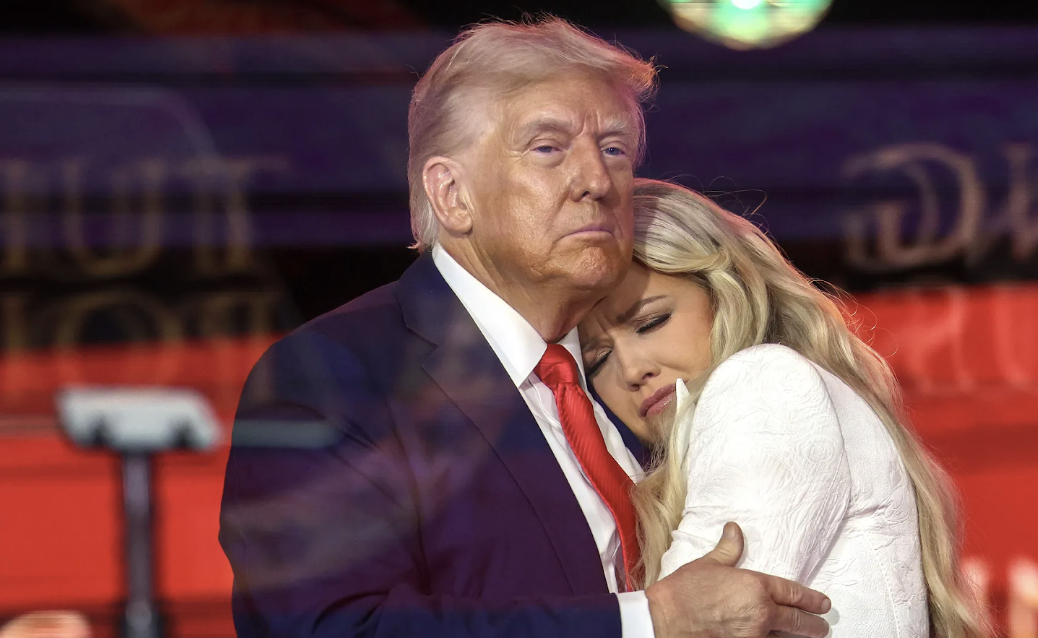
As Erika Kirk emerged on stage at State Farm Stadium in Glendale, Arizona, to eulogize her late husband, a line of sparkler machines quickly erupted, set against a soundscape of gospel music and the applause of over seventy-three thousand people:
Through all the pain, never before have I found as much comfort as I now do in the words of our Lord’s prayer, ‘Thy will be done,’ she said. I saw on his lips the faintest smile, and that told me something important; it revealed to me a great mercy from God in this tragedy… Charlie didn’t suffer… he blinked and saw his saviour in paradise.
Demise of the Charismatic Leader
“If you thought my husband’s mission was powerful before… You have no idea what you just have unleashed across this entire country … the cries of this widow will echo around the world like a battle cry,” she said1 in her first statement after Mr. Kirk’s death. In this moment, Mrs. Kirk made something incredibly salient: the murder of Charlie Kirk was just as much a site of possibility as it was a site of foreclosure. This reading, as this article will argue, is multiplicitous in its implications.
What, as verbalized by Mrs. Kirk, was an alleged catalyst for Christian resurgence, was also, in now infamous words of Jimmy Kimmel, an opportunity for “the MAGA gang” to “score political points.” This statement, along with the entirety of his opening monologue on September 13, led to the short-lived hiatus of ABC’s Jimmy Kimmel Live!—which promptly ended following a brief moment of bipartisan unity through collective uproar. The claim made by Kimmel, however controversial, is certainly a ripe subject for analysis, especially in the context of Kirk, who “live[d] like a capitalist every day.” Let us then investigate the so-called monetization of Kirk’s murder while engaging with theories of leadership succession and routinization.
The concept of a posthumous recognition effect is long-established and within political and sociological schools of thought. Max Weber cites “the demise of the bearer of charisma2” creates a pocket for the process of routinization, in which the “non-everyday character3”4, of a given charismatic leader becomes increasingly rationalized. The mobilization of the word ‘rationalization’ is here used in the Weberian sense by which it describes the reduction of a given process (or person, here Mr. Kirk) into calculable, efficient, and controllable rules based on ‘scientific’ knowledge5. From this perspective, when a charismatic leader dies, sparking “the ensuing question of succession,6” the characteristics of said leader become distilled into something which can be regulated and mobilized at the will of those who hold power.
Before Death: Institutional Encroachment
While we remain in the ‘early days’ of a post-Kirk-murder landscape, the connections between his assassination and Weber’s routinization are already revealing themselves, and have been, even before his death. This is most evident, perhaps, through analyzing the reflections of far-right influencer Candace Owens, a longtime collaborator and friend of Kirk. “There was a lot of pressure,” she noted in a podcast episode posted on September 11, 2025, “they would have allowed him to lose—and wanted him to lose—everything, for changing or even slightly modifying an opinion.7” The opinion in question that Owens is referring to is Kirk’s alleged amendment of his pro-Israel ideology. According to Owens, Kirk had begun questioning his position on Israel, which the right wing of the U.S. had seemingly ubiquitously adopted—that of unequivocal support. Owens, too, had vocally8 become disenchanted with the Israeli state and, as such, was ostracized by many of her Republican peers. In the time close to his murder, Kirk acknowledged ethnic cleansing9 in Gaza, and admitted he was straying from pro-Israel ideation. Higher-ups at Turning Point USA and its wealthy donors, she continues, were angered by this development and were willing to pull out of multi-million dollar deals with him to make this clear.
Kirk’s changing ideology on the Israeli state, and his alleged willingness to make it widely known, is precisely what Weber is discussing when he talks about the non-everyday character of the charismatic leader. Indeed, his dissent from the ‘collective Republican thesis’ on Israel represented exactly the kind of behaviour that Weber theorized others would attempt to routinize. Through alleged coercion and economic threat, stakeholders and executives attempted to sanitize Kirk’s beliefs to render him a more calculable and controllable figurehead of the right. The organic materialization of said attempts, however, was never revealed as Kirk was murdered before he had the opportunity to publicize these putative changes in ideation.
Motivations and Effects of Routinization
Mr. Kirk’s assassination, continuing with our interpretation of Weber, would represent a site of possibility for further routinization of his likeness for the benefit of the powerful American right. According to Weber, the motivating forces behind routinizing a charismatic leader’s symbolic presence (where the true catalyst for routinization is their demise) are as such:
a) The ideal or also material interest of followers in the continuation and constant revival of the community; b) the even stronger ideal and even stronger material interest of the administrative staff—of the followers, disciples, party trustees, and so on …10
This analysis is quite helpful in evaluating the post-murder behaviours of Turning Point USA, some of Kirk’s close circle, the broader platform of the American and global conservative establishment, and their posthumous representations of Mr. Kirk. Remember, for Weber, routinization is about extrapolating a systematically digestible and sanitized version of the charismatic leader from their larger public image, while omitting their often volatile and unpredictable characteristics (which aided their erection as charismatic leaders to begin with). Through this, the symbolic value of the late charismatic leader in question is upheld through bureaucratic apparatuses to further the material and ideological interests of others. Let us now investigate potential sites of routinization of Charlie Kirk’s personhood:
TPUSA
The official website of Turning Point USA (TPUSA) has become quite the memorial for Kirk. Upon entering TPUSA.com, one is confronted with the message “Charlie’s vision. America’s future. The fight continues,” under which you are given the option to donate to TPUSA. Next, one finds another opportunity for economic contribution, this time directed to Kirk’s family directly. So far, this donation campaign, the fruits of which will be “received by Erika Kirk” unilaterally, has reached over two million dollars. Below this, one is provided with the opportunity to purchase T-shirts imprinted with a sketch of Kirk and a passage from Isaiah 6:8, “Here I am, God, send me.” Featured directly below this are opportunities to watch Krik’s memorial service and to receive wristbands with the slogan “We are Charlie Krik” for a donation.
One might say the official website has always directly featured Kirk to such a degree, but a visit to the Internet Archive disproves this. Before his assassination (snapshot taken from August 29, 2025—ten days prior), TPUSA.com looked very different; in fact, the only direct portal for donations was found at the very bottom of the main webpage. While it would be impossible to speculate accurately upon the intentions behind the modifications of TPUSA’s website, it is undeniable that the death of Charlie Kirk has been a moment for capitalist gain. In this way, TPUSA has rendered a collective mourning for Kirk into a set of economic rituals. As such, expressions of grief and desires to support are fulfilled through specific and regulated fiscal channels directly controlled by TPUSA. Further, the likeness of Kirk himself has been distilled into a series of images, slogans, and dogmas, institutionalized by the very organization Kirk founded in 2012.
The Campus Tour
The important question of succession also illuminates itself here, implicitly evident in the declaration of Mrs. Kirk: “Our campus tour in the fall will continue.” Notable speakers for this tour include Mrs. Kirk herself, Vice President J.D. Vance, Tucker Carelson, and Megyn Kelly. If you happened to be interested in acquiring tickets to one of these tour stops (which are free, to be charitable), you would be met with the following words:
Each stop is a chance to honor Charlie’s mission and keep the fight alive. We know he wouldn’t want us to surrender or be coerced into silence. Free speech is only free if we use our voices.
The ambiguous “our” in Mrs. Kirk’s assertion is somewhat clarified here. Whether it is intended to represent TPUSA as an organization, the speakers of these events, or the entirety of the American right, one thing is consistently true—the “our” involves the late Charlie Kirk. Now, Kirk’s persona has come to be symbolically represented by a select few, interpreted here as a quasi-appointment of a line of succession. At the top of this chain might not even be Mrs. Kirk; one might elicit the order of the memorial service for Mr. Kirk as evidence of this, with President Trump in charge of closing remarks, in lieu of Kirk’s wife. Another concept from Weber proves helpful here. Weber states that a transfer in leadership through succession “can be transmitted by ritual means from one bearer to another.11” While Weber evokes a laying of hands or coronation to illustrate this dimension, it does not take much interpretive work to view the college tour itself as a ritual within which key actors legitimize their authority. Through the tour, involving debates with students and social media content creation, the chosen speakers at these events will consistently engage in the practices that made Kirk famous, thereby embodying Kirk and initiating themselves to symbolize his mission. The calculated and regulated visibility of these pseudo-successors, combined with their institutional backing and ritual engagement, creates a “magic[al]12” force which authorizes their inheritance of Kirk’s leadership.
Control of the Supply of Unreleased Footage
A final site of routinization is worth accenting, specifically the imminent question over the controlled distribution of unreleased footage of Mr. Krik. In her first statement after her husband’s murder, she made it known that the future of TPUSA, and her husband’s mission, more conceptually, would be unprecedented. She highlights the sheer volume of unreleased footage of Kirk,
“So in the words of my husband, buckle up, cause there is a lot of content… and we have so many amazing things down the pipeline that we are working on currently that we will [voice spoken off camera: “unveil in due time”]… I am so excited.”
Here is perhaps the most calcified and direct example of how Kirk’s legacy is undergoing a process of Weberian bureaucratization. The demise of Kirk has allowed for recordings and other representations of his likeness to be strategically released for institutional propagation and a routinized renewal of his authority.
A Bureaucratized Legacy?
Continuing our interpretation through a Weberian reading, representations of Kirk will only continue to enter processes of routinization and institutional entanglement. This posthumous release allows for control over which tapes are and are not released, but no matter how robust the catalogue of unreleased footage may be, its quantity is finite nonetheless. The manufacturing of anticipation for these representations of Kirk will create a pseudo-market for such material, and control over such a powerful supply is, of itself, a meaningfully legitimizing force.
With a rotating series of TPUSA guest hosts carrying on the Charlie Kirk Show, Mrs. Kirk and the Vice President carry on the legacy of Kirkian collegiate debates, and the White House incorporates his memory into its ethos; the murder of Charlie Kirk has proven to be a site for bureaucratic entrenchment, institutional development, and ideological propagation. Kirk’s image has entered a process of routinization, which yields the potential to be renewed into perceptible perpetuity. Only the test of time will reveal the degree to which Kirk’s memory is embedded in the conservative institution and imagination, and further, the extent to which claims that his personhood is being distorted emerge.
Post-Script: National Day of Remembrance for Charlie Kirk
In the time between this article’s completion and its actual publication, a key development which ties the bow on our Weberian analysis revealed itself. On October 10, 2025, President Trump released a proclamation, declaring the 14th of October as the National Day of Remembrance for Charlie Kirk. While it is important to note that this proclamation is not legally-binding in the sense of compliance enforcement, it was made through the passing of a congressional resolution (S.Res. 403) sponsored by Senator Scott Rick. The resolution, however:
Encourages educational institutions, civic organizations, and citizens across the United States to observe this day with appropriate programs, activities, prayers, and ceremonies that promote civic engagement and the principles of faith, liberty, and democracy that Charlie Kirk championed.
Here, our discussion of ritual is calcified. While legal enshrinement may not be fully realized, Trump has effectively made a normative call on institutions and citizens alike to perpetuate Kirk’s mission and uphold his persona through ritualized behaviours. Further, he has directly infused this call-to-action with overtones of religious and civic morality. This development represents an additional step in the rationalized routinization of Kirk’s image.
The state prescribing a day directly for the mourning of Kirk is perhaps the most calculable, controlled, and routine example of how his death is being absorbed into the larger institutional fabric of the current U.S. administration and its larger conservative establishment. Kirk’s likeness, through this interpretation, is now a matter of ‘official business,’ which can now be subjected to the efficient excellence of the American bureaucracy, rendered sanitized through routinization. As figureheads continue to speak for Mr. Kirk, most notably his wife and the President himself, they functionally embody him—and through continued embodiment, they increasingly legitimize their existence as his pseudo-successors.
Moreover, in the propagation of ‘We are all Charlie Kirk’ notions, said figureheads instill the idea that everyone can ‘be’ or at least symbolize Kirk, that is, identify with the distilled version of him that the State and bureaucracy are propagating. Through ritual engagement or monetary action, supporters of Kirk have been bestowed an opportunity to represent him, thereby crystallizing his routinization. Now, Kirk’s image is by definition ‘everyday’ in character: manifested through ceremony, materially immortalized on wristbands and T-shirts, (quasi)succeeded by a range of powerful individuals, and even routinized in the calendar year.
What is clear is that Kirk’s legacy is no longer his own. Instead, his likeness has become subject to a process of routinization by which his state-sanctioned, sanitized symbolic value incrementally outweighs the status-quo-challenging characteristics that made him so ‘non-everyday.’
Edited by Tristan Hernandez
The argument defended in this article is solely that of the author and does not reflect the position of the McGill Journal of Political Science, the Political Science Students’ Association, or the McGill Department of Political Science
Featured image of President Trump and Erika Kirk, Charlie Kirk’s widow, onstage during the memorial service for the conservative activist at State Farm Stadium in Glendale, Arizona, on Sunday. Photo: Win McNamee/Getty Images. Credit: Axios. (2025, September 21). Charlie Kirk memorial service photos. Retrieved from https://www.axios.com/2025/09/21/charlie-kirk-memorial-service-photo
- 06:58. ↩︎
- 379. ↩︎
- Crudely, the kind of person one does not encounter every day. ↩︎
- 378. ↩︎
- Weber, 1921. ↩︎
- 379. ↩︎
- 21:44. ↩︎
- 12:30. ↩︎
- Refers to “various policies or practices aimed at the creation of an ethnically homogenous geographic area through the displacement of an ethnic group from that particular area.” ↩︎
- 379. ↩︎
- 382. ↩︎
- 382. ↩︎