On January 20th, 2025, Donald Trump was inaugurated for a second time as president of the United States. Then, just over two months later, in an electoral outcome widely viewed as a referendum on Trump-style politics, Canadians elected Liberal leader Mark Carney as Prime Minister. Carney’s election has been interpreted as a sign that the trajectories of Canadian and American politics are diverging. But is it possible to make this assumption? Canada has a history of right-wing extremism, and although the country has grown to be more progressive in recent decades, as economic instability and wealth inequality push more Canadians to political extremes, a domestic resurgence of radical right-wing politics is not impossible.
As a settler colonial state, xenophobia and ethnic nationalism are not foreign to Canada. Fear over loss of status and cultural decline led the white nationalist group the Ku Klux Klan (KKK) to flourish throughout Canada during the 1920s and then again to a lesser extent during the 1970s. Similarly, during the 1930s and 1940s, antisemitic fear led many Canadians to identify with the German Nazi party. This increase in antisemitic hate culminated with one of the largest riots in Canadian history, which occurred after a group of Canadian Nazis jeered at a Jewish baseball team, harassing them with swastika banners following their game in Christie Pits in Toronto. This intimidation led to a violent outbreak between the Nazis and the counter-protestors that grew to include more than 10,000 people and which spread across large parts of the city.
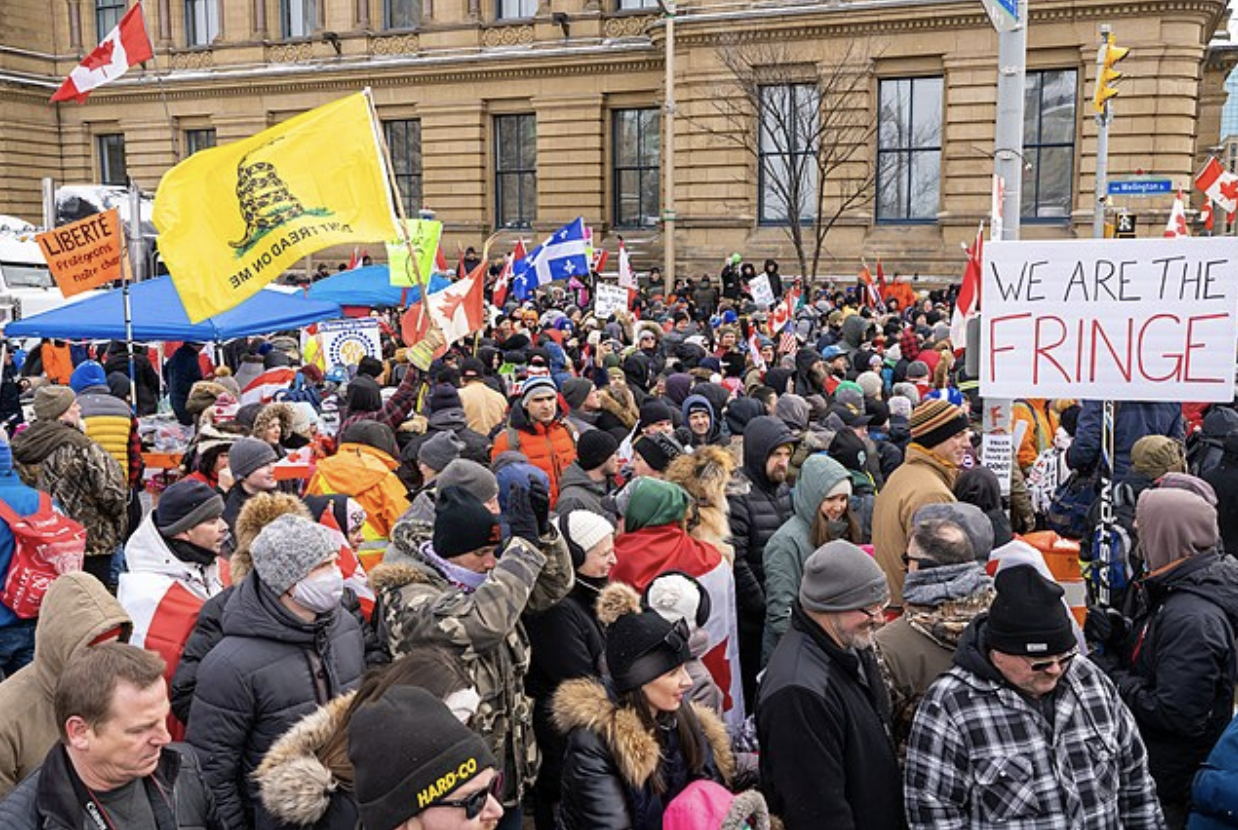
In more recent history, ideologically motivated violent extremism (IMVE) has, according to the Canadian Security Intelligence Service, been driven by “an increase in extreme anti-authority and anti-government rhetoric often rooted in the weaponization of conspiracy theories.” The prominence of this rhetoric has its root in the Covid-19 pandemic and what was considered by some to be an authoritarian public health policy during that period. Groups such as the Freedom Convoy felt that Canadians’ fundamental freedoms were violated by the government and that there needed to be structural changes to rectify these injustices.
This theory that the government has been corrupted and seeks to undermine the rights and position of its citizens who belong to a Canadian “cultural heritage” is especially prevalent among neo-Nazi fight clubs, which have grown in popularity throughout recent years. They outwardly present as nationally conscious social groups for men interested in fitness and martial arts, but their key aim is to train for a violent revolution against the current political order. These clubs perceive that the national soul of Canada has been destroyed by immigration and government policy and that in order to return Canada to its former greatness, there must be a rebirth of a mythical, pure, ethnically white past.
One of these neo-Nazi fight clubs, Second Sons, is a self-described “Canadian men’s nationalist group” and claims, “Our birthright has been stolen from us as we are being pushed out of society, academics and the workforce and replaced by foreigners without any roots or connections to the Canadian people.” They see this as being the result of a Canadian political establishment that “has become hopelessly corrupt and rotten with foreign money and influence.” On Labour Day of this year, Second Sons marched through Queenston Heights Park in Niagara-on-the-Lake, gathering around the statue of Isaac Brock wearing shirts with the words “he who guards” or “all thy sons.1” This public display was a way to project their ideology and intimidate local communities.
Second Sons is only one part of a growing ideological community. Contributing to a senate report on IMVE, Ontario Tech University professor Barbara Perry stated that between 2015 and 2021, there were at least 300 new extremist right-wing groups in Canada—mostly concentrated in Quebec, Ontario, and Alberta. She explains how these groups vary widely in their ideological commitments, with many being divided by the different elements of the extreme right-wing movement, such as Islamophobia, anti-immigration sentiment, misogyny, or accelerationism2. Professor Perry states that many individuals within the extremist movement join several groups, choosing those that fit into their own personal worldview.
Some of these newer extremist groups also fit into transnational movements, and, while it would be wrong to accredit all of Canadian political extremism to foreign influence, this international connection has been important for their growth. The international rise of neo-Nazi fight clubs specifically can be attributed to two men: the Russian Denis Kapustin and the American Robert Rundo, who both advanced the idea of creating these clubs to train for what they see as an impending race war. Rundo is central to the Rise Above Movement, which has directly founded “active clubs” in Europe, America, Canada, and Australia.
But how is it that these groups are growing in size and number? Many feel that as Canada becomes more diverse and accepting of various ways of life, Canadians should be moving away from xenophobia and an ethnic-based understanding of national belonging. However, University of Toronto professor Jason Stanley argues that this isn’t actually the case. He writes that as a dominant group loses its place in a hierarchy, that loss of privilege creates an anxiety that, when compounded by economic anxiety, can be easily manipulated by fascist rhetoric. Stanley states that this rhetoric turns the compounding anxiety into “fear that one’s family is under existential threat from those who reject its structure and traditions.3”
Canada has been plagued by increasing wealth inequality, a housing crisis, and a deteriorating health care system, which create anxiety in the lives of many working-class Canadians. As the country is faced by tariffs, which further threaten the economy and the job security of thousands, this anxiety will increase along with a feeling of distrust of the government. During the last election, Carney communicated himself as someone capable of solving crises, but even if he is successful dealing with Trump, Canada will be impacted by an unstable global economy out of his control. This government ineffectuality against economic change and the planned increase in austerity measures will potentially drive more Canadians toward a political extreme. This possible furthering of political polarization presents an opportunity for Canadian far-right extremist groups to attract more members, and to threaten the democratic norms central to Canadian politics.
Edited by Catriona Hayes Morris
The argument defended in this article is solely that of the author and does not reflect the position of the McGill Journal of Political Science, the Political Science Students’ Association, or the McGill Department of Political Science.
Featured image by Maksim Sokolov obtained via Wikicommons
.jpg)
- A reference to an outdated version of the Canadian national anthem. The referenced verse sung that Canada was “in all [it’s] sons command”, but it was revised in 2018 to say “in all of us command” for the sake of gender inclusivity. The shirts are likely emphasizing the masculine nature of their movement as well as protesting what they see as their disenfranchisement from society. ↩︎
- Accelerationism is a belief in violence as a means of hastening societal collapse so a new ethno-nationalist order can take over. ↩︎
- Stanley, Jason. How Fascism Works: The Politics of Us and Them. New York: Random House, 2020. ↩︎